


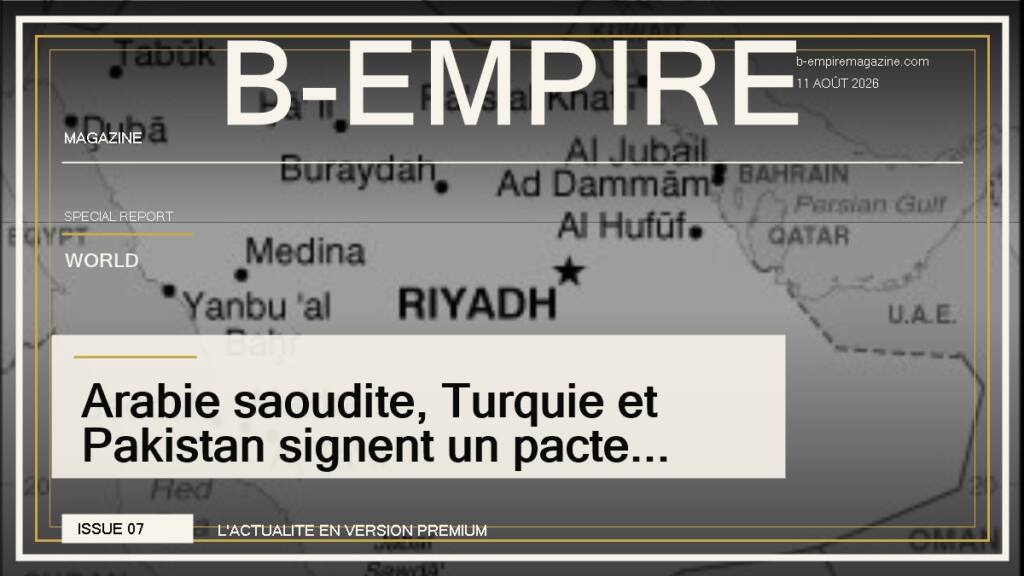
The signing of the Mecca pact marks a turning point in the security politics of the Middle East and South Asia. On August 7, 2026, Saudi Arabia, Turkey and Pakistan announced a mutual defense agreement built around a clear principle: an armed attack against one of the three countries will be considered an attack against all. The Associated Press described the agreement as a major step in the alignment of three powers that each bring a different lever: money and energy for Riyadh, military capacity and defense industry for Ankara, and strategic military depth for Islamabad.
The agreement does not automatically create a new NATO. Its decision-making mechanisms, operational limits and the exact nature of a joint response have not been fully made public. But the political weight is already clear. The three capitals say they want to strengthen deterrence, military cooperation and regional security at a moment when American guarantees, the war in Iran, drone attacks and the safety of energy routes dominate strategic calculations.
What each country brings to the pact
Saudi Arabia brings financial power, influence in the Gulf and a central role in global energy markets. The kingdom has spent years diversifying its security guarantees without breaking from Washington. Attacks on Saudi energy infrastructure have shown that wealth alone is not enough if air defense, intelligence and response capacity remain vulnerable.
Turkey brings an experienced military, a crucial geographic position and a defense industry that has gained credibility through drones, naval systems and armored vehicles. Ankara remains a NATO member, but President Recep Tayyip Erdogan is also seeking independent room for maneuver. The Mecca pact gives Turkey a bridge toward the Gulf and South Asia without formally leaving its Western security framework.
Pakistan gives the agreement its most sensitive dimension. It is the only nuclear-armed power in the Muslim world and has long maintained close military and religious ties with Saudi Arabia. That does not mean its arsenal would automatically be used for its partners. But Pakistan’s presence changes the perception of collective deterrence and forces neighbors to study the agreement carefully.
A defensive alliance with a powerful regional signal
Pakistan has stressed that the agreement is purely defensive and not aimed at any specific country. That clarification is intended to limit reactions from Iran, India and Western partners. It does not erase the threshold effect: by officially linking Riyadh, Ankara and Islamabad, the pact creates an architecture that could matter in crises across the Gulf, the Red Sea, the Levant and South Asia.
Iranian criticism already shows that the agreement is being read as more than a diplomatic photograph. Officials close to Tehran have dismissed the pact as unable to guarantee Saudi security. That reaction underlines a wider reality: the agreement comes in a region where every military move is interpreted through rivalries involving Iran, Gulf monarchies, Israel, the United States and Asian powers.
Washington, New Delhi and Brussels will need to adapt
For the United States, the pact is a reminder that regional allies no longer want to depend on a single protector. Riyadh remains close to Washington, Ankara is inside NATO and Islamabad keeps complex ties with the West and China. But the three countries are showing that they can also build a collective security layer among Muslim powers without waiting for constant arbitration from Western capitals.
India will watch the dossier especially closely, because any expansion of military cooperation among Turkey, Saudi Arabia and Pakistan indirectly affects its strategic environment. Europe is also concerned: Turkey remains a pillar of NATO, Saudi Arabia is a major energy partner, and regional tensions can influence oil prices, maritime routes, arms sales and migration pressures.
The unknowns that will decide the pact’s credibility
An alliance is not defined only by its declaration. It is defined by exercises, planning, intelligence sharing, chains of command and the ability to respond under pressure. The Mecca pact will therefore need to prove that it is more than a political commitment. The three countries must define what counts as an attack, how a joint decision is made and what kind of support each member is expected to provide.
The risk runs in two directions. If the agreement remains vague, it may disappoint and look like a symbol with limited military weight. If it becomes too rigid, it may increase tensions by giving every local crisis a collective dimension. The pact’s strength will depend as much on diplomatic discipline as on military resources.
Why this matters for B-EMPIRE
The pact tells a larger story: regional powers are taking more control over their security. They are not abandoning traditional alliances, but they are building additional safety nets closer to their own interests. For companies, investors and governments, that matters because it can alter maritime security, energy costs, military budgets and relations linking the Gulf, Europe and Asia.
Mecca did not simply host a signature. It gave visible shape to a strategic realignment already underway. The pact does not guarantee peace, but it announces that Riyadh, Ankara and Islamabad want to act together in a world where protection is increasingly negotiated among regional powers. That message, more than the legal formula itself, is what redraws the map.
Sources
- Associated Press – Saudi Arabia, Turkey and Pakistan have signed a key defense agreement, August 7, 2026
- The Times – Turkey’s vision of a Sunni Muslim Nato requires a big leap of faith, August 11, 2026
- The Guardian – Houthis claim attack on Saudi refinery after defense pact, August 9, 2026
- Le Monde – Turkey seeks to join the Saudi-Pakistan defense pact, January 11, 2026