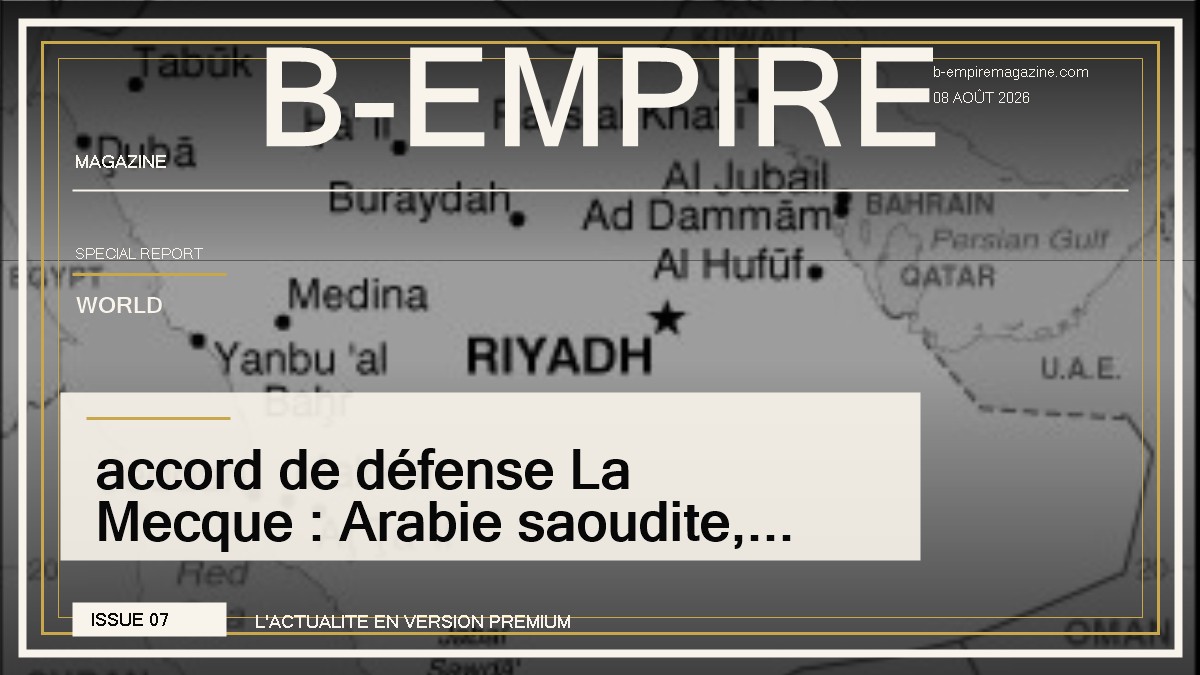
Three powers, three strategic levers, and a promise that immediately changes the dynamics of power: an attack against one will now be considered an attack against all. Gathered in Mecca on August 7, 2026, Saudi Arabia, Turkey, and Pakistan signed a collective defense agreement whose implications extend far beyond their borders. The kingdom brings its energy and financial weight, Ankara contributes the second-largest NATO army along with a rapidly expanding defense industry, and Islamabad adds a military power equipped with nuclear weapons.
The agreement, signed by Saudi Crown Prince Mohammed bin Salman, Turkish President Recep Tayyip Erdogan, and Pakistani Prime Minister Shehbaz Sharif, comes at a time when the region is shaken by war in Iran, tensions in the Red Sea, and a resurgence of Houthi attacks in Yemen. Presented as defensive and not directed against a specific actor, it nonetheless establishes a new center of gravity. For Western capitals, Israel, Iran, India, and the Gulf monarchies, the message is impossible to ignore.
The Clause That Gives the Pact Its Power
The heart of the text lies in a familiar formula of military alliances: any armed attack against one of the three states will be treated as an attack against all. This logic of solidarity transforms a political partnership into a deterrent commitment. It primarily seeks to raise the potential cost of aggression, hoping that an adversary will back down before the first shot is fired.
However, the operational details have not been made public. It remains unclear what specific circumstances would trigger assistance, whether it would automatically be military, how the three countries would coordinate their commands, or what role Pakistan’s strategic capabilities would play. This caution is essential: discussing a common nuclear umbrella would go beyond the available facts. What is certain, however, is that the gathering of these three military forces is already altering diplomatic calculations.
Oil, NATO, and Nuclear: An Unprecedented Triangle
Saudi Arabia possesses substantial financial resources and a central position in energy markets, but it has been seeking to diversify its security guarantees for several years. Pakistan has long maintained close military relations with Riyadh. Their bilateral mutual defense agreement, concluded in September 2025, had already established the principle that aggression against one would concern the other. Pakistani forces arrived in Saudi Arabia in April 2026 as part of this arrangement, according to the Saudi official agency.
The inclusion of Turkey adds a new dimension to the architecture. Ankara is a NATO member, has an experienced army, and has developed drones, missiles, ships, and equipment exported across several continents. This does not mean that the Atlantic Alliance becomes part of the agreement: Turkey’s commitments to Riyadh and Islamabad remain distinct from NATO treaties. However, this dual membership places Turkey at the intersection of overlapping security systems.
Finally, Pakistan adds a particular strategic depth. As the only Muslim state officially equipped with nuclear weapons, it also possesses a significant conventional army. Islamabad can thus offer expertise, training, and military credibility, while its partners can provide capital, energy, and markets for its defense industry. The agreement is therefore also likely to accelerate arms contracts, joint exercises, and technology transfers.
Why the Timing is Both Concerning and Reassuring
The signing comes amid exceptional instability. Clashes related to Iran have disrupted energy routes and heightened anxiety around the Strait of Hormuz. In Yemen, new Houthi attacks against positions linked to the Riyadh-supported camp have revived the risk of escalation. In this context, the pact can be read as a stabilization mechanism: demonstrating collective strength to deter further offensives.
However, any alliance carries an inverse risk. If the consultation mechanisms are vague, a local crisis could drag in partners who had not anticipated participating. The three governments will therefore need to clarify the difference between political support, territorial defense, maritime protection, and external intervention. The credibility of an alliance depends as much on its limits as on its promises.
India, Iran, and Israel Will Recalculate Their Positions
In New Delhi, any military evolution involving Islamabad is closely monitored. However, India maintains significant economic relations with Saudi Arabia and growing ties with several Gulf partners. Riyadh will need to convince that its new arrangement does not automatically transform a South Asian crisis into a broader confrontation. Turkey, whose relations with India are sometimes tense over the Kashmir issue, adds a layer of sensitivity.
Iran will primarily observe how the agreement is implemented near the Gulf and its borders. The signatories claim not to target anyone, but Tehran could interpret any additional military presence, integrated missile systems, or naval deployments as direct pressure. Israel, for its part, will need to incorporate into its scenarios the possibility of enhanced coordination among three Muslim powers with complementary capabilities.
What This Changes for Europe and France
For Europe, the agreement touches on several simultaneous issues: energy security, maritime stability, arms sales, counter-terrorism, and NATO cohesion. France is a major military partner of several Gulf states and maintains a presence in the region. Paris will need to assess whether this new structure complements existing arrangements or signals increased strategic autonomy from Western powers.
The economic stakes are equally concrete. An escalation in the Gulf would affect oil prices, maritime insurance, air transport, and inflation in Europe. Conversely, credible deterrence can reduce the risk of disruptions. French defense manufacturers will also monitor the evolution of purchases and technological cooperation, as Turkey seeks to gain market share and Saudi Arabia aims to produce more equipment domestically.
A Signal of Autonomy Sent to Washington
For decades, Gulf security has largely relied on American power. The Mecca pact does not replace this relationship, but it shows that states in the region no longer want to depend on a single guarantor. They are building flexible coalitions, funding their own capabilities, and seeking partners capable of acting swiftly. This diversification is not necessarily a rupture with Washington; it serves as an assurance in an increasingly unpredictable world.
The big question now will be one of execution. A communiqué can impress for twenty-four hours; a lasting alliance requires joint exercises, crisis protocols, compatible systems, and constant political trust. If these elements follow, the Mecca Agreement could become one of the most significant security constructs of the decade. Otherwise, it will remain a spectacular diplomatic message. In either case, the world is watching: the Middle East has just received a new signal that no one can ignore.
Reliable Sources
- Associated Press â signing and main provisions of the three-way defense agreement
- Pakistani Ministry of Foreign Affairs â context of the previous Saudi-Pakistani agreement
- Saudi Press Agency â Pakistani deployment in Saudi Arabia in April 2026
- Turkish Ministry of Foreign Affairs â regional coordination between Turkey, Pakistan, and Saudi Arabia