


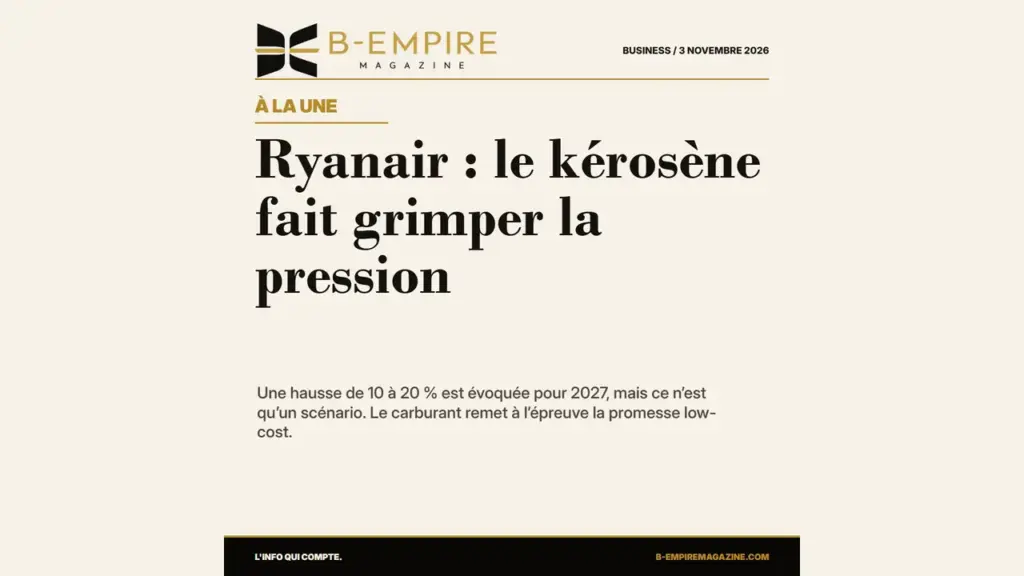
Low-cost flying does not eliminate costs; it makes them visible in different ways. Ryanair warns European airfares could rise by 10% to 20% next year, according to chief executive Michael O’Leary, cited by the Associated Press on November 2. This is neither an announced fare schedule nor a guaranteed uniform increase. It is a conditional forecast made as aviation fuel becomes more expensive and the airline says it may not fully offset the increase in its fuel bill through ticket prices.
The statement matters because Ryanair built its brand on very low headline fares and the ability to fill its aircraft. When Europe‘s most emblematic low-cost carrier contemplates a significant increase, the discussion extends beyond its own pricing policy: it reveals the point at which a ticket costing a few dozen euros collides with energy prices, operating constraints and travellers’ sensitivity to the final cost.
A Forecast, Not an Increase Already Decided
The 20% figure should be read as the upper end of a scenario, not as a promise that every ticket will cost one-fifth more. Airfares vary with season, route, booking lead time, load factor and competition. An airline may raise some prices, leave others unchanged, or adjust schedules and capacity. O’Leary’s forecast reflects expected market pressure; it cannot calculate the price of a specific trip today.
The distinction matters to passengers and investors. Low headline fares are only one part of an airline’s economics. Baggage, seat selection, priority boarding and add-on sales also contribute to revenue per traveller. When fuel rises, a carrier can pull several levers: charge more, cut costs elsewhere, improve aircraft utilisation or accept lower profitability on certain routes.
Fuel Works With a Lag, but It Still Has an Effect
Jet fuel is one of an airline’s major expenses. Its price follows energy markets, with additional swings tied to refined-product availability. AP reports that aviation fuel rose faster than crude oil during the Middle East conflict, reflecting both higher crude prices and tighter supplies of refined fuel. Hedging contracts can cushion some of the shock in the short term, but they do not erase it: their effect depends on the share protected, the contract dates and market prices when agreements were made.
This timing explains why a surge today does not immediately produce the same increase across every ticket. An airline may have hedged part of its needs for a given period, while future purchases gradually reflect new market prices. The cost then filters into decisions about capacity, frequency and fares. For travellers, the risk is therefore not limited to the ticket price: a less profitable route may also run less often or disappear from the schedule.
The Low-Cost Model Is Under Pressure, Not Condemned
Ryanair says it does not expect European short-haul fares to fully offset the anticipated increase in its fuel bill. O’Leary has mentioned productivity measures and other possible savings, including in support functions. The comments underline the limits of a strategy based on low prices: efficiency can protect margins, but it cannot permanently replace energy that has become more expensive.
Low-cost airlines still have advantages. Highly occupied aircraft spread fixed costs over more passengers; a standardised fleet simplifies maintenance and training; advance bookings help schedule aircraft use. These strengths cannot neutralise an oil shock, but they can make the model more resilient than operators with higher structural costs. How much of the expense can be passed to customers will also depend on competition and consumer purchasing power.
Price sensitivity remains especially high on short trips, where trains, cars or simply cancelling the journey may be alternatives. Airlines must therefore balance carefully: raising fares too quickly can reduce bookings, while artificially holding them down may weaken margins. The final level will emerge from thousands of route-by-route decisions, not from a percentage mechanically applied to the entire network.
What Travellers Can Reasonably Expect
For travellers, the soundest reading of the announcement is volatility, not certainty of a general increase. Tickets bought well in advance may remain attractive on some dates, but prices depend heavily on demand and seat availability. Comparing the full trip cost — baggage, transfer to a secondary airport, schedule and possible extra nights — is more useful than looking only at the base fare.
Higher fuel costs could also widen the gap between routes and seasons. High-demand services may absorb costs more easily, while seasonal or less-frequent routes become more vulnerable. Passengers who rely on a specific connection should watch its frequency and change conditions rather than assume a headline fare will remain available until the last minute.
Energy Is Again an Airline Strategy Issue
Ryanair’s forecast is a reminder that a ticket price is the output of a wider system: oil, refining, hedging, airport capacity, competition and consumer choices. European airlines can improve efficiency, but they do not control geopolitical shocks or fuel supply. The transition to lower-carbon aviation fuels is another medium-term challenge, but it is not an immediate answer to a price spike.
If fuel stays expensive, fares could indeed rise, but O’Leary’s scenario remains an expectation rather than an established fact. The real measure will be how airlines divide the increase among travellers, internal savings and reduced capacity. European low-cost flying is not disappearing; it is entering a phase in which its central promise — making departure affordable — depends increasingly on a cost neither Ryanair nor its customers can control.
Sources
- Associated Press, November 2, 2026 — Ryanair’s fare forecast and rising aviation fuel costs.
- International Air Transport Association, Jet Fuel Price Monitor — tracking global aviation fuel prices.
- Reuters via Euronext, October 20, 2026 — earlier comments by Michael O’Leary on European fares and fuel hedging.