


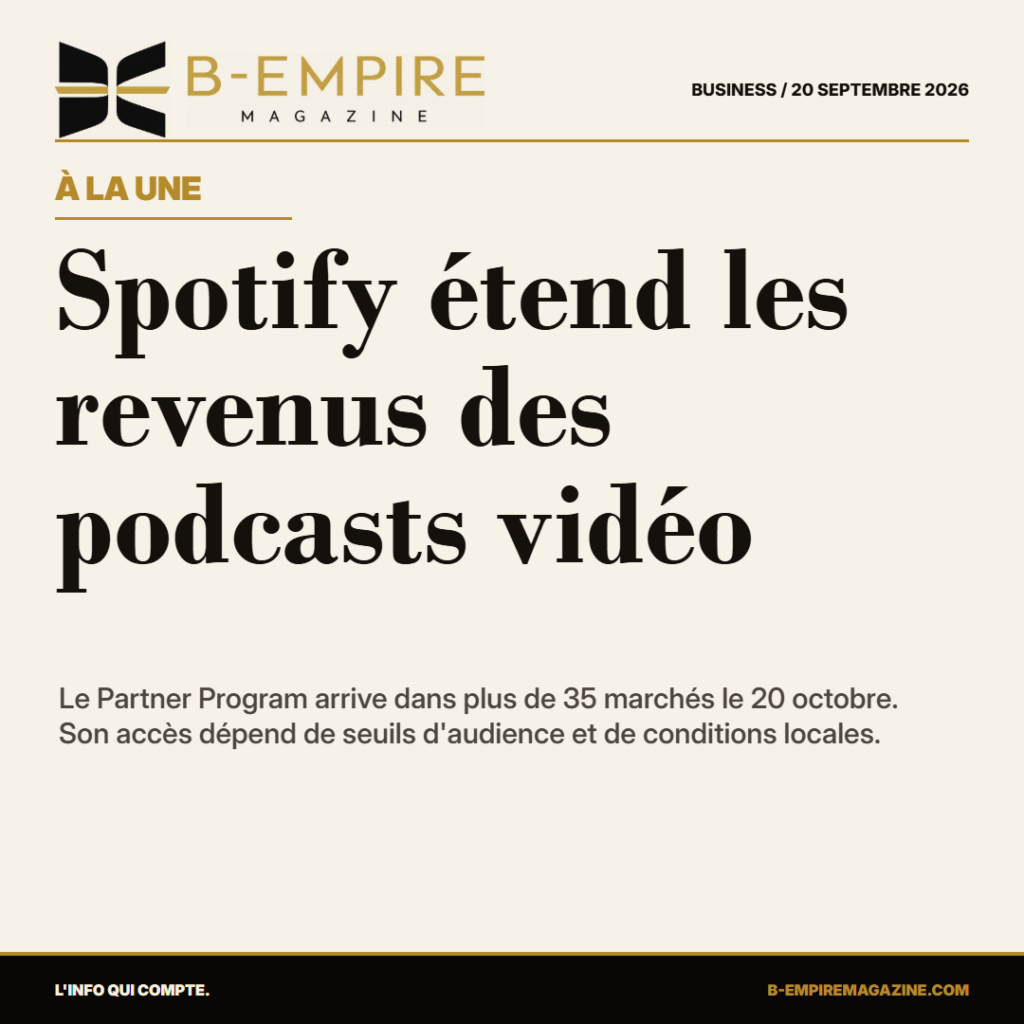
Video podcasting has become a business arena in which platforms compete not only for listening time but for creators‘ economic relationships. On September 17, 2026, Spotify announced that its Partner Program would expand to more than 35 new markets, including Italy, Spain, Brazil, Mexico and Colombia. Its help documentation sets the rollout for October 20. For eligible shows, the offer combines revenue from Premium subscribers watching video, advertising and tools for managing brand partnerships. The geographical opening is real; it does not mean every podcaster can immediately make a living from it.
An expansion toward Spanish- and Portuguese-speaking markets
Spotify’s published list has a strong presence in Latin America and the Caribbean, alongside several European markets. It includes Brazil, Mexico, Colombia, Chile, Peru, Spain, Italy and Poland. The selection takes the program well beyond its first countries in Europe, North America and Oceania. It may give creators working in more languages additional ways to earn, but the existence of a technical option guarantees neither a local audience nor comparable advertising rates across territories.
For Spotify, the move is competitive as well. A creator able to publish a filmed show, understand its audience and collect several forms of revenue in the same environment has another reason to devote time to the platform. The company describes this as its largest program expansion yet. Its announcement says monthly payouts to enrolled shows have increased by more than a third since eligibility was broadened earlier this year. That figure describes a group of participants; it is not the typical income of a new show.
Three revenue streams, three different mechanisms
The Partner Program combines mechanisms that should not be confused. Eligible videos can earn revenue when watched by Premium subscribers in covered markets. Ads inserted by Spotify offer another possible source of income, including on the free tier and on other listening platforms in certain circumstances. Creators can also organize and measure their own embedded brand partnerships; Spotify says they keep all the revenue from those deals. None of this is a fixed salary. Earnings depend on audience, format, territories and commercial agreements.
For Premium subscribers, the promise is different: dynamic ads are removed from participating video podcasts in the affected markets, although sponsorship messages embedded by the creator can remain in the episode. Viewing may feel more continuous without being free of commercial messages. That distinction matters for audience trust. A brand placement can be part of a show’s business model, but it should not be mistaken for an independent editorial conversation. Video makes that boundary more visible.
Access comes with conditions
Spotify’s help page sets out the application criteria: host the show on Spotify for Creators, have a legal address in an eligible market, publish at least three episodes, and reach 2,000 consumption hours and an audience count of 1,000 on Spotify over the previous 30 days. Admission also requires compliance with monetization policies. Those thresholds are more than paperwork; they draw a line between a new project and a show that has already found an audience. A creator can work seriously without meeting them and will then remain outside the program.
Another rule deserves attention: according to official support guidance, a video episode needs at least one ad break to qualify for Premium video revenue. Payments use Spotify’s own formula, which may change, and account for factors including qualified viewing time and subscribers’ markets. The limited visibility into that calculation makes forecasting harder for a small studio that must pay for filming, editing and guests before revenue is known. Creators will need to track production costs as carefully as their new earnings dashboards.
Video changes the job, not just the medium
Filming a podcast involves more than placing a camera in front of microphones. Images add decisions about sets, lighting, rights to clips, accessibility and editing pace. Video can make an interview easier to discover and produce short segments that help an episode circulate. It can also raise costs and encourage producers to favor formats that travel well online over conversations that reward slow listening. Broader monetization resolves that tension only if the new revenue genuinely covers the additional expense.
Spotify says video shows already in the program have recorded average growth of more than 45% in consumption hours since its launch. That observation describes existing participants, not a forecast for each newly eligible market. After October, it will be worth examining how many shows qualify, what share of earnings comes from subscriptions, ads or sponsorships, and whether smaller productions see durable results. A platform can widen access without automatically narrowing the gap between large content brands and independent creators.
The real appointment is in October
As of September 20, the expansion has been announced but has not yet taken effect in the new countries. October 20 will provide the first concrete test of enrollment, tool availability and the clarity of local conditions. Over the longer term, the mark of change will not be the number of territories on a map, but whether shows of different sizes can regularly finance their work. Spotify is opening a new door for video podcasting; creators still need to examine what lies behind it, with numbers in hand.