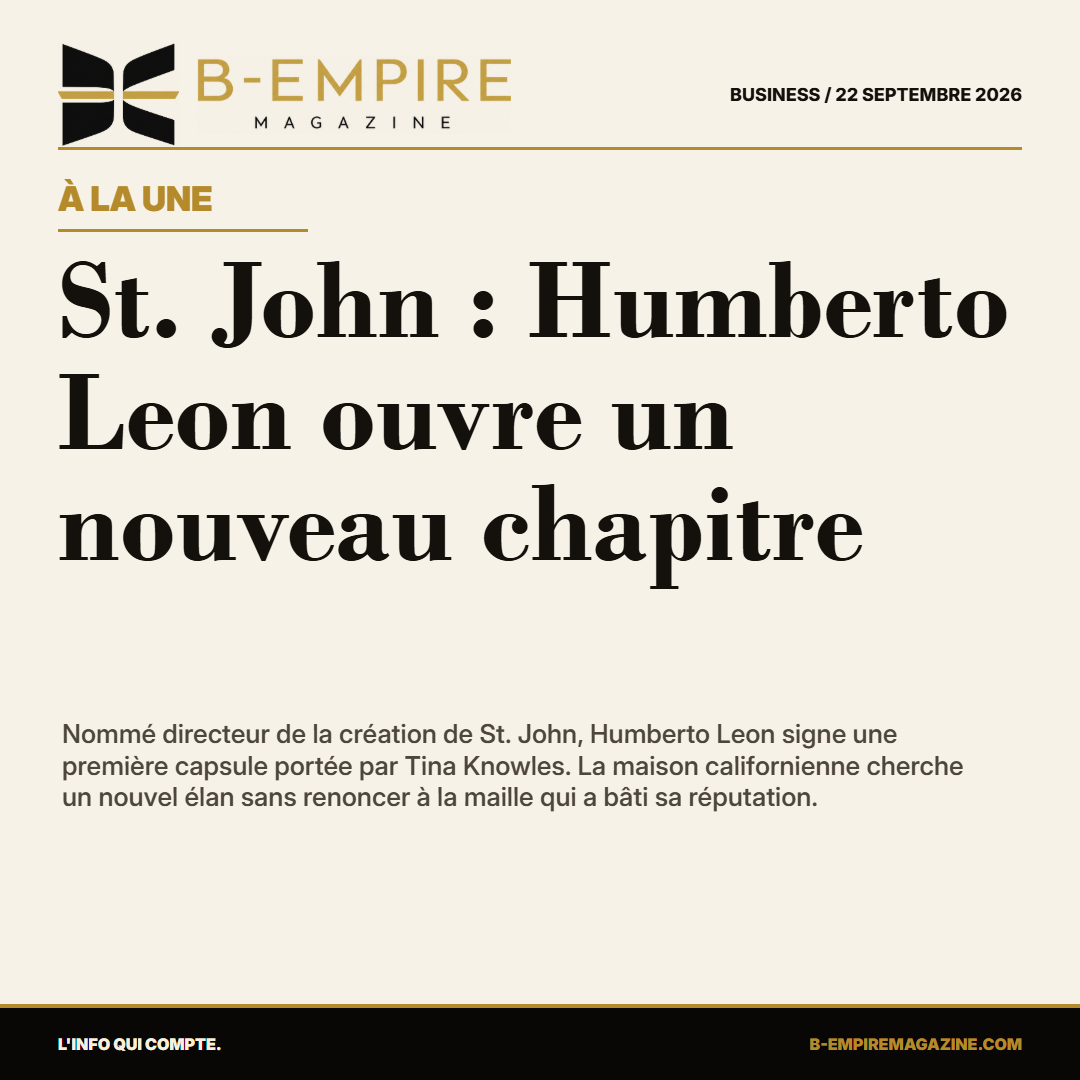
Lanvin Group officially announced Humberto Leon as St. John’s creative director on September 21, 2026. The news could look like another round of musical chairs in fashion. It says something more specific: a California house with nearly 65 years of history is trying to recover cultural relevance without losing the knitwear expertise that made it recognisable. A first Fall 2026 capsule, already visible on the brand’s website, gives that ambition a concrete form.
Leon does not arrive as a designer confined to a studio. He co-founded Opening Ceremony with Carol Lim in 2002, and the pair led Kenzo’s creative direction from 2011 to 2019. His career also includes collaborations, costume design, retail spaces and responsibility for the visual identity of the music group KATSEYE. That movement between clothing, music, performance and community makes his appointment legible at a time when a brand is no longer defined solely by its runway.
An Archive to Wear, Not Keep Behind Glass
St. John’s challenge is to treat its history as working material. The house names knitwear, sportswear and jewellery among its signatures. On the page devoted to Leon, it describes a capsule reinterpreting the abstract floral and animal motifs associated with founder Marie Gray. Matte duchesse satin, brushed alpaca jacquard, saturated colour and confident tailoring move those references into a present-day wardrobe.
The most interesting gesture involves jewellery from the 1980s and 1990s: some original pieces are being reissued, while their shapes become hardware on garments. The archive stops being merely a campaign image. It enters the physical construction of the product. For a historic house, that is a way to make the past recognisable through touch and use instead of settling for decorative nostalgia.
Tina Knowles Is a Precise Storytelling Choice
The capsule campaign features Tina Knowles, photographed by Kanya Iwana. St. John describes her as a long-time admirer and wearer of the brand. The designer, entrepreneur and author’s presence therefore works as more than a celebrity pairing: it places the renewal within a history of women who already know the label, wear it and transform it through their own lives.
That representation matters in an industry often obsessed with youth as a visual shortcut. St. John instead presents experience and continuity as signs of desirability. The choice does not prevent the house from speaking to new audiences. It simply avoids pretending that renewal requires erasing the customers who built its reputation. The campaign can connect generations, popular culture and everyday elegance without turning a garment into a museum costume.
The Commercial Bet Behind the Appointment
For Lanvin Group, strong creative direction must produce more than a media moment. It must help St. John clarify what distinguishes it in a market where a high price is no longer sufficient proof of value. Products already displayed online, from knitwear to jackets and accessories, show a premium position. The question is whether the public will recognise a coherent proposition rather than a set of pieces noticed at launch.
The link between Leon and California supports that story. St. John built its identity there, and the designer has developed a practice connecting fashion, restaurants, art and creative communities. This geographic and cultural proximity gives the collaboration a plausible foundation. It does not, by itself, guarantee lasting growth. Execution quality, product availability, repeat purchases and the house’s ability to welcome new customers without losing established ones will matter more.
What the First Capsule Can Actually Prove
An inaugural capsule is a manifesto, not yet a scorecard. It makes choices of material, silhouette and casting visible. It cannot establish that the commercial strategy has succeeded. The announcement provides no sales target, detailed timetable for future collections or measurement of customer reception. Calling this appointment a completed turnaround would therefore be premature.
What can be observed is more precise: St. John has entrusted its codes to a designer accustomed to building bridges between worlds, and has chosen to show products immediately rather than an abstract intention. The Tina Knowles campaign completes that language with a figure whose relationship to dress is not limited to posing. Together, they give the relaunch a voice, a silhouette and a possible audience.
American Luxury Between Memory and Motion
St. John’s case is a reminder that heritage is not valuable simply because it is old. It becomes valuable when a new generation can use it. Well-made knitwear, a familiar motif and a reissued jewel do not automatically add up to a vision. Placed in a coherent whole, however, they can become the elements of a contemporary vocabulary that does not need to deny its origins.
Leon will now be judged on that coherence. His first capsule suggests a direction: more colour, archival references brought into view and an idea of American luxury that feels less fixed. The real test will come after the novelty effect, when St. John must show that this energy can last collection after collection, store after store and customer after customer.