


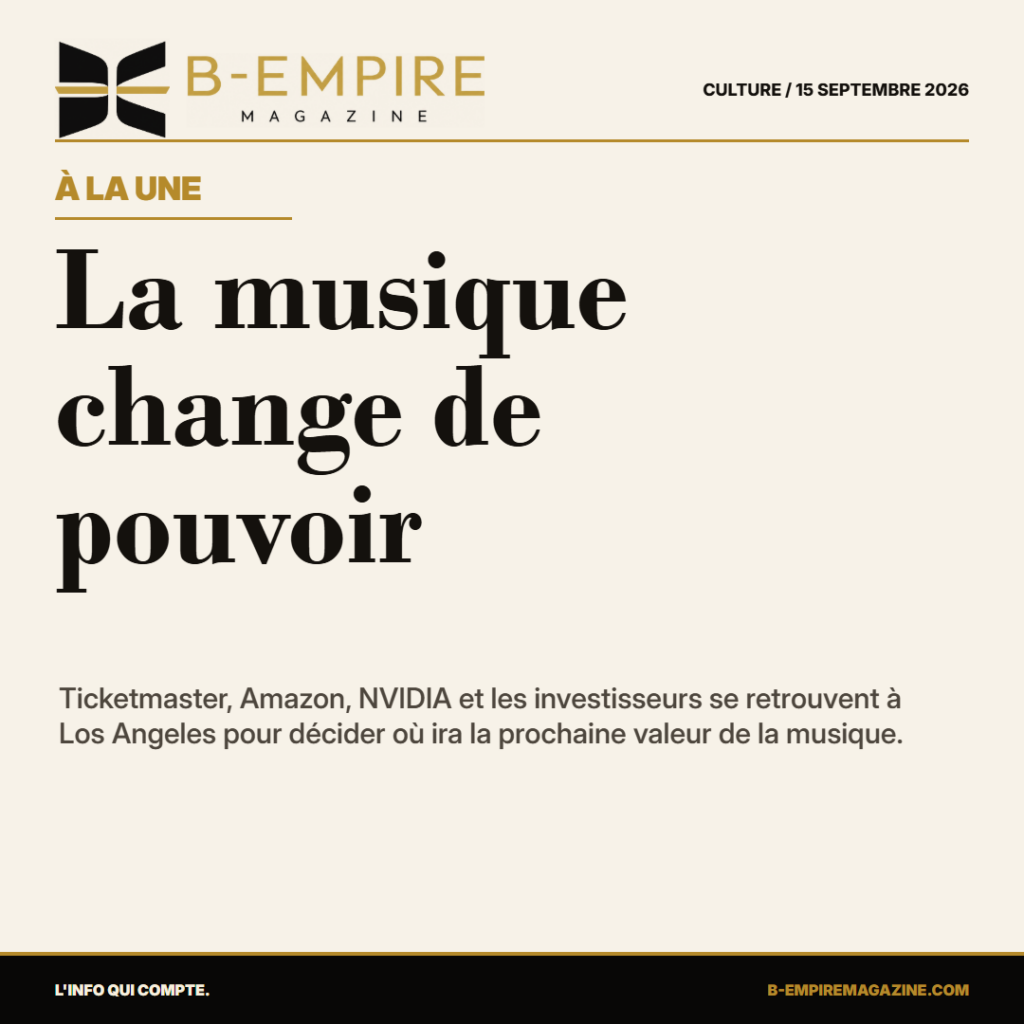
The future of music is no longer just played out in studios or on charts. It is now negotiated between platforms, catalog owners, ticketing giants, data specialists, and artificial intelligence companies. On September 15, 2026, the Trapital Summit gathers in Los Angeles several leaders who control these new levers. Ticketmaster, Amazon, NVIDIA, Primary Wave, Chartmetric, and MIDiA Research are on the agenda for a day dedicated to the value of songs, concert pricing, audience loyalty, and the competition for attention.
The event is not a festival aimed at the general public. This is precisely what makes it interesting. In a Hollywood venue, the players who finance, distribute, analyze, and monetize culture will confront their visions. Their common question is simple yet decisive: after a decade dominated by streaming subscriptions, where is the next great reserve of growth?
A Summit at the Heart of a Gigantic Market
The global recorded music industry has crossed a symbolic threshold. According to the IFPI, its revenues reached $31.7 billion in 2025, up 6.4%, marking the eleventh consecutive year of growth. Streaming accounts for nearly 70% of the market, and paid subscriptions now boast 837 million users. France maintains its sixth position globally, while Latin America, Asia, and several emerging markets are accelerating rapidly.
These figures tell a story of success but also of dependency. A significant portion of the economy relies on monthly streams billed to millions of subscribers. However, the growth in user numbers cannot continue indefinitely. Platforms are therefore seeking to increase the value per subscriber, labels want to better monetize their catalogs, and artists are trying to transform a volatile audience into a sustainable community.
Ticketmaster Arrives with the Power of Live Concerts
The presence of Saumil Mehta, global president of Ticketmaster, places the ticket at the center of the summit. The program includes a discussion on the future of ticketing as demand for shows reaches record levels. Live Nation reported selling over 143 million tickets by mid-July 2026, which is more than 14 million ahead of the previous year. In the second quarter, nearly 49 million spectators attended its concerts.
Live performances have become the most tangible proof of an artist’s strength. Listening can be passive, triggered by a playlist or an algorithm. Buying a ticket, traveling, booking a hotel, and dedicating an evening to a concert reveal a much deeper commitment. This economy also nourishes cities, brands, transportation, and tourism. It explains why ticket technology, the fight against bots, and direct fan relationships have become strategic issues.
Catalogs Are Worth Gold, But Their Value Must Be Defended
Larry Mestel, founder of Primary Wave, is set to open discussions with a revealing question: what is the price of a timeless song? His company has built its influence by investing in rights related to artists like Whitney Houston, Prince, James Brown, and The Notorious B.I.G. Catalogs are sought after because they can generate revenue for decades, circulating in films, series, advertisements, games, and social media.
However, the value of a catalog no longer rests solely on historical royalties. It depends on the ability to reactivate a work for new generations, to create documentaries, experiences, physical products, or unique licenses. The IFPI notes that vinyl has also seen a 13.7% increase in 2025. In a digital economy, the object becomes a sign of belonging, and musical heritage transforms into intellectual property that can be exploited across multiple platforms.
AI Promises More Creation but Opens a Rights War
The appearance of Richard Kerris, head of media and entertainment at NVIDIA, will be one of the most closely watched moments. Artificial intelligence can accelerate production, enhance recommendations, restore archives, translate voices, or tailor experiences to each audience. It can also multiply synthetic tracks, blur artists’ identities, and shift value toward those who own the models and computing infrastructure.
Thus, the topic transcends mere technological fascination. It concerns consent, traceability, licenses, and compensation. An industry that has only just stabilized its economic model after piracy does not want to see a new generation of services training for free on its heritage. The challenge of the summit will be to understand whether AI becomes a licensed tool serving creators or a new shortcut capable of circumventing their work.
True Wealth Is Now Called the Superfan
MIDiA Research describes an increasingly diversified music economy, where streaming remains central but fandom-related revenues are gaining more weight. Physical products, extended rights, premium experiences, communities, and direct purchases allow for surpassing the uniform value of a stream. Not all fans spend the same amount, and companies want to better identify those willing to sustainably support an artist.
This is also the purpose of sessions dedicated to audience loyalty and the new sound of global music. Chartmetric provides the data, Amazon offers distribution and attention power, Ticketmaster handles transactions, while publishers hold the rights. The battle lies in the connection between these worlds. Whoever understands the complete fan journeyâdiscovery, listening, community, ticketing, and purchaseâholds a significant advantage.
Why This Gathering Transcends Hollywood
The market is no longer organized around a single cultural center. The IFPI emphasizes that all regions progressed in 2025: Latin America surged by 17.1%, Asia by 10.9%, and Europe by 5.6%. African, Latin American, Asian, and European artists can build a global audience without waiting for traditional American validation. However, they still need to negotiate with infrastructures often concentrated among a few large companies.
The Trapital Summit thus offers a snapshot of the new cultural power. The song remains the starting point, but value is shifting toward data, rights, communities, events, and technologies capable of connecting these elements. The winner of the next decade may not be the one who produces the most tracks. It will be the one who best transforms a musical emotion into a sustainable, transparent, and global relationship.
Sources
- Trapital â Official Program of the Trapital Summit 2026, accessed September 15, 2026.
- IFPI â Global Music Report 2026, March 18, 2026.
- Live Nation Entertainment â Second Quarter 2026 Results, July 30, 2026.
- MIDiA Research â Global Music Forecasts 2026-2033, August 2026.