


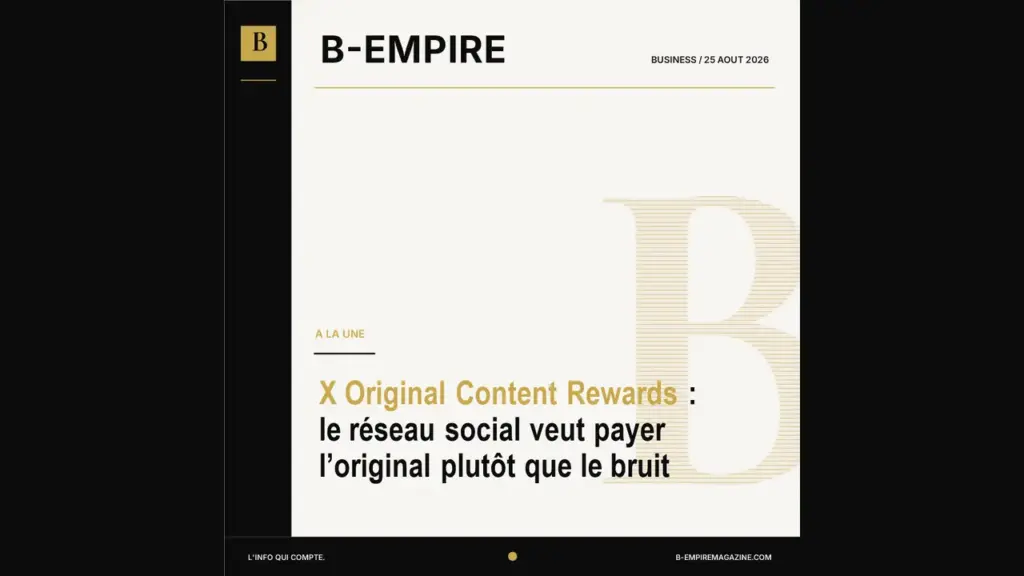
X wants to change the mechanics of its creator economy. The platform stopped accepting new enrollments in its Creator Revenue Sharing program on August 7, 2026, and plans to retire it on September 7. Beginning September 8, creators already enrolled will be able to apply for the new Original Content Rewards program. On paper, the message is simple: reward recycled content less, and pay more for work genuinely produced by its authors. In reality, X is also acknowledging that its revenue system had ended up paying for some of the noise it claimed to organize.
The shift is more than a rebrand. The old revenue sharing program long encouraged creators to optimize for reaction, controversy, rapid reposting and formats that could travel without context. The new framework promises to move money toward original posts: analysis, reporting, photos, videos, memes, graphics or commentary that provides its own value. The bet is clear: if money finally follows creation rather than circulation alone, the feed could become less dependent on aggregators and accounts whose business is to repost faster than everyone else.
The End of an Old Platform Reflex
According to X’s official help page, creators already enrolled will continue earning money through September 7, 2026, with two payments scheduled for August 14 and August 28, followed by a final payout expected around September 11 for revenue earned before the shutdown. After that, they will need to move to Original Content Rewards. X says access will roll out gradually for existing members and that eligibility criteria will be visible in Creator Studio.
Those dates give the reform a very concrete dimension. Creators are not facing a vague algorithmic intention, but a revenue migration. In the platform economy, this kind of transition acts like a cash-flow shock: some accounts will need to change how they post, others will need to prove their originality, and those most dependent on volume-driven payouts will see their model exposed. The word “original” becomes an economic condition, not only an editorial virtue.
What X Now Calls Original
The new Original Content Rewards page lays out the entry requirements: be an adult, be based in an eligible country, have an account in good standing, hold a personal or business account, maintain an active Premium, Premium+ or Premium Business subscription, reach at least 500,000 Home Timeline impressions from verified users over the previous 90 days, excluding replies, and have at least 500 verified followers. Political or government organizations are not eligible.
The most sensitive part concerns the content itself. X lists as ineligible posts copied or substantially reproduced from another creator, content downloaded and reuploaded without authorship, harmful or sexually explicit material, posts exclusively focused on monetization coaching, automated posts, disinformation and posts carrying a helpful Community Note. In other words, X is trying to draw a line between internet remix culture and the industrial economy of appropriation.
That line will be difficult to enforce. Commentary can be original even when it starts from a viral video. A meme can transform an existing image while creating a new reading. A news account can aggregate public information while doing real work of selection. Conversely, a visually polished format can still be a disguised copy. X will therefore need to arbitrate not only with rules, but with detection models, human review and probably many disputes.
The Fight Against Aggregators Becomes a Brand Strategy
TechCrunch summarized the stakes by citing X’s diagnosis: the incentives of the old program had become “misaligned.” The phrase says a lot. A social platform never pays only creators; it pays for a type of behavior. If money rewards impressions without sufficiently distinguishing the source of the content, rational actors learn to publish whatever produces reactions at the lowest cost. The result is familiar: duplication, contextless clips, rage bait, screenshots and permanent recycling.
For X, this is not only a moral problem. It is a product problem. A feed dominated by reuploads and copies loses value for users, advertisers and professional creators who hesitate to invest time in a platform where their work can immediately be captured by others. Original Content Rewards tries to restore a promise: publish with us, and the platform will recognize more of your initial contribution.
Social Media Today notes that the reform fits into a series of adjustments already made in 2026, including efforts to limit payouts to aggregators and better police certain artificial-intelligence-generated material. The logic is consistent: creator monetization can no longer be simply an engagement machine. It becomes a tool for governing the feed. By choosing who gets paid, X also chooses which type of content has an incentive to exist.
Creators Enter an Era of Proof
For serious creators, the reform may look positive. An independent journalist, analyst, videographer, photographer or humorist who publishes original material benefits when the platform better distinguishes the author from the amplifier. But the new model also adds documentary pressure: creators may have to prove the origin of an image, the transformation of a source, the authorship of a video or the added value of a comment.
This is where the battle becomes cultural. The internet grew up on quotation, reposting, screenshots and edits. The creator economy now demands rights, contracts, histories, ownership signals and sharper categories. X cannot abolish remix culture without losing part of its energy. But it also cannot keep financing recycling indefinitely while claiming to support creators. Original Content Rewards is therefore an unstable compromise between spontaneity and professionalization.
The Real Test Will Be Arbitration
The program’s success will depend less on the announcement than on execution. If the rules are applied opaquely, major accounts will call it arbitrary. If they are too loose, recyclers will quickly learn how to route around the definition of originality. If they are too strict, X could discourage some of its liveliest native formats, especially fast commentary and memes. The platform is walking a narrow line: it wants a cleaner feed without drying out the speed that makes it valuable.
The reform also says something broader about the future of social networks. For years, platforms allowed people to believe that engagement was an almost natural measure of quality. They are now discovering that engagement is a manipulable material, and that monetization accelerates every tactic that manipulates it. Money reveals the flaws in the design. By placing originality at the center, X admits that value is not measured only by views, but by the real contribution to the platform’s cultural stock.
For creators, the era ahead will be less simple but potentially healthier. The account that invents, investigates, films, explains or transforms intelligently should carry more weight. The account that copies and optimizes will need something other than speed. The essential question remains: can X recognize creation without becoming a permanent court of originality? The answer will decide whether Original Content Rewards is a genuine market correction, or simply another rule in the endless game of attention.