
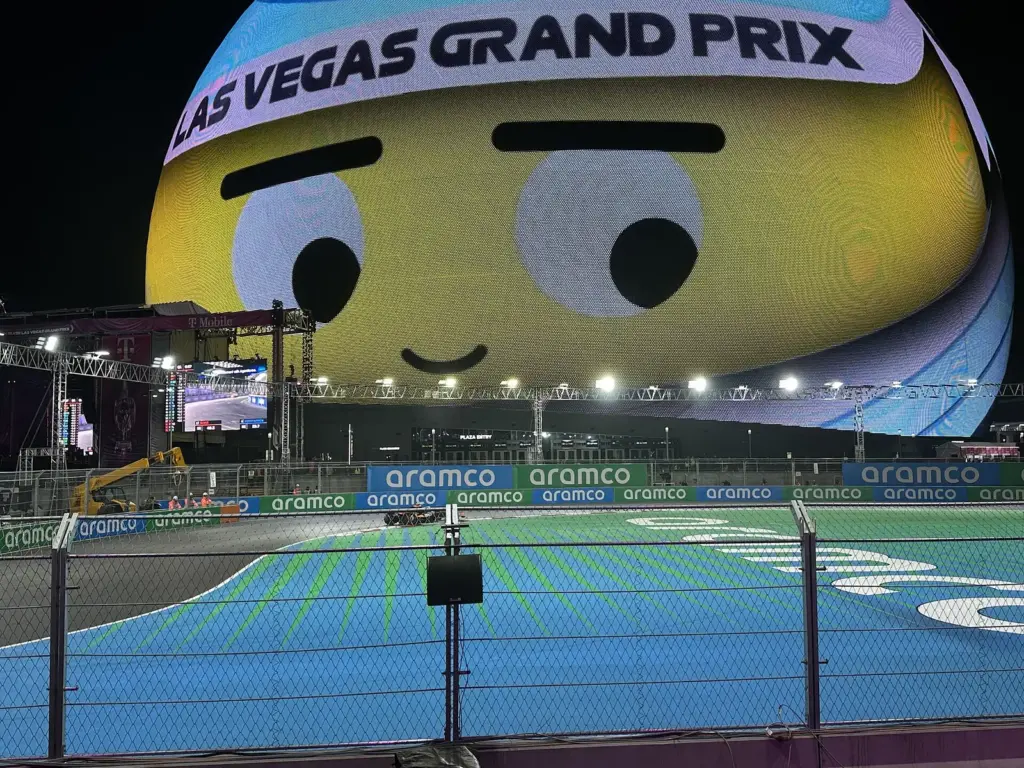
The fastest driver will not start from the front. Under the lights of the Strip, Kimi Antonelli clocked the best time in the qualifying session for the 2026 Las Vegas Grand Prix, but a penalty related to his power unit pushes him back to sixth place. Max Verstappen thus inherits pole position, with George Russell alongside him. In just a few minutes, Las Vegas produced the perfect scenario for a tense race: a world champion on the front row, another forced to attack from the heart of the pack, and a grid reshuffled by mechanical penalties.
Antonelli completed his final lap in 1 minute 33.893 seconds, which was 0.258 seconds faster than Verstappen. The performance is clear, but the Saturday night standings do not tell the whole story. The FIA confirms that Mercedes car number 12 must serve a five-place grid penalty for using an additional engine component. The Dutchman will therefore start from the first position, with Russell beside him.
Antonelli Wins the Time Battle, Not the Grid Battle
Antonelli’s final attempt was as spectacular as it was improbable. The Mercedes driver crossed the line just in time to launch his fast lap, after a complicated preparation in traffic. On a circuit where slipstreaming can save precious time on the long straights, positioning behind another car became almost as important as pure speed.
The young Italian managed to turn this chaotic situation into a reference lap. He outpaced Verstappen and Russell, while all drivers sought the best compromise between a clear track and the aerodynamic advantage offered by a car in front of them. Mercedes thus confirmed its competitiveness on the Nevada street circuit, despite the known penalty before the session.
But the rule is relentless. The provisional grid published by the FIA places Verstappen on pole, Russell second, Lando Norris third, and Isack Hadjar fourth. Arvid Lindblad completes the top five, while Antonelli drops to sixth place. The best time remains recorded in the qualifying results, but the first position on the track belongs to the Red Bull driver.
Why the Penalty Changes the Entire Race
Starting sixth in Las Vegas does not preclude aiming for victory. The circuit measures 6.201 kilometers and features long acceleration zones where overtaking is possible. The slipstream, already decisive in qualifying, could also allow Antonelli to quickly climb the ranks if his Mercedes maintains its top speed efficiency.
The challenge will be to avoid incidents in the opening corners and to protect the tires on a cold track. With low track temperatures during qualifying and little data on dry conditions after a rain-affected session, teams approach the Grand Prix with more uncertainties than usual. Race setups and the ability to get the tires into their optimal window could determine the outcome as much as the starting position.
For Verstappen, the promotion to pole is a major opportunity. He may not have been the fastest on a lap, but he will have the best position to control the start, choose his line at the first braking zone, and set his pace. Russell, positioned right next to him, represents an immediate threat. Mercedes thus retains one car on the front row and another capable of coming back from behind.
Ferrari Trapped, McLaren Also Penalized
The session also turned into a nightmare for Ferrari. Charles Leclerc and Lewis Hamilton did not reach Q3, finishing eleventh and twelfth in the qualifying standings, respectively. In such a media-exposed race, seeing both red cars eliminated before the final phase is a significant setback, even if the long straights may offer opportunities for recovery.
McLaren will also have to deal with a sanction. Oscar Piastri, seventh in qualifying, is pushed back to seventeenth place due to a ten-position penalty for using an additional power unit component. Norris, on the other hand, benefits from the adjustments to secure third place and share the second row with Hadjar.
This redistribution places several young drivers in an unexpected position. Hadjar will start fourth and Lindblad fifth, just ahead of Antonelli. Their starts will be closely watched: they will need to defend their positions against a faster Mercedes while avoiding compromising their own strategies in the early laps.
Las Vegas, a Spectacle Where Strategy Matters as Much as Speed
The Grand Prix will run for 50 laps, covering a total distance of 309.958 kilometers. The layout runs alongside some of the most famous landmarks in Las Vegas and combines a very high average speed with heavy braking zones. This architecture favors attack but also increases the risks of wheel lock-ups, contact, and neutralization.
Qualifying has already shown that the race will not simply be a comparison of performance. The timing of pit stops, the potential appearance of a safety car, and the management of cold tires can overturn the hierarchy. For Antonelli, an offset strategy could open a window to the podium. For Verstappen, the goal will be to maintain control and build a gap before the first stops.
The Strong Signal Sent by Antonelli
Even deprived of the first place on the grid, Antonelli sent the strongest message of the evening. Beating Verstappen by more than two-tenths on a decisive lap, in traffic and under pressure, confirms his ability to deliver a top-level performance. The penalty does not detract from the quality of the time; it simply transforms his challenge.
The narrative duel is now perfectly set. Verstappen starts ahead without having dominated the session, while Antonelli must prove that his speed can survive the pack, dirty air, and strategic choices. Russell, Norris, and Hadjar find themselves between the two. In a city built around risk, F1 has composed a grid where almost every position already tells a story of battle.
The start is scheduled for 8 PM local time, on the night from Saturday to Sunday. One certainty remains before the lights go out: Antonelli won qualifying on the clock, but Verstappen earned the right to lead the pack. The final answer will play out over 50 laps, amidst the neon lights of Las Vegas.