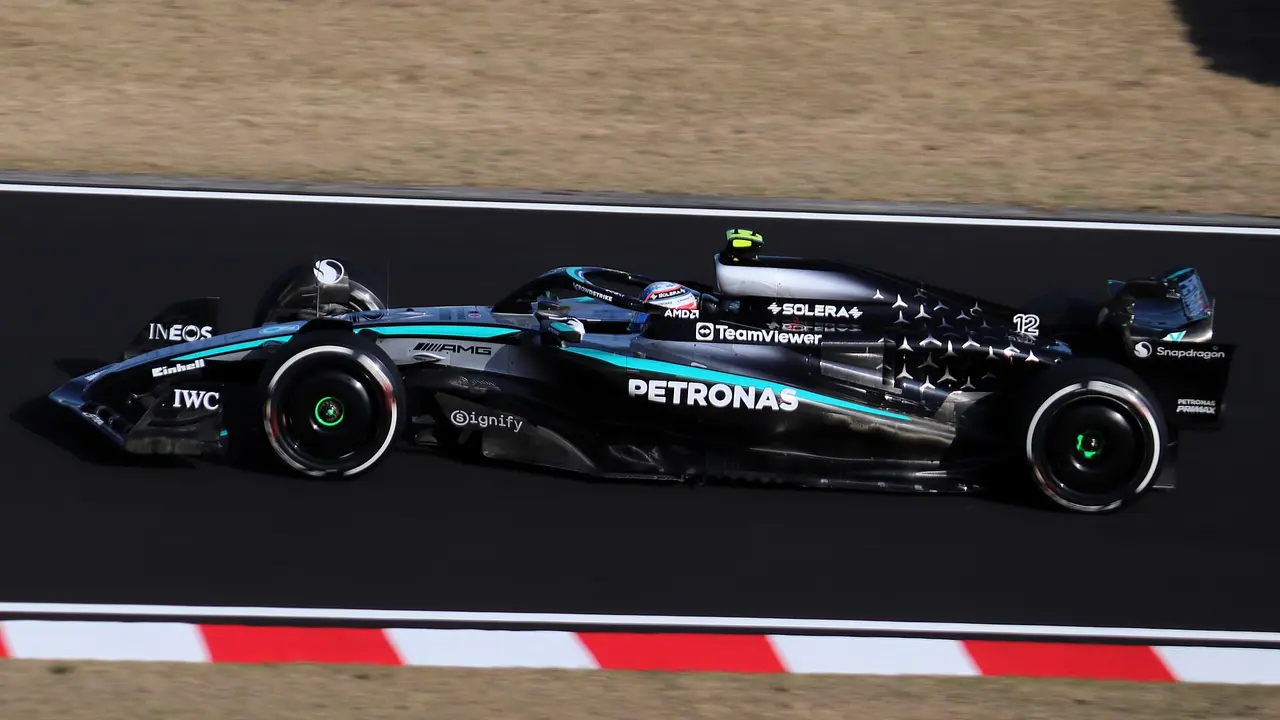
Monza had been waiting for this moment for sixty years, but no one could have imagined such a dizzying scenario. Starting from 19th place due to a penalty related to a power unit change, Kimi Antonelli sliced through the pack to win the 2026 Italian Grand Prix. At just 20 years old, the Mercedes driver became the first Italian to triumph in his home Grand Prix since Ludovico Scarfiotti in 1966. A home victory, an almost unprecedented comeback, and a new demonstration of strength in the title race: in one afternoon, Antonelli transformed Monza into a historic stage.
The official result places his teammate George Russell 3.857 seconds behind and Max Verstappen 14.718 seconds back. Lando Norris and Oscar Piastri complete the top five, while Lewis Hamilton finishes sixth for Ferrari. However, this leaderboard tells only part of the story. The real shock comes from the starting point: Antonelli launched from the second-to-last row on a circuit where overtaking is possible, but climbing eighteen positions requires speed, strategic precision, and cool-headedness.
From 19th to Victory: A Rare Feat
According to Formula 1, no Italian victory at Monza had been recorded since Scarfiotti drove a Ferrari to victory in 1966. The climb from 19th position also holds exceptional statistical significance: it is the second-lowest starting position from which an F1 Grand Prix has been won. In a championship where mere tenths separate the best cars and dirty air complicates overtaking, advancing in this manner is a total performance.
Antonelli built his race without succumbing to impatience. He needed to avoid contact in traffic, protect his tires, and seize every opportunity. His Mercedes had formidable top speed, but power alone is not enough at Monza. The braking zones at the first chicane and the Variante della Roggia punish the slightest mistake. Each overtaking maneuver requires a judgment of slipstream, distance, and grip with almost surgical precision.
Mercedes Achieves a Double That Changes the Championship
Russell’s second place gives Mercedes a significant double. The team not only won a spectacular race: it placed two cars ahead of Verstappen, Norris, and Piastri, its most dangerous rivals. After thirteen rounds, Antonelli now holds a 66-point lead over Russell in the drivers’ standings, according to the official report published after Monza. This margin guarantees nothing, but it offers considerable strategic protection for the remainder of the season.
The success also confirms that the Italian is no longer seen as a fleeting revelation. He knows how to win from the front, but Monza proves he can also overturn a compromised race. For a title contender, this ability is crucial. Championships are rarely built solely during perfect weekends. They are also won when Saturday goes wrong, when a penalty pushes the car to the back of the grid, and when one must turn damage into opportunity.
Italy Celebrates a Mercedes Driver, Not a Ferrari
The paradox makes the scene even more powerful. Monza is the emotional territory of Ferrari, a place where red transcends sport to touch national identity. Yet, the driver who ended six decades of Italian waiting was driving a Mercedes. The tifosi saw Hamilton finish sixth and Charles Leclerc retire after an early crash. Thus, national joy and the disappointment of the Scuderia mingled in the stands.
This complexity tells the unique place Antonelli occupies. He represents Italy without racing for Ferrari. His rise gives the public a national hero capable of winning immediately while forcing the Scuderia to watch a rival monopolize its own theater. For Mercedes, the image is extraordinarily powerful: seeing an Italian triumph at Monza in a Silver Arrow creates an emotion that marketing could never fabricate.
Why This Victory Could Define a Career
All victories earn 25 points, but some become milestones that change the perception of a driver. Winning at home from 19th place belongs to this category. Antonelli had already demonstrated his speed and accumulated successes in 2026. At Monza, he added a narrative: that of the young leader capable of surviving chaos, exceeding expectations, and bearing the pressure of an entire country.
This dimension matters to supporters, sponsors, and rivals. Competitors now know that a penalty may not necessarily eliminate him. Fans have a race destined to be replayed for years. Mercedes, finally, has a face that can embody the new technical era of Formula 1. In a globalized sport, champions also become exportable stories, and this one has all the elements of a modern legend.
A Signal Sent to the World and France
The significance of this feat extends far beyond Italy. Formula 1 gathers a global audience, and Monza remains one of its most recognizable circuits. In France, where the championship retains a loyal audience despite the current absence of a national Grand Prix on the calendar, this race reminds why the discipline still produces events capable of crossing borders. Pierre Gasly, finishing seventh with Alpine, also offers a point of French interest on a Sunday dominated by Mercedes.
The weekend also reshuffled narratives around the major teams. Verstappen limits the damage with a podium. McLaren places Norris and Piastri just behind, unable to threaten the Mercedes. Ferrari leaves its home race without a podium, while Antonelli transforms local pressure into energy. These contrasts will fuel the remainder of the championship as much as the technical data.
The Moment No One Can Ignore
There are still races to come, and the title is not yet awarded. A lead can dwindle, a technical evolution can alter the hierarchy, and reliability remains a constant threat. But September 6, 2026, has already entered the history of Monza. The result does not depend on interpretation: Antonelli won from 19th place, ahead of his teammate, and returned to Italy a home victory awaited since 1966.
The world of F1 has been searching for the face of its next generation for several seasons. At Monza, it saw that face emerge from the back of the grid, overtake nearly the entire field, and raise its arms in front of a country moved. This victory may not yet decide the championship, but it offers Kimi Antonelli something rarer than a trophy: a day that motorsport will not forget.