
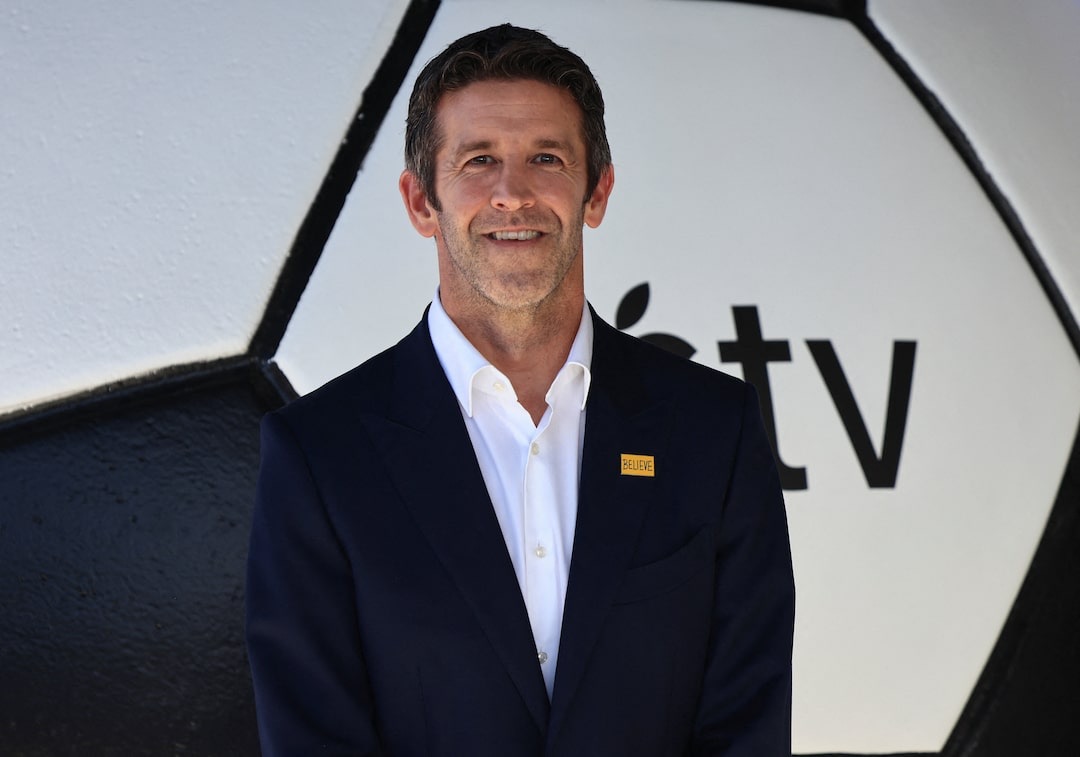
The incoming head of Apple has sent a message that Hollywood cannot ignore. Just weeks away from succeeding Tim Cook, John Ternus has expressed his intention to build on the company’s progress in film and television. Behind this seemingly cautious statement lies a considerable ambition: to make entertainment a sustainable pillar of the Apple ecosystem, alongside devices, services, and artificial intelligence. For studios, platforms, and creators in Europe, this signal could shift the balance in an already fierce global battle.
John Ternus spoke on Monday, July 27, in Los Angeles, at the premiere of the fourth season of âTed Lasso.â The choice of venue was far from accidental. This series has become the most popular symbol of Apple’s offensive in original content. According to Reuters, the future CEO stated he is determined to extend the group’s momentum in entertainment when he takes office in September.
A Hardware Engineer at the Heart of Hollywood
The contrast is striking. John Ternus has built his career in hardware engineering, far from the red carpets. Joining Apple in 2001, he gradually took responsibility for the products that power the company: iPhone, iPad, Mac, and other devices. He will become CEO on September 1, 2026, while Tim Cook will transition to executive chairman of the board.
His presence at a series premiere thus adds a strategic dimension to his words. It shows that the future leader does not view Apple TV as a peripheral activity reserved for producers. Content is now tied to how Apple sells its services, retains its customers, and imbues its brand with cultural value.
The group launched its original streaming service in 2019. Within a few years, it has amassed awards, attracted international stars, and established several franchises. âTed Lassoâ has created a rare global attachment, while the film âCODAâ provided Apple with a historic win at the Oscar for Best Picture. The platform has also invested in science fiction, thrillers, documentaries, and productions intended for the big screen.
Why This Statement Goes Beyond Apple TV
Apple is not only fighting for screen time. Its true advantage lies in integration. A series can be watched on an iPhone, iPad, Mac, or connected TV, promoted in its digital stores, and then linked to other services. Each success strengthens the relationship between the user and the ecosystem.
This logic explains why the number of subscribers is not the only relevant indicator. Entertainment can reduce churn, support bundled offers, and give the brand a daily presence that goes beyond phone renewals. It also allows Apple to engage with the worlds of music, sports, podcasts, and cinema.
For John Ternus, the challenge will be to maintain this ambition without letting costs spiral out of control. Streaming remains a challenging sector: major platforms are all seeking to improve their profitability, talent is expensive, and audiences can cancel a subscription in seconds. Producing less but better, transforming more programs into events, and building sustainable franchises could become the guiding principle.
âTed Lasso,â Much More Than a Hit Series
The return of âTed Lassoâ after more than three years offers Apple an ideal showcase. The series combines humor, emotion, and football, three languages that easily cross borders. Its new season, centered on a women’s team, also arrives amid a growing interest in women’s sports and their representation on screen.
By appearing at this premiere, Ternus connects his future leadership to one of Apple’s few immediately identifiable cultural properties. The message is twofold: the new CEO will not renounce Tim Cook’s legacy, and he wants to use content as a growth engine. For Hollywood, it assures that a player with immense financial resources wishes to remain in the race.
However, the challenge now is to replicate this phenomenon. A platform cannot rely indefinitely on a single iconic title. It must renew attention, create new characters, and offer powerful enough events to trigger subscriptions. This is where Ternus’s promise must evolve into a concrete editorial strategy.
A Global Battle Against Netflix, Disney, and Amazon
Apple operates in a competition where each player has a different advantage. Netflix benefits from global scale and exceptional recommendation power. Disney relies on decades of characters and franchises. Amazon can integrate video into a much broader business relationship. Apple, on the other hand, has a base of premium devices and unique control over the user experience.
Ternus’s appointment could bring content and technology even closer together. Upcoming innovations in screens, spatial audio, accessibility, mixed reality, or personalization could be conceived with studios from the outset. This convergence is the real threat to competitors: Apple would no longer just sell series but a complete way to discover and experience them.
Artificial intelligence will inevitably be at the center of this evolution. It can help localize works, improve recommendations, and facilitate certain production steps. However, it raises major questions about copyright, employment, and creator compensation. The future CEO will need to ensure that technological innovation does not undermine the trust of the artists Apple needs.
What France and Europe Stand to Gain
For France and Europe, the announced acceleration opens up concrete opportunities. Global platforms need stories that can travel, recognizable settings, and local talent. Paris, European festivals, French studios, and independent producers could become more significant partners if Apple seeks to expand its catalog beyond English-language productions.
Europe also has a unique regulatory and cultural framework. Funding obligations for creation, media timelines, and data protection impose adaptations. These can be seen as constraints but also as an invitation to develop a deeper local presence. A platform that wants to count sustainably in France must invest in works, teams, and long-term relationships.
Ternus’s profile could favor a structured approach: fewer isolated hits, more coherence between production, distribution, and technology. If this strategy genuinely includes European markets, it could bring new funding to French cinema and series while enhancing their international visibility.
The First Major Test for Tim Cook’s Successor
John Ternus will inherit a company transformed by fifteen years of Cook’s leadership. Apple has become a services powerhouse in addition to being a hardware giant. The future CEO must now prove that he can create the next cycle of growth without diluting the group’s identity.
Entertainment will be one of his most visible tests. An iPhone is judged on its performance and sales; a series is also measured by emotion, conversation, and its place in popular culture. Leading these two worlds requires different reflexes. Ternus seems eager to show that he will not choose between them.
His statement in Los Angeles is not yet the announcement of a budget, an acquisition, or a new franchise. However, it sets a direction. As the transition approaches on September 1, Apple signals to Hollywood that the studio at the heart of its ecosystem is not a temporary experiment. The next chapter could be one where the largest technology company definitively transforms its influence into global cultural power.
Sources
- Reuters via The Star â about John Ternus at the âTed Lassoâ premiere and entertainment strategy, July 27, 2026.
- Apple Newsroom â John Ternus’s appointment and official transition timeline, April 20, 2026.
- Associated Press via WTOP â background and profile of Appleâs future CEO, April 2026.
- Le Monde â John Ternus’s trajectory and succession stakes, April 22, 2026.