


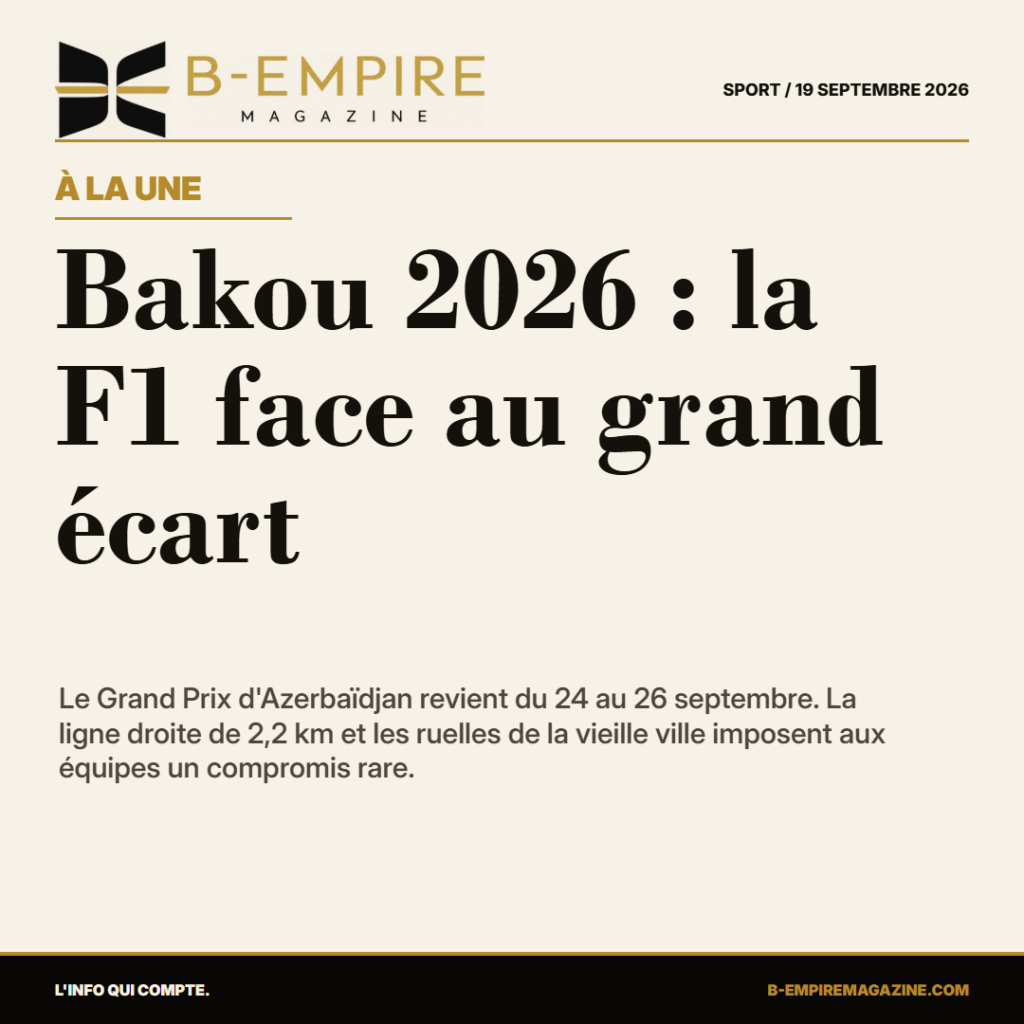
In Baku, a car that is quick on a straight can become vulnerable only a few corners later. The 2026 Azerbaijan Grand Prix is scheduled for September 24-26, with practice on Thursday, qualifying on Friday and the race on Saturday. The 6.003-kilometer street circuit places a long acceleration alongside the Caspian Sea next to tight passages through the old city. Days before the event, the interesting question is not who should be crowned favorite before a lap has been run. It is why this track forces every team to decide what it is willing to sacrifice in one place to gain elsewhere.
A circuit built on contradiction
Formula 1 describes 20 corners and a roughly 2.2-kilometer flat-out run along the waterfront. A slipstream can help set up an overtake into Turn 1, where heavy braking follows a long acceleration. Elsewhere, the course snakes between buildings and the old city’s walls. Turns 8 to 10, near Icheri Sheher, form an especially narrow passage. There, a driver earns time through precision, not merely a high top speed. A small error can cost considerably more than a slow lap, since barriers leave so little room for a correction.
That contrast demands an aerodynamic compromise. More downforce builds confidence in the twisting sectors but can hurt speed on the long straight. Less drag helps a car attack or defend at the end of that straight, at the price of a more delicate machine in slower corners. A setting that looks perfect in one sector need not be right across the whole lap. This is why practice matters: teams must study not just an overall time, but precisely where they gain or lose tenths of a second.
Three days to find a balance
The official timetable schedules two practice sessions for Thursday, September 24, a third on Friday, September 25 before qualifying, and 51 racing laps on Saturday, September 26. That layout gives teams opportunities to compare configurations, but it cannot guarantee that they will find the right answer. Track conditions, braking confidence and tire behavior can shift during the weekend. Qualifying on a street circuit often rewards commitment, yet it also exposes drivers to walls that will not forgive a line taken even slightly too wide.
The starting grid will matter, but it will not tell the entire story. A long straight creates overtaking chances that many other city circuits rarely offer. At the same time, a driver must get through the narrow sectors cleanly to stay in a position to attack later. This alternation frustrates simple conclusions: a spectacular qualifying lap is not automatically a promise of pace over 51 laps. Tire use, braking and traffic will matter all the way to the checkered flag, not only over one fast attempt.
A decade of history, no guaranteed script
F1 first raced in Baku in 2016 under the European Grand Prix name; the Azerbaijan Grand Prix designation arrived in 2017. The 2026 event therefore marks a decade of the circuit on the calendar. Several past races have reinforced its unpredictable reputation. Daniel Ricciardo won a turbulent event in 2017. In 2024, Oscar Piastri took the lead from Charles Leclerc and went on to win. In 2025, by contrast, Max Verstappen controlled the race from pole position while Piastri was out on the first lap.
Those memories illustrate a range of possible outcomes, not a rule that Baku must always produce chaos. A circuit can contain considerable risk without every risk becoming an incident on a given Saturday. Turning a previous crash into a prediction would confuse history with analysis. Before the race, a narrower claim is possible: strong braking zones, close barriers and a long slipstreaming section create many moments when a driving or setup decision can count. The rest will depend on the cars and circumstances of this particular edition.
The setting is part of the identity
Baku is not a permanent track placed beyond a city. Its route follows the Caspian waterfront and then passes through historic streets. Medieval walls near the castle section have become some of the championship’s most recognizable images. They attract cameras, but they also shape the driving: spaces that seem open beside the water disappear in the tight passages. The city is not merely a commercial backdrop. It supplies the physical constraint that gives the race much of its distinctive character.
The tenth anniversary also comes with a music program announced by F1, featuring Katy Perry and Calvin Harris during the race weekend. For the organizer, this makes the event a wider entertainment destination than a motorsport contest alone. On track, however, the essential task is less visible than the concerts: finding the combination of grip and speed needed to pass through two almost opposite circuits in a single lap. The surrounding spectacle may broaden the audience; it cannot solve the teams’ technical problem.
Wait for the track, not the prediction
Early practice will show which cars gain time on the straight, which look comfortable in the old city and which must make further compromises. Qualifying will give a clearer picture of single-lap speed. The race will subject those choices to distance, traffic and opponents’ responses. The official page does not yet list a result for this edition. That is a good reason to keep analysis in proportion: before September 24, Baku is a promise of contrasts, not a podium that has already been written.