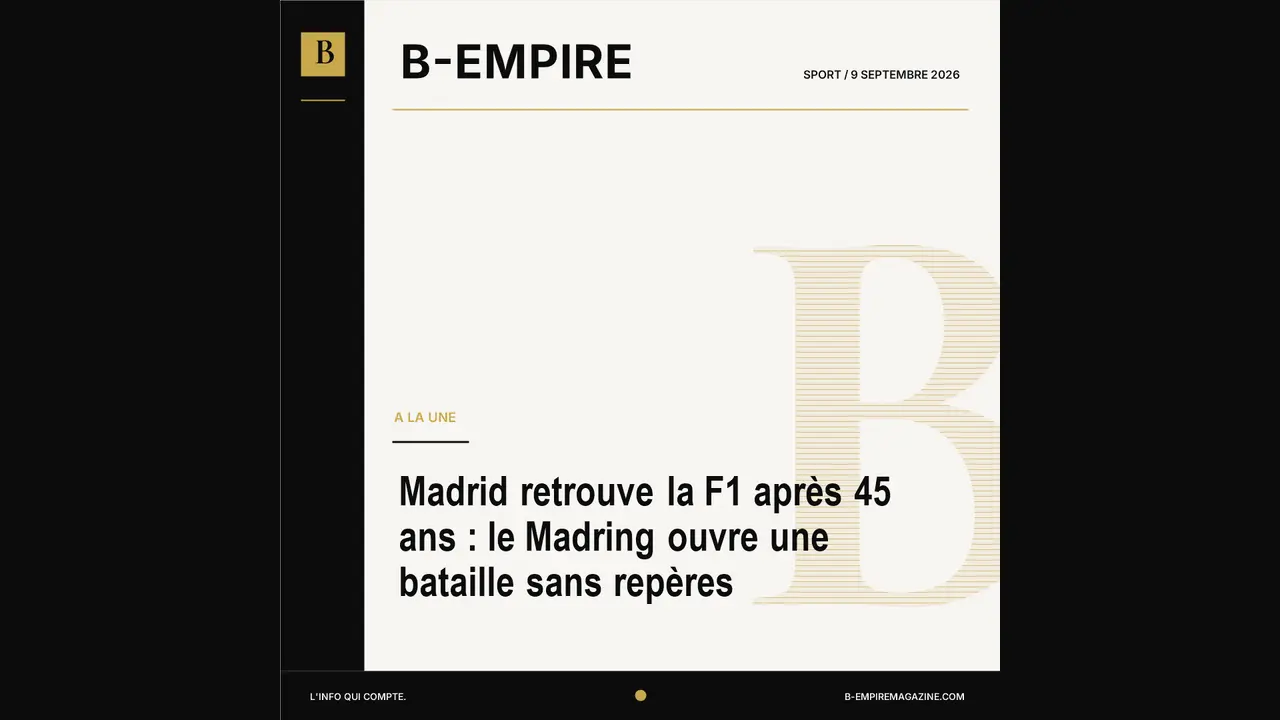
Madrid is preparing for a weekend that could redraw the map of global motorsport. From September 11 to 13, 2026, Formula 1 returns to the Spanish capital for the first time in 45 years and introduces the brand-new Madring. The 5.474-kilometre circuit has no race history, no established hierarchy and almost no real-world reference points. For drivers, teams and millions of viewers, that blank page turns the Spanish Grand Prix into one of the season’s most compelling events.
The race takes place on Sunday, September 13, following Friday practice and Saturday qualifying. Yet the occasion already extends far beyond lap times. Madrid wants to prove that a capital city can become a complete Formula 1 stage, bringing together competition, tourism, technology, music, fashion and commerce. Formula 1, meanwhile, gains a new urban showcase in the centre of a strategically important European market.
Why the Madring leaves every team facing the unknown
Formula 1’s official preview describes the Madring as a completely new challenge and says the competitive order will be difficult to predict. That uncertainty is the main source of tension. Engineers have simulations and preparatory data, but they do not have the years of knowledge collected at Monza, Silverstone or Barcelona.
Every setup decision therefore carries more risk. Ride height, downforce, cooling, tyre management and the balance between straight-line speed and grip must be confirmed in only a few sessions. A rapidly evolving track surface could overturn Friday’s conclusions. Drivers must learn the circuit’s real limits while preparing for a qualifying session in which track position and timing may prove decisive.
The novelty creates a rare form of psychological equality. Leading teams arrive with greater resources, but no driver can rely on a decade of experience through the same corner. Whoever first understands the sequences, protects the tyres and identifies genuine overtaking opportunities can convert instinct into a valuable advantage.
A 45-year wait and two Spanish heroes
The last Formula 1 race held in Madrid took place at Jarama in 1981. The 2026 return revives that national memory in a radically different setting. Located near IFEMA and Valdebebas, the Madring was designed to connect more directly with the city and its public transport system.
For Spanish fans, Carlos Sainz and Fernando Alonso add enormous emotional weight. Sainz became the first driver to complete a lap of the new venue during its inauguration. Alonso represents a longevity and popularity spanning generations. Even without a promise of victory, their appearances should produce the loudest moments of the weekend.
The event is also important for the identity of the Spanish Grand Prix. After decades associated with Barcelona-Catalunya, Madrid must win over established supporters while attracting a new audience. Success will be measured not only by overtaking, but also by transport, spectator experience and the circuit’s ability to create memorable television images.
Madrid turns the race into a global festival
The city has built a programme that stretches beyond the circuit, with fan zones, demonstrations, technology events and free activities across the wider region. The logic is clear: make Formula 1 feel accessible even to people without a race ticket.
The meeting of sport and culture can even be seen in fashion. Formula 1 and Madrid label Pompeii launched an official nine-piece unisex capsule on September 8. Pit crew jackets, mechanic shirts and references to racing heritage translate the Grand Prix into streetwear. It is more than a merchandising detail: modern Formula 1 increasingly sells an aesthetic and a cultural identity alongside competition.
According to El País, more than 100,000 tickets had been sold and organisers projected an annual economic impact of up to 450 million euros for the capital. Those forecasts will ultimately need to be tested against results, but they show the scale of the ambition. Hotels, restaurants, retail, transport and Madrid’s international image all have a stake in the event.
A decisive test for Formula 1’s global strategy
Formula 1 has spent years turning each Grand Prix into a destination. Madring concentrates that strategy through proximity to a major city, accessibility, ambitious architecture, commercial activations and content built to travel across social media. If the weekend works, Madrid could become a reference for other semi-urban projects.
There are risks. The first edition of an event this large can expose weaknesses in traffic, queues, grandstand sightlines, disruption for residents or other operations. Madrid has prepared a mobility plan and specific access routes, while people living near the venue have adjusted to temporary restrictions. The verdict will be delivered beyond the asphalt as much as on it.
What to watch during the weekend
- Track evolution: a new surface can gain grip quickly and transform setup choices.
- Qualifying: one mistake or badly timed flag can overturn the grid on an unfamiliar circuit.
- Tyres: the lack of race history makes degradation harder to predict.
- The Spanish drivers: every move by Sainz and Alonso will be amplified by the home crowd.
- Organisation: transport, access and spectator experience will shape Madring’s long-term reputation.
A blank page the world will watch being written
The first Madring winner will secure more than another championship result. That driver will attach a name to the birth of a circuit and Formula 1’s return to Madrid after almost half a century. This is the weekend’s essential appeal: nobody yet knows which image will become historic.
The promise is simple. An entire city becomes a stage, 20 drivers enter territory without a modern past and the competitive order must be rebuilt live. Formula 1 is not merely returning to Madrid; it is opening a laboratory for its future.