


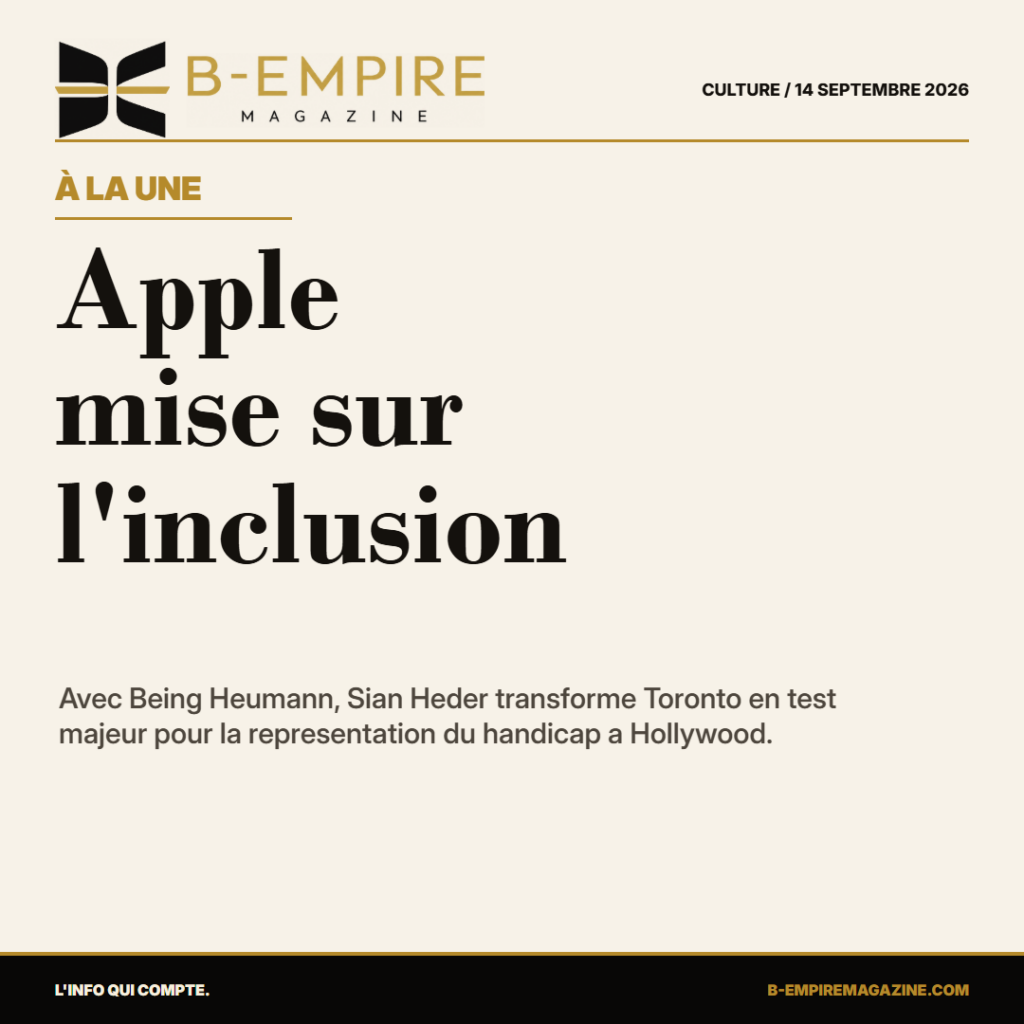
By opening the Toronto International Film Festival with Being Heumann, Apple and Sian Heder are not merely launching a prestige film: they are asking a question Hollywood too often avoids. What is an industry worth if it celebrates inclusion when it becomes ceremony, but struggles to turn it into a lasting production method? After CODA, Heder returns with a huge subject: Judy Heumann, the activist who turned disability into a civil rights battle rather than a sentimental footnote.
The Associated Press reports that the film premiered at TIFF 2026 as a tribute to Heumann and to the historic 1977 sit-in at San Francisco’s federal building, a 28-day occupation that became decisive in the implementation of Section 504 of the Rehabilitation Act. Apple, for its part, confirms a release in select theaters on November 6, followed by a global Apple TV launch on November 13. The calendar is clear: festival, cinema, streaming, awards season.
After CODA, the Second Test
CODA gave Apple a historic moment: the first Best Picture Oscar ever won by a streaming platform. But the success of one film is not enough to change an industry. That is what Sian Heder implicitly says with Being Heumann. Representation cannot remain an exception rewarded every few years. It has to become a language of casting, sets, budgets, marketing and accessibility.
The choice of Judy Heumann is powerful because it prevents the film from reducing disability to an inspirational individual arc. Heumann did not simply overcome a personal obstacle. She organized, negotiated, occupied, blocked, spoke and insisted. Her story reminds us that accessibility is not an act of kindness. It is a political, legal and cultural infrastructure.
TIFF as Global Amplifier
Toronto remains one of the few festivals able to turn a premiere into a popular conversation. Cannes consecrates the auteur, Venice imposes prestige, Telluride sharpens awards season. TIFF tests the encounter with a wide audience. Making Being Heumann the opening film therefore gives Apple an ideal stage: one where social cinema can be seen not as a moral duty, but as a cultural event.
Roy Thomson Hall indicates that the opening screenings were planned with open captions and an ASL interpreter for the live onstage components. That detail should not be treated as technical background. It shows the difference between talking about accessibility and actually organizing the conditions for the people concerned to participate in the festival ritual.
Apple Seeks a New Proof of Prestige
For Apple, the film fits a readable strategy. The platform cannot win the streaming war through volume against Netflix or Prime Video. It has to win through perception: premium films, identifiable auteurs, awards campaigns, international talent and moments of conversation. Being Heumann checks all those boxes, but with an additional requirement: coherence between the subject and the production.
Apple highlights Ruth Madeley as Judy Heumann, Mark Ruffalo, Dylan O’Brien and a cast including many disabled actors. AP notes that Heder rebuilt some spaces with accessibility in mind and sought to create a more authentic working environment. In the economy of prestige, that method becomes an asset: it can protect the film from the charge of simple opportunism.
Inclusion as an Economy of Trust
The issue goes beyond one film. Hollywood is living through a period of distrust: franchise fatigue, budgets under pressure, generative AI, social tensions and platform competition. In this context, audiences look more closely at how stories are made. Who speaks? Who is hired? Who decides? Who is absent from the room? The answers become part of cultural value.
Being Heumann can therefore work as a promise, but also as a test. If the film succeeds, it will show that a disability-rights civil story can occupy the center of the cinema calendar without being marginalized. If it fails, it will remind the industry that good intentions are not enough. Direction, writing, casting and political complexity will have to carry the same weight as the message.
The Risk of the Useful Film
The danger for this type of project is familiar: becoming useful before becoming alive. Some of the harsher reactions around Toronto have already pointed to the risk of a biopic that is too tidy, too explanatory and too eager to reassure. That risk matters because Judy Heumann was not a smooth icon. She was strategic, funny, impatient, confrontational and able to turn anger into organization.
To reach its subject, the film will therefore have to accept friction. A story of struggle cannot be merely a sequence of obstacles overcome. It has to show exhaustion, compromises, imperfect alliances, administrative violence and the long time scale of rights being won. That is where cinema can move beyond simple illustration.
Why This Launch Matters
As of September 14, 2026, Being Heumann is more than a festival title. It is a test for Apple, for Sian Heder and for Hollywood’s ability to build inclusion that does not disappear after speeches. The film arrives with a powerful story, an ambitious platform and a release calendar designed for prestige. The essential question remains: will the system agree to change its practices as quickly as it likes to applaud its symbols?
For B-EMPIRE, the signal is clear: the future of premium cinema will not be decided only by budgets, stars and festivals. It will also be decided by the moral credibility of images. Being Heumann reminds us that an industry can turn a cause into content. The real luxury will be turning that content into shared power.
Sources
- Associated Press, interview around Being Heumann at TIFF, September 12, 2026
- Apple TV Press, teaser and release dates for Being Heumann, September 2, 2026
- Apple TV Press, official Being Heumann page
- Roy Thomson Hall, TIFF world premiere of Being Heumann, September 10, 2026
- The Guardian, films to watch at TIFF 2026, September 10, 2026