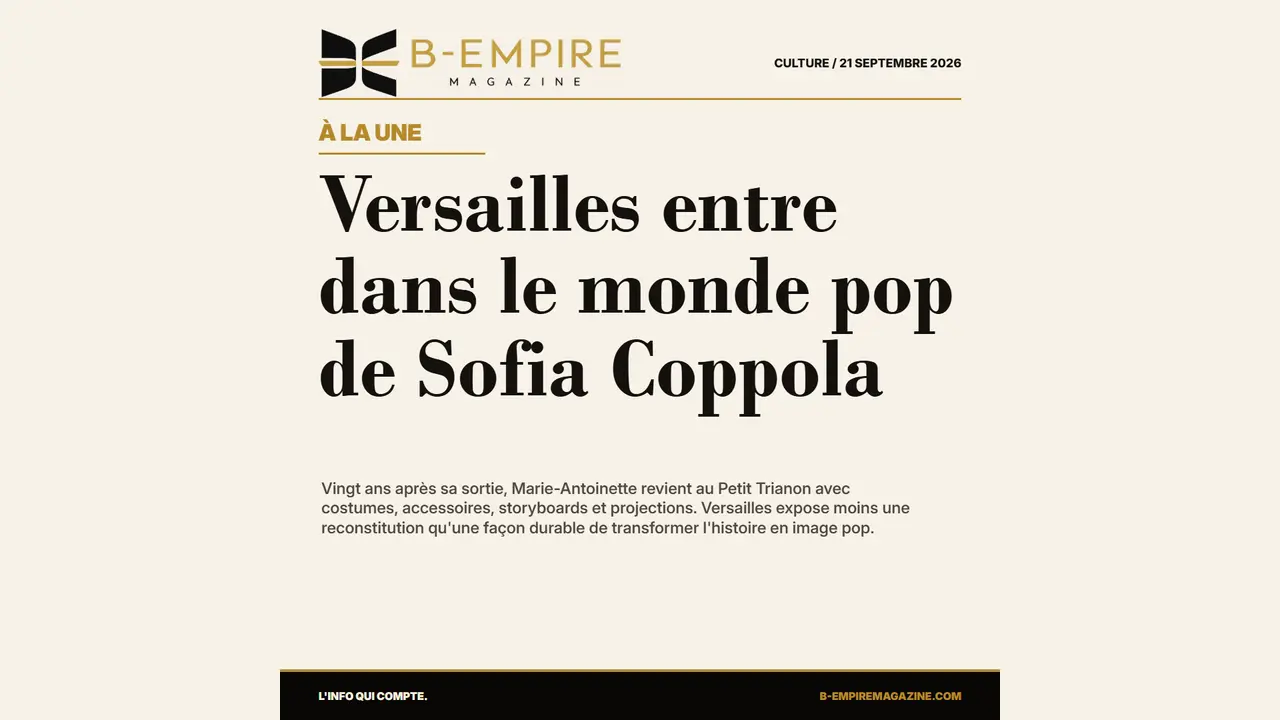
Twenty years after turning Versailles into an adolescent palace, Sofia Coppola is returning to the Petit Trianon in the form of an exhibition. From September 22, 2026, to January 24, 2027, the estate is celebrating Marie Antoinette, released in 2006 and filmed largely within its spaces. Original costumes by Milena Canonero, props, storyboards, annotated scripts, set photographs, design elements and reconstructed spaces form a presentation developed with the director.
The location creates a rare situation: visitors will be able to watch certain sequences in the rooms where they were filmed. The exhibition is therefore not simply placing cinematic objects inside a historic monument. It brings together three layers of memory: the queen’s life, the representation constructed by the film and the memory audiences now carry of that representation.
A Historical Film That Refused Distance
In 2006, Sofia Coppola was not trying to make an exhaustive biography. Her film chose the intimacy of a young woman displaced, watched and confined within a court system. Boredom, loneliness, parties and the pressure of collective attention mattered as much as political events. That perspective unsettled viewers expecting a conventional history lesson, but it gave the character unusual proximity.
Contemporary music, editing, pastel colours and Kirsten Dunst’s energy created a deliberate short circuit between the eighteenth century and youth culture in the early 2000s. The film did not claim that the two periods were identical. It used the cultural language of its audience to make excess, isolation and the social construction of a female image emotionally legible.
Costume as a Parallel Screenplay
Milena Canonero’s work forms the exhibition’s natural centre. Awarded the 2007 Academy Award for Best Costume Design, her clothes do more than establish a period. They follow the character’s changing condition, from her fragile arrival at court to her immersion in almost unreal abundance. Colours, volumes, textures and shoes tell what dialogue does not always express.
The Academy of Motion Picture Arts and Sciences has used the film as a teaching example: Coppola wanted a pastel palette inspired by French macarons, so Canonero developed sherbet-coloured dresses. The principle shows how historical research can coexist with a decisively contemporary choice. Costume becomes an emotional translation rather than a documentary copy.
When a Monument Exhibits Its Own Double
Versailles is not a neutral setting. The palace carries historical, tourist and political authority that cinema transforms whenever it chooses a frame, light or movement. By hosting traces of the production today, the institution is exhibiting its cinematic double: a Versailles that became colour, rhythm, desire and melancholy for millions of viewers.
The operation might seem circular, since the monument is celebrating a work that reinforced its visual power. It becomes more productive when it makes the process visible. Annotated scripts, storyboards, photographs and set elements remind us that an iconic image results from a sequence of choices, experiments and professions. Cult status no longer erases the process; it becomes a route toward it.
The Petit Trianon as Real Space and Imagined Refuge
Presenting the exhibition at the Petit Trianon strengthens this exchange. Historically associated with the search for a life less governed by ceremony, the site became a refuge in the queen’s popular image. The film uses the tension between desired freedom and material privilege. Visitors therefore move through a real building carrying successive stories that do not always align.
The museum’s challenge is to prevent the film’s seductive aesthetic from becoming automatic historical truth. A behind-the-scenes exhibition can help preserve that distinction by showing an interpretation, its tools and its period. Visitors can admire the power of a dress or scene while understanding that each constructs a point of view.
An Influence Beyond Cinema
The Palace of Versailles argues that the film helped shape an icon combining history, modernity and pop imagination, with an influence still visible in fashion, design and photography. That afterlife comes partly from the coherence of its world. A colour, pair of shoes, floral arrangement or song can evoke the film without directly showing its heroine.
In an era of images circulating outside their original context, that quality has become an economic and cultural force. The Marie Antoinette aesthetic feeds fashion editorials, campaigns, parties and digital content. Its longevity, however, depends on more than a photogenic palette. It rests on a contradiction that remains current: visual pleasure can be both an escape and the representation of confinement.
Revisiting Instead of Merely Commemorating
The twentieth anniversary arrives as films from the 2000s enter cultural heritage without losing their place in popular culture. Celebrating them carries the risk of easy nostalgia. The arrangement announced by Versailles offers a more interesting path: returning to objects and documents to understand why certain images endured.
The exhibition can connect several audiences. Film lovers will follow Coppola’s method; Versailles visitors will see how a camera rewrites the monument; fashion enthusiasts will encounter Canonero’s work. None of these perspectives exhausts the film. Together they show how a historical feature can become an object of history in its own right.
The Image Returns to Its Place
In 2006, Marie Antoinette borrowed Versailles to build an interior world. In 2026, Versailles is recovering the traces of that creation and placing them on view. This return confirms cinema’s power: it does not merely record a place but changes how later generations look at it.
The exhibition’s success will depend on preserving the tension between seduction and analysis. Dresses, shoes and sets will naturally attract the eye. Notes, sketches and screenings can reveal the labour supporting the surface. That is where the anniversary gains meaning: not by freezing a cult film inside its most beautiful images, but by showing how those images were conceived, produced and made strong enough to return home twenty years later.