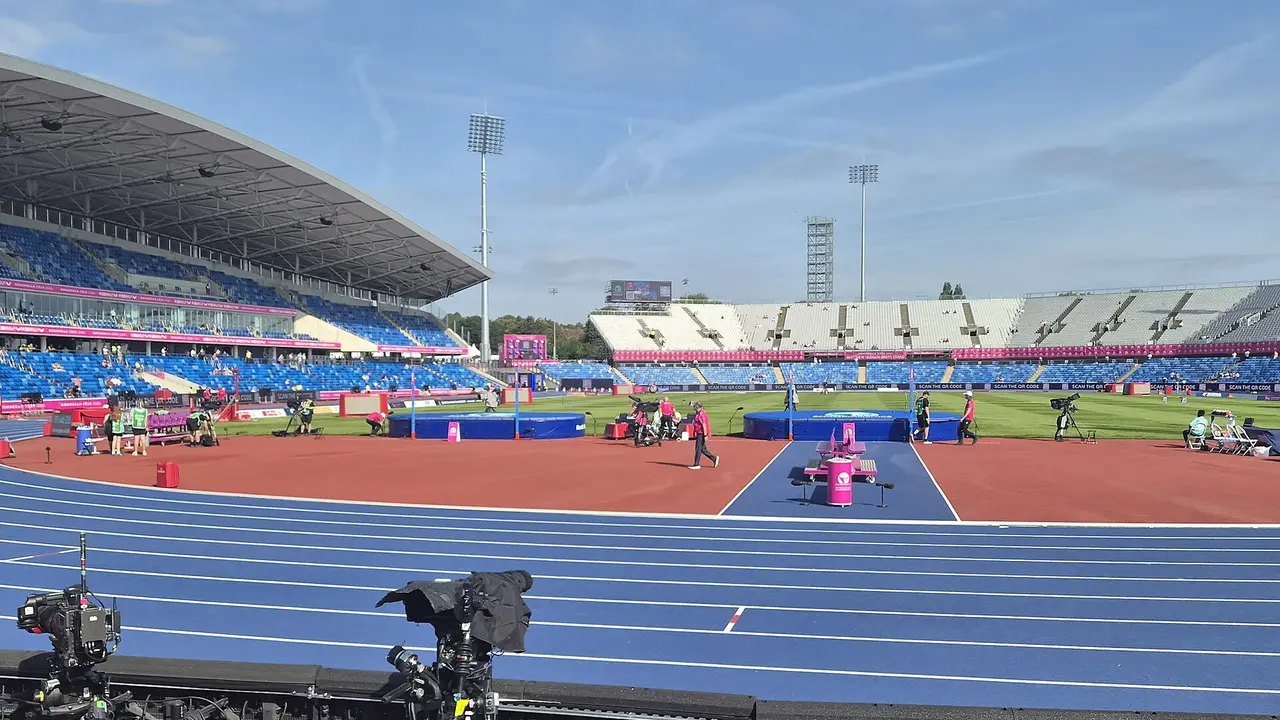
A British queen, tense stands, and a French team leaving without the metal they desired the most: Birmingham 2026 delivered much more than just a results table. The European Athletics Championships, concluded on Sunday, August 16, at Alexander Stadium, showcased a European discipline that is faster, denser, and more unpredictable. For the French team, the silver and bronze medals prove that the level exists. However, the absence of a title transforms this event into a warning less than two years before the Los Angeles Games.
The contrast is striking. France sent a delegation of 80 athletes and arrived with ambitions fueled by the legacy of Paris 2024. Yet, they leave Birmingham without visible dominance, while Great Britain has found a new popular face in Amy Hunt, and Italy has confirmed the depth of its model. This is not a story of collapse; it is one of continental competition that leaves no margin for error.
Amy Hunt Transforms Birmingham into a Global Stage
At 24, Amy Hunt was the magnetic figure of the week. L’Ãquipe confirms her victories in the 100m and 200m. AS details an even more spectacular harvest: four gold medals, complemented by relays, with a 100m won in 11 seconds and a 200m clinched in 22.19 seconds. Her success transcends pure performance. A British sprinter has managed to give the championship a simple, viral, and immediately exportable narrative.
Modern sport is also won through faces. Hunt offers European athletics a recognizable heroine at a time when federations are striving to maintain attention between two Olympic Games. Her short, readable, and spectacular races are tailor-made for social media. Birmingham thus produced what every major event needs: a character who encapsulates the competition in a few images without diminishing the richness of other achievements.
The French Team Close to the Summit, Yet Never Above
France did not leave empty-handed. Alice Finot secured silver in the 3000m steeplechase, marking a significant return to the forefront. Just Kwaou-Mathey took silver in the 110m hurdles after a personal journey marked by injuries. Kounta also earned silver in the 400m, while Marie-Julie Bonnin claimed bronze in the pole vault. These podium finishes tell a story of resilience, hard work, and a genuine ability to rise to the occasion.
However, they also reveal a limit. In continental competition, turning a final into a victory distinguishes a solid nation from a dominant one. The French have often been close enough to hope, but rarely strong enough to impose their narrative. The elimination of Gabriel Tual before the final of the 800m, while defending his title, symbolizes the harshness of this level: status no longer protects anyone.
Two Years After Paris, the Legacy Must Become a Method
Paris 2024 was supposed to leave a legacy: more practice, resources, visibility, and an inspired generation. Birmingham reminds us that an Olympic legacy is not only measured by the number of renovated stadiums or collective memories. It must translate into training pathways, medical support, stability for coaches, and the ability to advance finalists to the podium, and then from the podium to gold.
The French short sprint illustrates the problem. Before the Championships, L’Ãquipe already highlighted its reduced representation in the selection. Meanwhile, Great Britain utilized its talent pool, public support, and relays to construct a demonstration of speed. France has talent, but it cannot wait for the miraculous appearance of a star. It must cultivate depth, discipline by discipline.
A Europe That No Longer Slows Down
Birmingham also confirmed that European athletics is no longer organized around a few strongholds. Jakob Ingebrigtsen won again in the 5000m. Audrey Werro held her ground against Keely Hodgkinson in the 800m. Italy played high in the rankings until the last events. The Netherlands, Switzerland, Norway, Germany, and Great Britain each have hubs capable of producing champions.
This dispersion makes every final more dangerous. It also means that preparation for Los Angeles 2028 cannot be conceived solely in relation to the United States, Jamaica, or the African powers in middle and long-distance events. The European competition alone is already sufficient to expose vulnerabilities. Before dreaming of the world, one must be capable of winning on their continent.
Safety: The Other Lesson of the Week
The competition experienced an unusual episode on Saturday night. Associated Press reports that a man with improper accreditation was discovered in a stadium area, leading to a temporary halt of transport and the postponement of ceremonies. The West Midlands police made an arrest on suspicion of fraud and clarified that there was no immediate risk to the public. Organizers later assured that the stadium could safely host the final evening.
AS, present on-site, described approximately 25,000 people affected by the wait and a system that held athletes, media, and spectators. The incident ended without drama, but it serves as a reminder of the complexities of major events: the public’s experience depends as much on the fluidity of transport and accreditation as it does on the spectacle on the track.
The Appointment France Cannot Miss
The French assessment should lead neither to catastrophism nor to self-satisfaction. Several medalists have proven they can withstand pressure. Finalists have gained valuable experience. However, the political and sporting clock is ticking: each season leading to Los Angeles must now produce visible progress, particularly in sprints, relays, and disciplines where France already has a tradition.
Birmingham 2026 thus leaves a dual image. European athletics has found a queen in Amy Hunt and shown an exciting density. France, on the other hand, has touched the summit several times without occupying it. This ‘almost’ is not a condemnation. It is an urgent invitation to transform talent into a system, podium finishes into titles, and the legacy of Paris into sustainable results.