Carmelle Conquers Asia : The Victory That Enters the Philippines into History
At 19 years old, Carmelle becomes the first winner of Eurovision Asia. With Sobra-Sobra, the Philippines opens a new era for pop on the continent.
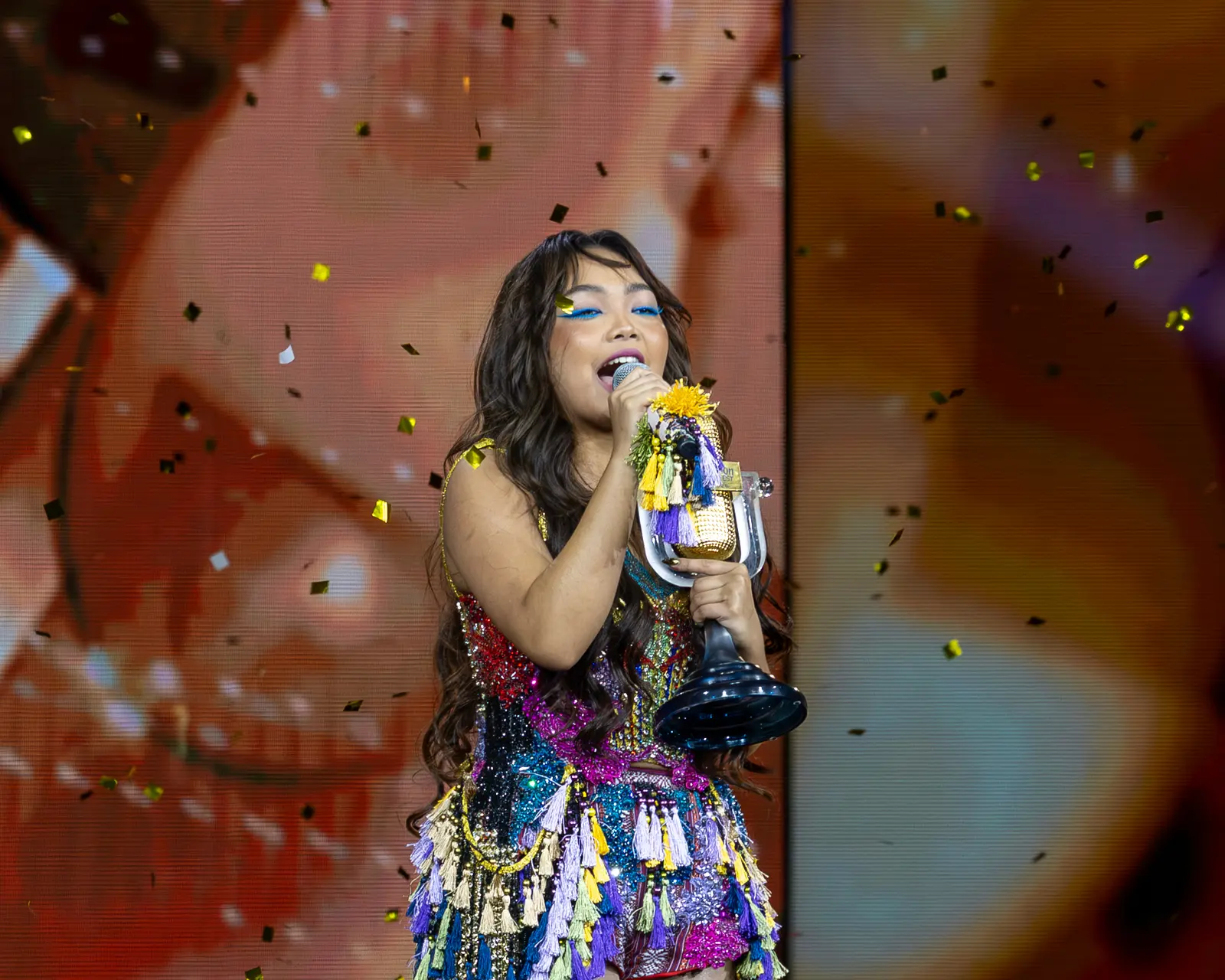
A new chapter in global pop has just been written in Bangkok. At just 19 years old, Philippine singer Carmelle has won the very first edition of the Eurovision Song Contest Asia with Sobra-Sobra, a dance-pop track driven by a message of female empowerment. By dominating both the jury and public votes, she has not only claimed a trophy but has also become the first face of a competition designed to provide Asia with a common international music stage.
The final took place on Saturday, November 14, 2026, at the One Bangkok Forum in the Thai capital. Eleven countries were represented: Bangladesh, Bhutan, Cambodia, Laos, Malaysia, Mongolia, Nepal, the Philippines, South Korea, Thailand, and Vietnam. Facing established artists and spectacular productions, Carmelle secured 211 points, ahead of the Thai duo Mang x Daou, who received 170 points, and Vietnamese artist Tóc Tiên, who came in third with 164 points.
A Clear Victory Before the Jury and the Public
The final score tells a story of unambiguous victory. According to ABS-CBN, Carmelle topped the national jury votes with 93 points and then led the public vote with 118 points. This double dominance is significant: it indicates that Sobra-Sobra resonated with both the professionals tasked with evaluating the artistic proposal and the viewers called upon to choose their favorite performance.
The young singer was the sixth artist to take the stage. In an energetic staging that combined choreography, powerful lights, and vocal confidence, she transformed the song into a declaration. The title, whose expression can evoke the idea of “too much” or “more than enough,” celebrates a woman who refuses to diminish her strength to meet expectations. Carmelle presented the piece as a tribute to Filipino women, giving the performance a cultural significance beyond the simple pop refrain.
At 19, Carmelle Already Carries a Historic Responsibility
Winning the inaugural edition creates a unique status. All future winners of Eurovision Asia will be compared to Carmelle, the first artist to lift the trophy. After her victory, the singer acknowledged the weight of this moment and the importance of appearing on a global stage. Her national journey had already sent a signal: Sobra-Sobra was chosen during the Philippine selection process against nine other proposals, with voters from several countries participating.
The success is also symbolic for the Philippines, a market where music, singing contests, and fan communities hold a significant place in popular culture. Filipino artists have long had a strong vocal reputation and a very active diaspora, but the pathways to truly global recognition remain challenging. This victory now provides the country with a simple, powerful, and exportable narrative: the Philippines has won the first Eurovision in Asia.
Why Eurovision Asia Can Change the Map of Pop
The contest arrives at a time when Asian music has never been more visible. K-pop fills stadiums across multiple continents, Japanese productions circulate through animation and video games, while the Indian, Indonesian, Vietnamese, Thai, and Philippine scenes find new audiences through platforms. Yet, this vast region did not have a continental television event bringing together such diverse identities under a single format.
Eurovision Asia does not merely seek to replicate its European model. Its potential strength lies in the linguistic, musical, and visual diversity of eleven countries whose industries do not all share the same size. The broadcast ensured in participating countries, on the official YouTube channel, and by several broadcasters that are members of the European Broadcasting Union has given the final a reach that immediately transcends regional borders.
However, the launch remains a test. An inaugural edition must prove that it can maintain attention beyond the novelty effect, attract new broadcasters, and transform songs into lasting hits. The European contest has built itself over several decades, with its rituals, rivalries, controversies, and fan communities. Its Asian equivalent will need to invent its own identity without becoming a mere copy.
Bangkok, Capital of a Borderless Evening
The choice of Bangkok gave this first final an immediately recognizable image. Artists entered aboard tuk-tuks, while the flags of the eleven delegations filled the hall. The Thai duo Mang x Daou defended the host country’s colors with Aroma and finished second. Tóc Tiên brought Vietnam to third place with Em Tiên, ahead of Malaysian Aina Abdul and Laotian representative Thinla.
The presence of Dara, the winner of the 2026 European Eurovision for Bulgaria, established a bridge between the two competitions. This appearance reminded everyone of the power of the Eurovision brand, as well as the ambition to circulate artists between stages and audiences. For Carmelle, this connection already opens up prospects: festivals, collaborations, contracts, and international invitations can transform a television victory into a sustainable career.
“Sobra-Sobra”, A Message Designed to Travel
The winning piece relies on an effective formula: immediate energy, a memorable chorus, and a message understandable even when the listener does not master the language. This combination partly explains its ability to cross borders. In the age of short videos, a performance must be identifiable in seconds, but it must also carry a strong enough story to survive after the final.
The theme of female affirmation gives Sobra-Sobra a universal dimension without erasing its Filipino roots. Carmelle does not present her identity as an obstacle to exportation but as the heart of her narrative. This is precisely what distinguishes artists capable of making a mark internationally today: they no longer ask the global audience to forget their origins; they invite them into their universe.
The Real Challenge Begins After the Trophy
The victory guarantees exceptional visibility, but not automatically a global career. Carmelle must now convert the attention into streams, concerts, and new songs. Her team must ensure that Sobra-Sobra does not remain tied to a single evening. The schedule for the coming weeks will be crucial: media appearances, winning performance, social media strategy, and potential international release can extend the momentum.
For the Philippine music industry, the result also represents a collective opportunity. Labels, songwriters, producers, and broadcasters have concrete proof that a local proposal can win international votes. If this success encourages more investments in artists, visual production, and distribution outside Southeast Asia, its impact will far exceed the trajectory of a single singer.
A First Winner, and Already a Global Symbol
In Bangkok, Carmelle won more than a contest: she gave a face to the birth of a new continental scene. Her age, message, and the clarity of her victory create an ideal narrative for a generation that discovers artists through platforms before linking them to a country or industry. The first chapter of Eurovision Asia now belongs to the Philippines.
The future will tell whether the contest becomes an institution and whether Carmelle transforms this historic night into an international career. But the signal is already impossible to ignore: Asian pop no longer wants to merely export a few isolated phenomena. It is building its own stages, its own events, and its own symbols. On November 14, 2026, the first of these symbols was named Carmelle.
Sources
- Eurovision, official statement on Carmelle’s victory, November 14, 2026.
- European Broadcasting Union, results and broadcast of the first Eurovision Asia, November 14, 2026.
- Associated Press, Carmelle wins the inaugural edition in Bangkok, November 14, 2026.
- ABS-CBN, details of the votes and final score, November 15, 2026.
- GMA News, final ranking and reactions in the Philippines, November 15, 2026.