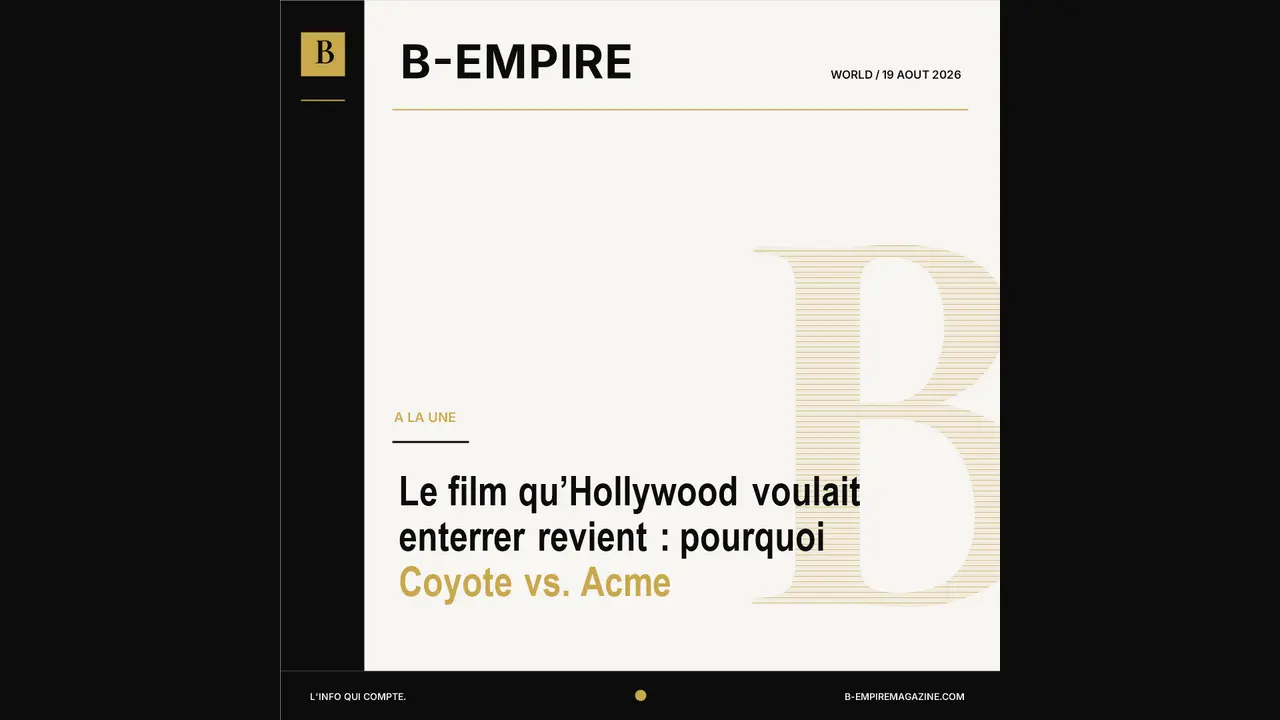
It was supposed to vanish into a vault, become an accounting line and join the list of completed films the public would never see. Yet Coyote vs. Acme will finally arrive in theaters on August 28, 2026. Days before its worldwide release, this comedy mixing live action and animation is no longer just the return of the Looney Tunes: it has become the symbol of an unlikely victory against Hollywood‘s coldest logic.
Directed by Dave Green, the film brings together Will Forte, John Cena and Lana Condor around an idea as absurd as it is obvious: after decades of explosions, falls and defective gadgets, Wile E. Coyote finally sues the Acme corporation. But fiction ended up looking like reality. Completed and then abandoned by Warner Bros., the project was defended by its artists, its crews and an online mobilization before being picked up by independent distributor Ketchup Entertainment.
The Film a Studio No Longer Wanted to Show
The story of Coyote vs. Acme shocked far beyond animation fans. In 2023, Warner Bros. Discovery decided not to release the film even though production had been completed. That decision, tied to a tax write-down logic, turned a family comedy into a case study on studio power: can a film be treated as an asset to be erased, even when hundreds of people have finished it and an audience wants to discover it?
The Associated Press reports that Ketchup Entertainment ultimately acquired the project for around 50 million dollars. The move is spectacular because it reverses the expected script. An independent company takes over a major studio production built around globally known characters and gives it a large theatrical release. Ketchup presents the launch as proof that independent distribution can compete in ambition and cultural impact with legacy players.
A Fan Campaign Turned Into an Economic Argument
The rescue of the film is not only a contract story. It is also tied to public pressure. The hashtag #ReleaseCoyoteVsACME kept the project in the conversation, while crew members and viewers demanded that it be shown. That mobilization did not replace financing or distribution, but it created something financial tables measure poorly: visible demand, a community and a story already charged with emotion.
The marketing campaign has smartly absorbed that conflict. The film is being sold as the one “Acme does not want you to see,” deliberately blurring the line between the fictional lawsuit and the real abandonment. According to Ketchup Entertainment, a trailer reached 25 million views in twenty-four hours. Even if the true test remains theater attendance, that virality proves that the project’s turbulent past has become its best advertising.
Why Coyote vs. Acme Goes Beyond Looney Tunes Nostalgia
The film obviously benefits from the power of the Looney Tunes. Wile E. Coyote, the Road Runner and the Acme universe cross generations and borders without needing long introductions. But today’s interest does not rest only on nostalgia. Early critical reactions describe a work aware of its own history, able to turn the little guy’s fight against a giant company into a comment on the industry that almost deleted it.
That dimension gives the film rare potential. Children can see a physical, colorful comedy; adults can read a satire of corporate responsibility; cinema professionals can see a warning about what happens when a financial decision becomes a cultural scandal. The plot is built on a simple question: who is accountable when a company’s products constantly fail? In the context of its release, a second question appears: who decides that a completed work deserves to exist?
A Global Test for an Independent Distributor
The August 28 release will also be watched as an economic test. Ketchup Entertainment must convert sympathy into tickets sold while competing with groups that have considerable marketing networks. The official site already offers ticketing, while the strategy stresses the event-like nature of the comeback. The family rating and the reported running time of about one hour and forty-one minutes give the film accessible positioning, but online attention never guarantees box-office success.
The risk is real: a highly engaged community can make a phenomenon look larger than it is. But the opportunity is just as real. If Coyote vs. Acme succeeds, it will give producers, creators and distributors a powerful argument for bringing other neglected projects back into circulation. It will also show that a familiar intellectual property can recover value outside the system that had condemned it.
The Signal Hollywood Cannot Ignore
For several years, world cinema has been going through a period of restructuring: platforms, mergers, cost reductions and the search for safe franchises are redefining decisions. In that landscape, the Coyote vs. Acme affair reminds us that the public does not only watch the final product. It also observes how studios treat works, artists and their own heritage.
France and Europe will follow this release with particular interest, because the debate over distributor diversity and the place of theaters is central there. An international success would not solve every tension in the industry, but it would prove that a film can survive a giant’s decision thanks to an alliance between creators, fans and independent capital.
Wile E. Coyote’s destiny has always been to fall, get back up and start again. This time, the metaphor is almost too perfect. The film that carries his name fell from an industrial cliff, refused to disappear and returns to face the public. On August 28, the numbers will say whether this is simply a beautiful rescue or the beginning of a deeper change. But one certainty remains: Hollywood is now watching a project it thought it had buried.