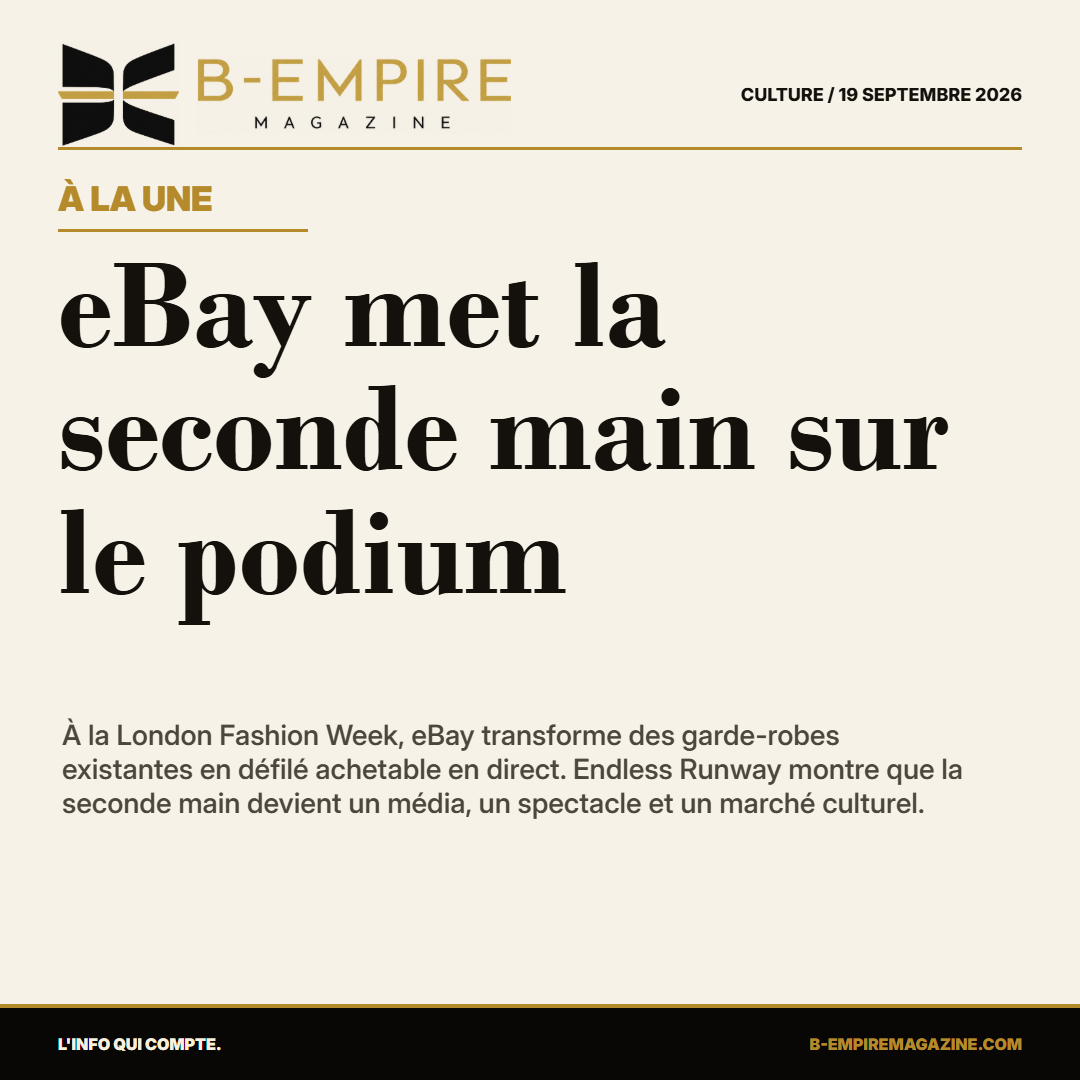
The most desirable garment may not be the one that has just been manufactured. For the third London edition of Endless Runway, eBay gathered pre-loved pieces from the wardrobes and creative worlds of Daisy Edgar-Jones, Sandy Powell, Harry Lambert, Adwoa Aboah and other cultural figures. Every look could be purchased in real time on eBay Live during the show. The idea goes beyond a vintage sale: it turns resale into a cultural event and the runway into a commercial interface.
The existing wardrobe becomes a collection
The 2026 theme, “Forever,” begins with a simple question: what deserves to live forever? Contributors from fashion, film, literature and art selected pieces connected to their personal histories or creative perspectives. eBay’s styling team then assembled them into coherent silhouettes. The result is not based on a collection designed from scratch, but on the ability to reinterpret clothing that already exists in the world.
This shift changes the definition of novelty itself. In the traditional model, the season demands new products and a rapid calendar. Endless Runway proposes editorial novelty: a garment can become current again through a new combination, context or wearer. Creation lies as much in selection and storytelling as it does in manufacturing.
Buying at the moment a look appears
eBay Live connects the emotion of the runway directly to the transaction. Viewers watch a silhouette advance, discover its story and can acquire the pieces without waiting. This synchronization narrows the usual gap between inspiration and purchase. It also gives second-hand commerce a language familiar to entertainment platforms: live video, interaction, scarcity and a sense of occasion.
The scarcity here is real rather than engineered. A pre-owned piece often exists as a single item in a specific size and condition. Once sold, it disappears from the feed. This constraint creates a particular tension that conventional commerce often tries to reproduce with limited editions. eBay already has scarcity within its inventory; the runway gives it staging and editorial authority.
Celebrities as wardrobe curators
The presence of Edgar-Jones or Oscar-winning costume designer Powell does more than attract attention. It turns their taste into a discovery tool. An actor, stylist, filmmaker or writer can explain why a piece deserves to be preserved, passed on or reinterpreted. Celebrity status moves closer to the role of an exhibition curator: the selection supplies context that increases the garment’s symbolic value.
This model is particularly powerful in an economy where consumers want to understand the origin and history of objects. A dress or jacket is no longer reduced to a brand and price. It enters a story made of provenance, memory, references and circulation. That narrative layer can make pre-loved fashion more desirable than new products, especially for an audience accustomed to building identity by mixing eras.
Resale adopts the industry’s codes
Endless Runway’s official place on the London Fashion Week schedule is an important signal. Resale is no longer confined to the calendar’s margins or presented as a moral alternative to creation. It enters the same space as new collections, with production, casting, art direction and global distribution. eBay is asserting that personal archives and worn clothing can generate as much spectacle as newly made garments.
For brands, this development is ambiguous. The secondary market can extend the visibility and value of their creations, reinforce confidence in quality and reach new buyers. It can also divert spending away from new goods. Houses that design durable and recognizable pieces nevertheless have an advantage: the more their products circulate and retain value, the more their cultural capital appears to withstand time.
Circularity must remain measurable
The vocabulary of circularity is not enough to guarantee a positive impact. Resale can extend the life of garments and reduce the need to manufacture some items, but its footprint also depends on shipping, packaging, returns and purchasing behavior. If frictionless transactions merely accelerate wardrobe turnover, the environmental benefit may be less clear.
eBay’s challenge is therefore to combine desire with information. Condition, authenticity, materials, measurements and provenance must be presented accurately. Trust is the invisible infrastructure of the resale market. A runway can create desire within seconds; only a reliable experience can turn a first purchase into a new habit.
A vast inventory made legible by editing
The strength of a platform like eBay is also its difficulty: millions of listings provide immense choice but can discourage users. Endless Runway acts as an editorial layer above that inventory. Contributors select, stylists compose and the live broadcast creates hierarchy. The platform does not merely host supply; it explains why certain pieces deserve attention.
This logic brings the marketplace closer to a fashion publication. It can create appointments, characters and stories around objects that would otherwise be buried in search results. It must nevertheless preserve a path for independent discovery. The charm of second-hand shopping also lies in accident, patience and the personal find, not only in a selection validated by familiar personalities.
Funding the future with clothes from the past
Proceeds from the sale are intended for the Central Saint Martins Fashion Fund, supporting scholarships, facilities and projects. The choice creates an effective symbolic connection: existing clothing funds the next generation of creators. Circularity becomes more than material reuse; it also becomes a circulation of resources and opportunities between those who already have visibility and those building their future.
The gesture does not solve the structural challenges of creative education or the cost of entering the industry. It does, however, show how a commercial operation can include a mechanism for transmission. For eBay and the British Fashion Council, this support reinforces the project’s cultural credibility while giving purchases a clearly identifiable collective consequence.
Fashion’s future may already be in the wardrobe
Endless Runway ultimately defends a contemporary idea of luxury: value does not necessarily come from the date of production, but from quality, rarity, history and the eye that reactivates an object. A wardrobe can function as a living archive, capable of being reissued without new raw material.
By placing pre-loved fashion on an official runway and making it shoppable during the spectacle, eBay brings together three worlds that once evolved separately: runway culture, the resale market and live entertainment. The result does not eliminate new creation, but it forces a useful question upon it. Before manufacturing the next desirable object, have we truly looked at everything that already deserves another life?