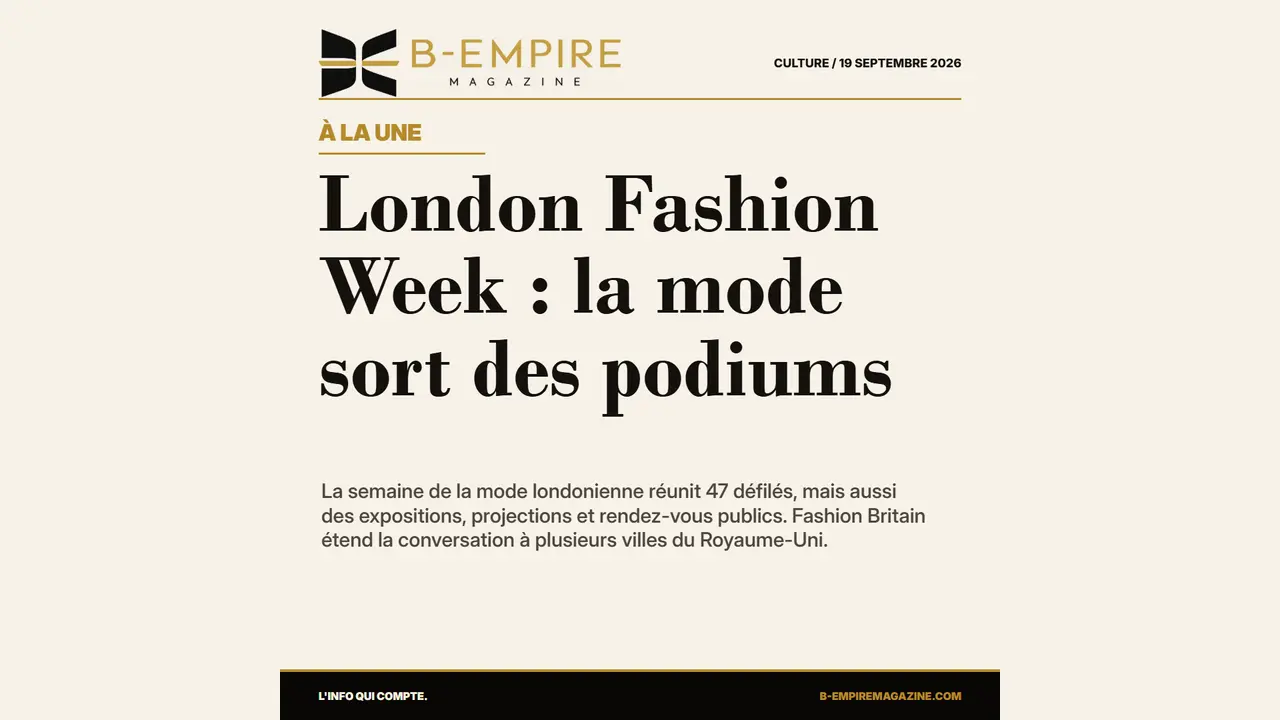
London Fashion Week in September 2026 no longer fits into the single image of an invitation-only runway. Opening on September 17 and running until September 21, it comprises 47 catwalk shows, 23 presentations, 10 digital activations and 53 evening events, according to the British Fashion Council. Around that professional schedule, shop displays, screenings, a jewelry showcase and public meetings offer other ways to encounter fashion. The Fashion Britain program takes the view beyond London altogether. This edition is therefore as much about access to designers as it is about discovering future collections.
The runway is only one format
The show remains the most visible moment: a collection takes shape in motion before buyers and the media. Yet 23 presentations and 10 digital activations suggest other ways of showing work. An installation can give people time to observe details; a screening can build an atmosphere; an online format can reach someone nowhere near the venue. This variety does not prove that each form receives equal attention. It does suggest that a fashion week now looks for several languages in which to tell the story of a collection.
The official program places participants of different sizes side by side. McQueen returns to London with Seán McGirr, Mulberry presents Christopher Kane’s first collection for the house, and Fashion East brings together GOYAGOMA, JACEK GLEBA and MÉ MÉ. New faces in BFC NEWGEN include Francesca Lake, Gui Rosa and Petra Fagerström. Established houses naturally attract attention, but these emerging designers are a reminder that London’s strength also lies in making room for heritage, experimentation and first steps on a professional stage.
Doors open to the public
Several offerings do not require a seat in a show’s front row. The BFC Jewellery Showcase at Dover Street Market displays selected pieces from designers linked to the council and is advertised as open to the public daily from 11 a.m. to 7 p.m. The British Vogue x Nike Café at 180 Strand welcomes visitors on September 19 and 20. A Selfridges edit brings Fashion Week designers into the store. Such initiatives do not dissolve the industry’s hierarchies, but they do provide concrete entry points for people who want to see creative work up close.
eBay is bringing back Endless Runway, a show centered on pre-loved clothes, alongside a livestream and sales on eBay Live. The link between catwalk, resale and transaction is revealing: fashion no longer keeps spectacle and the circulation of garments entirely separate. Viewers can watch and then buy, while previously owned clothing receives a new setting. The operation is still commercial; it would be too much to infer a lasting change in shopping habits from this event alone. It does, however, show the week experimenting with a wider range of formats.
Fashion beyond London
Fashion Britain accompanies this edition with a broader ambition: making creative scenes visible across the United Kingdom. The British Fashion Council names Bristol, Cardiff, Dundee, Edinburgh, Liverpool, London, Manchester and Newcastle among the cities involved. Its August announcement described more than 1,000 September events involving museums, galleries, retailers and designer conversations. That scale does not mean every event has equal weight. It makes a different claim: talent, workshops and audiences are not concentrated in a single capital city.
Examples make the idea concrete. In Dundee, V&A Dundee hosts conversations and an exhibition about the art of the fashion show. In Liverpool, Beyond the Rail celebrates the independent scene; in Newcastle, a Future Heritage program connects students with local partners. Bristol, Manchester and other cities also host panels and experiences mixing fashion with music or photography. These places need not reproduce London Fashion Week in miniature. They can tell the story of design through the people and infrastructure that sustain it every day.
Visibility must become opportunity
The harder test comes after the event. A public showcase may inspire someone to follow a designer; it does not automatically bring orders, production capacity or a viable career in that person’s city. The council presents Fashion Britain as a way to strengthen local creative economies and open career pathways. Measuring that ambition will require looking beyond the number of activities: which relationships between designers and workshops continue, which students find opportunities, and which communities remain involved after the calendar ends?
London itself offers a similar tension. A crowded program connects large houses, young labels, retail platforms and cultural partners. Their coexistence can produce discovery, but it also makes attention scarce: everyone must be seen within a saturated schedule. Forty-seven shows are a sign of activity, not a guarantee of equal visibility. Public and digital formats matter most when they let an individual idea be understood, rather than becoming one more piece of content in the week’s constant stream.
Another way to follow the week
As of September 19, Fashion Week is still underway. It is too early to deliver a verdict on the collections or declare which designers will leave a lasting mark. What can already be seen is a shift in the event’s frame: the runway remains central, but it sits beside open spaces, audiovisual work, resale and a wider British map. The value of that opening will be tested over time. For now, it invites us to see fashion not as one evening of images but as a network of people, cities and professions.