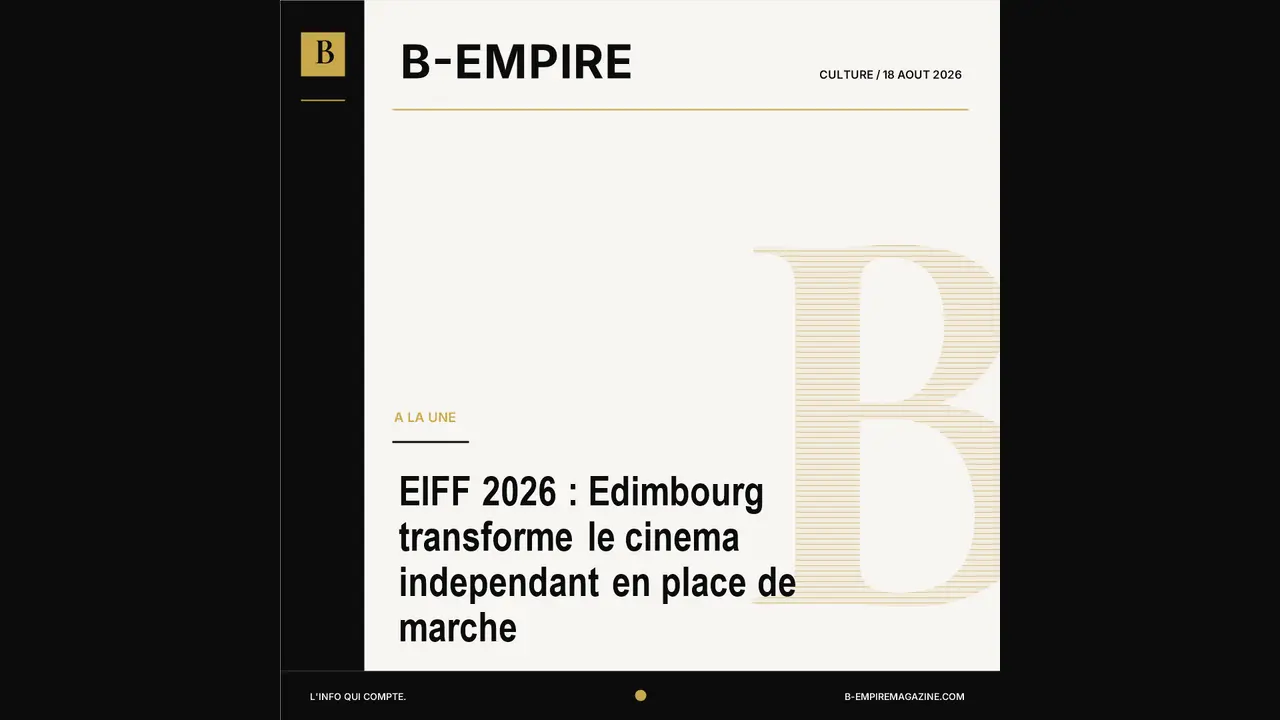
The Edinburgh International Film Festival closes on August 19, 2026, but the most interesting signal arrives before the final credits. This edition, running from August 13 to 19, is not only lining up premieres, retrospectives and conversations with prestigious names. It is positioning Edinburgh as a compact marketplace where independent cinema is trying less to survive than to become investable again.
The signal is clear in the official industry programme. Screen Scotland announced a week of sessions, brunches, meetings and talks at the Festival Hub at Central Hall, with participants including Christine Vachon, Ewan McGregor, Kenneth Branagh, Bruce Dern, Ken Burns, Max Minghella, Sarah Brocklehurst and Marc Turtletaub. This is not merely an intellectual red carpet. It is a way of telling producers, writers, distributors and investors that the conversation around films has to return to the centre of the value chain.
The August 18 schedule condenses that ambition. The day includes a session called Lights, Camera, Capital, staged with Screen Scotland around equity funding and the role of angel investors in film. The choice of subject is revealing. Festivals were long grand artistic showcases, then prestige engines for platforms and studios. Edinburgh is reminding the industry that they can also be places of financial education, where people explain how a project moves from passion into a capital structure.
For B-EMPIRE, this is the important shift. Independent cinema does not only lack ideas; it often lacks legibility for those who could finance it. Producers speak in terms of development, talent, rights, pre-sales and calendars. Investors speak in terms of risk, return horizon, portfolio and proof of traction. Between the two, translators are needed. A festival that puts capital in its official programme is not betraying art. It is recognizing that art needs a more shared economic grammar.
This edition also arrives with a strong cultural narrative. The Guardian describes a moment of renewed health for the Scottish industry, with a significant local presence and fresh attention around the festival’s relaunch. The opening with The Incomer, projects such as Borges and Me, The Education of Jane Cumming and These Violent Delights, plus the symbolic return of Trainspotting for its thirtieth anniversary, give the event a double function: celebrating a memory of cinema and selling a new generation.
The festival’s official listing confirms that density. EIFF presents itself as the home of independent cinema in the United Kingdom, with industry accreditation granting access to press and industry screenings, premieres, conferences, daily meetings and networking spaces. That architecture may sound ordinary. It is not. In a market where platforms buy less automatically, cinemas choose more carefully and distributors demand clearer audience signals, connection itself becomes strategic infrastructure.
Edinburgh also benefits from a rare urban alignment. In August, the city does not host only a film festival. It lives inside a festival economy, with theatre, stand-up, visual art, music, tourism and international media attention. That concentration creates attention many cities try to purchase all year. For cinema, the challenge is to convert that energy into useful meetings: a co-producer, an agent, a broadcaster, a sales partner, an investor who finally understands why a fragile film can become a solid cultural asset.
The Scottish case is especially interesting because it is not trying to imitate London. The British centre of gravity remains powerful, but Edinburgh can sell something else: a more legible scene, a strong territorial identity and an immediate relationship between local talent and international networks. In luxury, one might call that a signature. In cinema, it is a promise of distinction: stories rooted in a place, but capable of travelling.
The programme does not erase the tensions. Independent financing remains difficult, costs are rising, distribution models keep changing, and the prestige of a selection no longer guarantees a robust release. But EIFF 2026’s approach is smart because it refuses pure romanticism. It admits that creation needs material conditions, that talent needs support after the first feature, and that the meeting of private money, public funds and artistic expertise can become a competitive advantage.
The festival’s strength, then, is that it describes cinema as an ecosystem. Conversations with Branagh, McGregor, Vachon or Burns provide aura. Screenings provide discovery. Industry sessions provide the manual. Informal meetings provide the possibility of the fortunate accident, the corridor encounter that becomes a financed project. It is less spectacular than a standing ovation, but sometimes more decisive.
At a time when studios consolidate, platforms calculate and audiences choose with new brutality, Edinburgh restates an obvious truth: independent cinema can no longer rely only on the mystique of the auteur. It must learn to present itself as a complete cultural industry. EIFF 2026 is not only selling films. It is selling a method: bringing talent, capital, city, network and narrative into a format dense enough to provoke decisions.
That is why this week matters beyond Scotland. It shows how a historic festival can become modern again without chasing noise. Modernity here is not an app or a promise of artificial intelligence. It is a table where people speak frankly about creation, intellectual property, money, cinemas, audiences and risk. Independent cinema needs beauty. It also needs an engine room. Edinburgh has just reminded the industry that both can fit inside the same city.