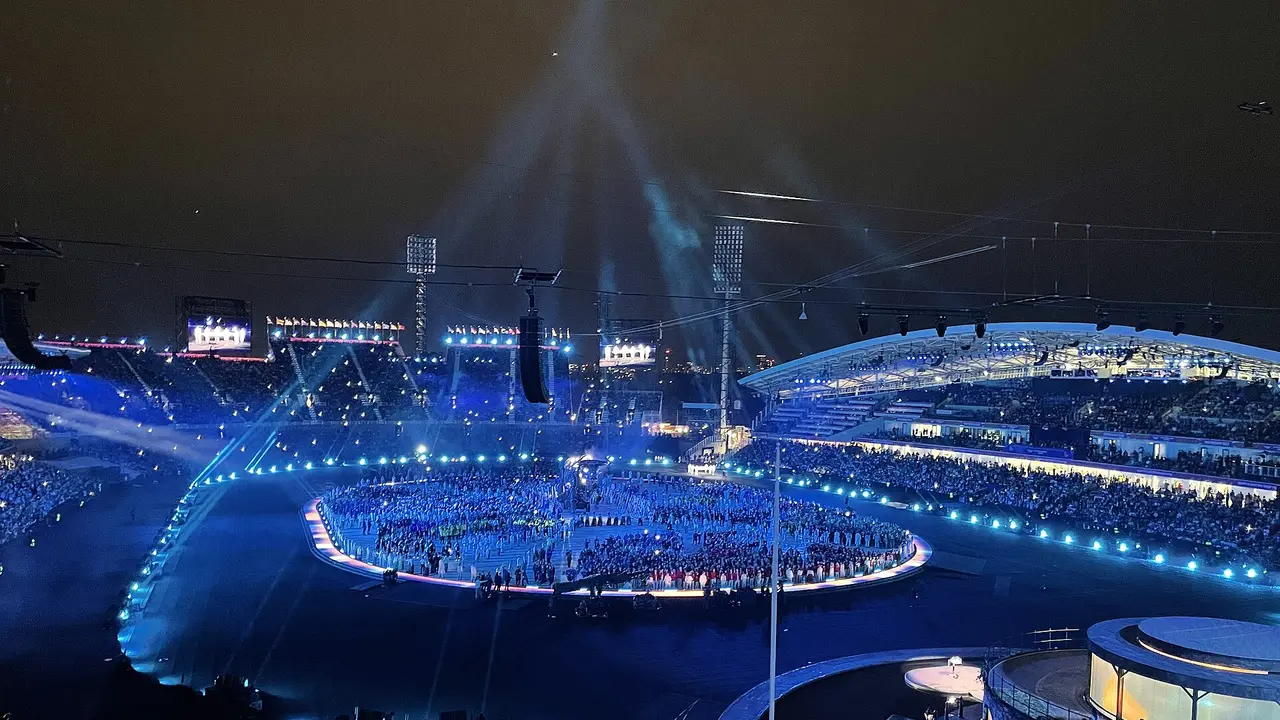
Less than two years ago, their survival was in question. On the night of August 2 to 3, the Commonwealth Games in Glasgow 2026 concluded under the lights of the OVO Hydro, with Simple Minds headlining and a highly symbolic handover to Ahmedabad, India. This finale transcends mere spectacle: it marks the success of a reduced event, built in urgency and observed by all cities that no longer wish to pay the exorbitant price of large competitions.
From July 23 to August 2, Glasgow brought together 74 Commonwealth teams around 215 events in ten sports. The edition also included six integrated parasport disciplines, an architecture that places both able-bodied and Paralympic athletes at the heart of a single narrative. The closing ceremony blended Scottish pop, local identity, and a projection towards Asia, notably featuring the announced participation of Shankar Mahadevan and Rashmika Mandanna for the Indian segment.
A Closing Night That Tells a Story of Rescue
Glasgow 2026 was not an ordinary edition. The Australian state of Victoria, originally chosen, had withdrawn in 2023 due to soaring costs. This defection opened a deep crisis: postponement, cancellation, or a permanent disappearance of the event were all possibilities. Glasgow, already a host city in 2014, ultimately agreed to take on the project with a much more compact format.
The solution relied on existing facilities, seven venues, a streamlined program, and the absence of a traditional athletes’ village. The goal was clear: to eliminate monumental constructions that can sometimes become burdens for decades. The ceremony held indoors at the OVO Hydro, a first in the history of the Games, encapsulated this strategy. Less gigantic, but immediately identifiable and easier to produce.
The British government emphasized that its support focused on operations, security, and contingent guarantees. A significant part of the funding also came from compensation paid after Victoria’s withdrawal. This financial detail matters: Glasgow did not simply improvise a sporting celebration; it tested a rescue method that could inspire other competitions weakened by inflation.
215 Finals and a Record Place for Parasport
The choice of ten sports caused frustrations. Badminton, hockey, rugby sevens, cricket, squash, and triathlon were not included in the program. However, the concentration also made the narrative clearer: athletics, swimming, track cycling, boxing, judo, artistic gymnastics, netball, weightlifting, bowls, and 3×3 basketball occupied most of the media space.
One of the strongest markers remains parasport. With 47 finals in six disciplines according to organizational data, Glasgow offered the most extensive parasport program in the history of the Commonwealth Games. Wheelchair basketball 3×3, para-athletics, para-swimming, para-track cycling, para-bowls, and para-powerlifting were integrated into the general schedule rather than relegated to a separate event.
This integration gives the event a distinctive advantage in a saturated sports market. The Commonwealth Games cannot compete with the Olympics in size. However, they can differentiate themselves through accessibility, proximity to the public, and representation of territories rarely visible in major global events. Gabon and Togo participated for the first time after their entry into the Commonwealth.
Ahmedabad 2030: The Handover That Changes the Scale
The closing ceremony primarily turned eyes towards Ahmedabad, also known as Amdavad, designated to host the centenary edition in 2030. The transition from Scotland to India transforms the perspective. Glasgow’s mission was to keep the Games alive; Ahmedabad will need to demonstrate that they can grow again without falling back into a spending race.
India represents a vast sports market, a demographic, media, and commercial powerhouse capable of attracting broadcasters and sponsors. It also harbors the ambition to host more major international competitions. The Indian segment of the ceremony, embodied by high-profile artists, was thus a declaration of cultural power as much as a ceremonial ritual.
The challenge will be to retain the Scottish lessons. A more spectacular edition should not mean an uncontrollable addition. The most credible model combines useful infrastructure, a program tailored to the host country, global digital broadcasting, and measurable legacies for the residents. Glasgow proved that a reduced format could evoke emotion; Ahmedabad will need to prove that expansion can remain responsible.
What France and Europe Can Learn
France is not a member of the Commonwealth and does not participate in these Games. However, it has every reason to observe the experience. After Paris 2024 and with new major European events on the horizon, the question of sobriety becomes central: how to maintain enthusiasm, imagery, and economic impact without building unnecessary facilities or transferring risks to taxpayers?
Glasgow offers an imperfect but concrete answer. The city reused its arenas and velodromes, concentrated competitions, and embraced less monumental ceremonies. This strategy is particularly suitable for European metropolises already equipped with infrastructure. It also paves the way for shared or regional bids, where the event adapts to the territory rather than the other way around.
The French reach is also audiovisual. In Europe, the competition was offered via Eurosport and HBO Max, a sign that intermediate multisport events are migrating towards paid and digital offerings. Their future will depend on their ability to produce strong narratives beyond historical markets: emerging stars, Paralympic performances, national rivalries, and local cultures.
A Saved Model, But Still Under Pressure
The organizational success does not resolve all issues. The reduction of the program excludes athletes, limits certain federations, and may weaken sporting universality. Dependence on private partners and broadcasting rights also creates a fragile balance. Finally, the Commonwealth remains traversed by debates about its colonial legacy and contemporary political relevance.
However, the 2026 edition avoided the most severe scenario: a cancellation that could have shattered the continuity of an almost century-old event. The closing ceremony thus did not merely celebrate medals. It validated the idea that a major competition can accept becoming smaller to survive, and then pass on a renewed platform to another region of the world.
When the last notes of Simple Minds echoed in the OVO Hydro, Glasgow did not offer a demonstration of gigantism. It delivered something perhaps more valuable: proof that a threatened global event can quickly reinvent itself, preserve its emotion, and prepare for its future. The next response will come from Ahmedabad in 2030.
Sources
- Glasgow 2026, official results and data.
- UK Government, public support and format of the Games, July 20, 2026.
- Associated Press, opening and international participation, July 23, 2026.
- Official Glasgow 2026 Website, program, ceremonies, and handover to Ahmedabad.