


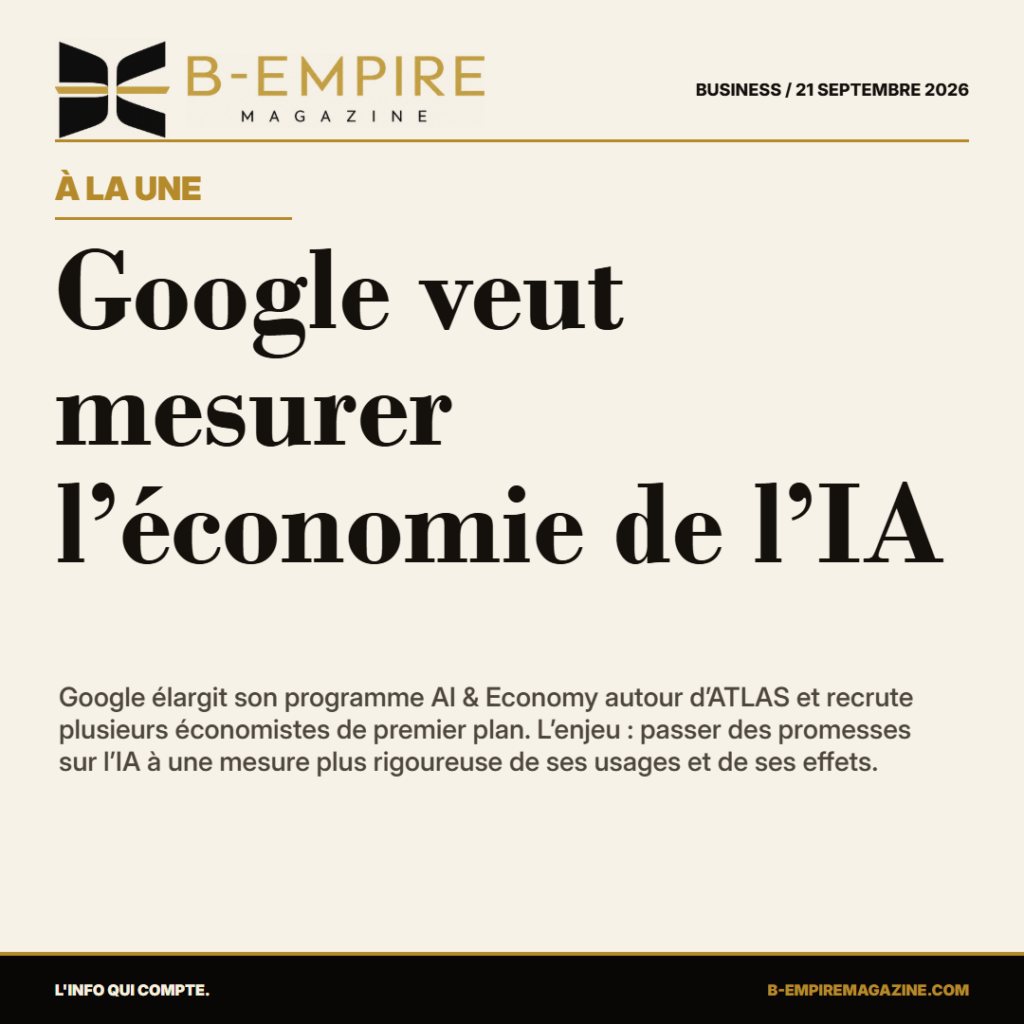
Is artificial intelligence already transforming the economy, or is it mainly transforming how companies describe the future? Google wants to provide a more evidence-based answer. The company is expanding its AI & Economy programme by bringing in prominent researchers, including Nobel economics laureate Philippe Aghion and Professor Ajay Agrawal, a specialist in the economic effects of AI.
The announcement builds on ATLAS, the Activity, Task, Landscape and Adoption Study, created to observe how Google’s AI tools are actually being used. Its stated purpose goes beyond tracking adoption. The programme aims to study work, productivity, growth, global technology diffusion and AI’s contribution to scientific discovery.
Fourteen million exchanges as economic material
The first ATLAS release is based on 14,653,926 de-identified interactions recorded between April 6 and April 19, 2026 across the Gemini app, Google AI Mode and the Gemini API. An automated pipeline separates work-related uses from daily-life activity. The exchanges are then clustered and mapped onto occupational and activity taxonomies.
That scale offers economists a view they rarely possess. Traditional surveys ask people to remember their behaviour, whereas usage data record what occurs inside the tool. ATLAS can identify tasks, industries, languages or geographies in which AI appears and follow their development faster than many official statistics can.
The first report found that more than 86% of observed interactions took place outside work. In professional contexts, AI often supported research, drafting, learning, iteration or troubleshooting rather than operating as an autonomous system performing an entire occupation. That finding adds nuance to scenarios in which automation immediately replaces whole jobs.
A research bench suited to a political debate
By expanding the team, Google is trying to turn ATLAS from a descriptive snapshot into a durable economic research programme. Philippe Aghion brings his work on innovation and growth; Ajay Agrawal has long examined AI as a reduction in the cost of prediction. Other profiles associated with the initiative cover public policy, business transformation and labour economics.
The choice of disciplines is strategic. Decision-makers want to know whether AI raises productivity, changes income distribution, accelerates research or weakens particular professions. Yet these effects do not advance at the same speed. A company can buy tools without changing its organisation. A worker can save time on one task without producing more over a full year. An industry can adopt AI quickly while concentrating the gains among only a few participants.
Measuring use is therefore not enough. Behaviour must be connected to outcomes: time saved, work quality, wages, jobs created or lost, investment, prices and the distribution of gains across places. The new programme will be judged precisely on its ability to bridge the gap between digital activity and economic consequence.
Platform data come with a built-in blind spot
ATLAS has a structural limitation: Google is studying the economy through the use of its own products. The sample does not represent all AI, every business or people who use none of these services. Professional tools such as Gemini Enterprise and Google Workspace are not captured in the same way in the initial dataset, potentially excluding a significant share of organised workplace use.
The collection period is also brief: two weeks in April. It provides an unusually detailed snapshot, but one that may be sensitive to product releases, work calendars and temporary habits. Automated classification adds another layer of interpretation. Google describes privacy protections, removal of identifying information and techniques intended to reduce certain model biases, but a category assigned by a classifier remains an estimate.
Those cautions do not make the project useless. They simply establish the correct reading: ATLAS is a massive proprietary observatory, not a neutral census of the world economy. Its credibility will depend on methodological transparency, opportunities for outside researchers to test its conclusions and comparison with other public and private sources.
The contest over indicators begins
Google is not alone in building an evidence economy around AI. Other laboratories publish their own usage indices, scenarios and studies of work. This competition may improve methodology, but it also creates a risk: each company may select the indicator that best supports its products, investments or strategic narrative.
For businesses, the useful message is less dramatic. Before deploying a tool widely, they should measure the tasks affected, verification time, errors, final quality, redistribution of work and new skills required. Governments should complement platform data with independent surveys, labour statistics and particular attention to groups that are less visible in digital traces.
Google’s expanded programme therefore marks an important step: the debate is moving from impressive demonstrations towards the measurement of real use. Yet the central question remains open. AI can appear in millions of conversations without automatically producing broadly shared growth. Measuring more is essential; understanding what is being measured matters even more.