Shopping may soon look more like a conversation than a sequence of product pages. On September 16, 2026, Google introduced several updates for retailers ahead of the holiday season: visibility measures for its AI experiences, an assistant embedded in certain YouTube ads and changes to checkout built on its Universal Commerce Protocol. The story is appealing to brands, but it is important to distinguish three things: what is already accessible, what is a limited beta and what still has to roll out.
Visibility becomes a new metric
Google says AI performance insights in Merchant Center are now generally available to businesses in Australia, Canada, India, New Zealand and the United States. The tool is meant to show how brands and products are discovered in AI Mode and AI Overviews, including comparisons of their share of voice with competing brands. That marks a meaningful shift: a merchant no longer wants to know only whether an ad was clicked. The question is also whether a product enters the answer that an interface assembles for a potential customer.
Such a measure may help a retailer identify weak presence in conversational experiences. On its own, however, it cannot explain why a shopper selected a product or whether a brand mention generated an additional sale. Visibility can be the beginning of a journey rather than its outcome. For a small business, the challenge will be reading these figures without feeling compelled to appear in every possible answer. A large retailer will need to connect them with conversion data and the actual quality of what it offers.
A YouTube ad that answers questions
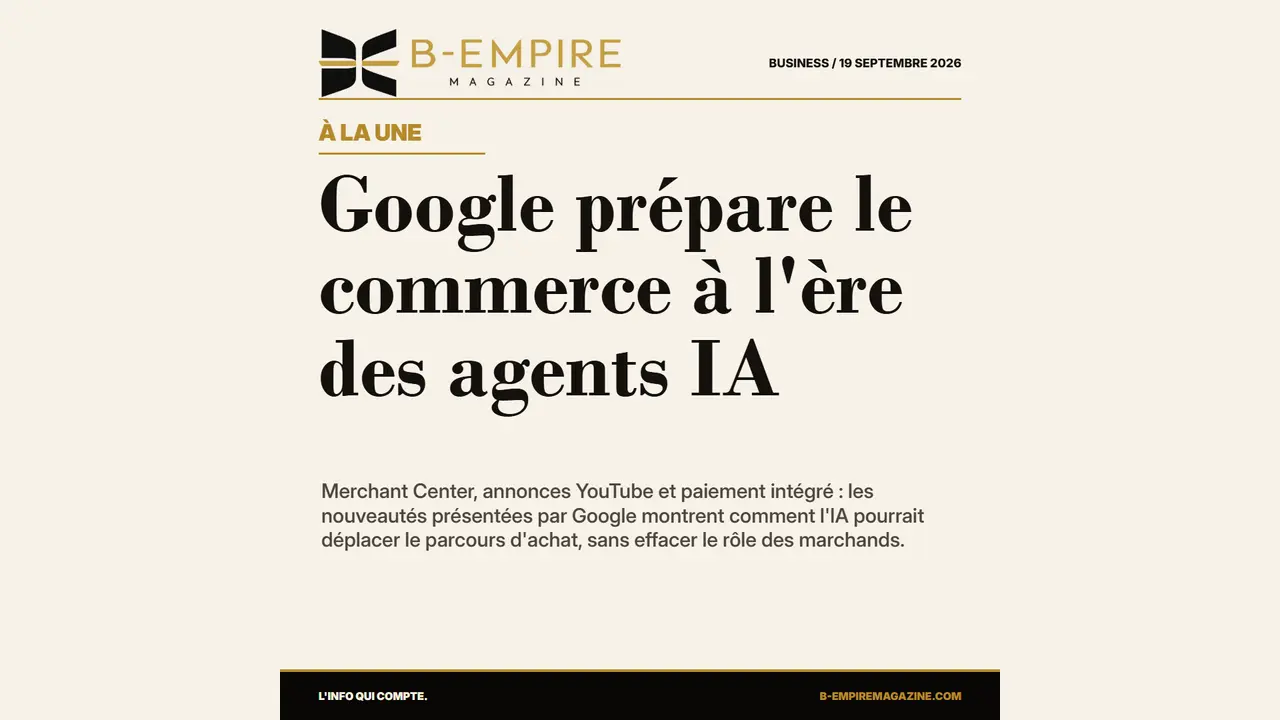
The most visible consumer-facing idea is Google’s proposed extension of Business Agent to YouTube advertising. The company is inviting eligible retailers into a United States beta. A viewer could ask detailed questions about a product within the ad experience and receive tailored guidance without leaving the video. Google previously introduced Business Agent in Search; YouTube would become another point of contact in the same effort to make commercial discovery conversational rather than a one-way message.
A smoother demonstration should not hide the practical questions. Helpful answers rely on accurate product data, current prices and understandable delivery terms. If the agent speaks confidently from an incomplete listing, the promised convenience could quickly become frustration. The merchant will also need to know which questions remain unanswered and when a human should take over. A beta is not proof of performance at scale. It is a test of a new place where a purchase decision might begin to take shape.
Checkout moves closer to discovery
Google also describes improvements to the Universal Commerce Protocol, or UCP, integration hub inside Merchant Center. Merchants using UCP-powered checkout can enable features including cart transfer to their own websites and more extensive checkout testing. Analytics capabilities are promised for a later date. According to Google, the new options are gradually rolling out in the United States, with Australia and Canada expected to follow early next year. Presenting them as available everywhere today would overstate the announcement.
Cart transfer deserves attention because it touches the balance of control between platform and retailer. Shortening the distance between discovery and checkout may reduce friction, yet brands also value a direct customer relationship, service standards and their own identity. A path back to their website can preserve part of that experience. The balance will depend on how integrations work in practice and what choices merchants retain. Google points to Tapestry, owner of Coach and Kate Spade, as an example of a retailer using UCP-powered checkout on Google surfaces, including Search and the Gemini app.
Product data remains the basic work
Despite the language of agents, the announcement keeps returning to something concrete: the product feed. Google recommends keeping prices, availability and descriptions accurate, then adding conversational attributes that provide richer product context. Video links can supply more visual, shoppable formats. Loyalty data can bring member benefits and prices into view. None of this is especially theatrical, but a commercial assistant cannot be better than the information it receives. A beautiful interface does little good if it describes the wrong size, color or delivery promise.
Google offers two figures that require context. According to the company, merchants adopting core Merchant Center best practices see an average 5% increase in conversions the following month. In a test with lululemon, conversational attributes supplied by the brand appeared in 50% of relevant AI Mode product recommendations. These are company-reported results, not a promise for every store. The second number measures the inclusion of product information in recommendations; it does not measure an increase in sales.
A new kind of distribution power
The announcements connect three stages often tracked separately: being discovered, answering doubts and completing a transaction. For brands, the prospect is a smoother journey. For Google, it strengthens the role of its interfaces at moments increasingly close to the purchase. That concentration may be efficient, but it also makes the rules of visibility, the data used and the measurement of results more important. The question is not simply whether AI can help sell products. It is under what conditions sellers maintain control over how their products are presented.
As the holidays approach, retailers should see these updates as tools to test rather than a transformation already completed. The insights cover five countries, the YouTube agent remains a US beta and several checkout functions are arriving in stages. The most immediate action is less futuristic: check listings, stock levels and promises made to customers. If conversation becomes a new storefront, trust will still be earned through the accuracy of what appears on screen and the quality of what arrives after the purchase.