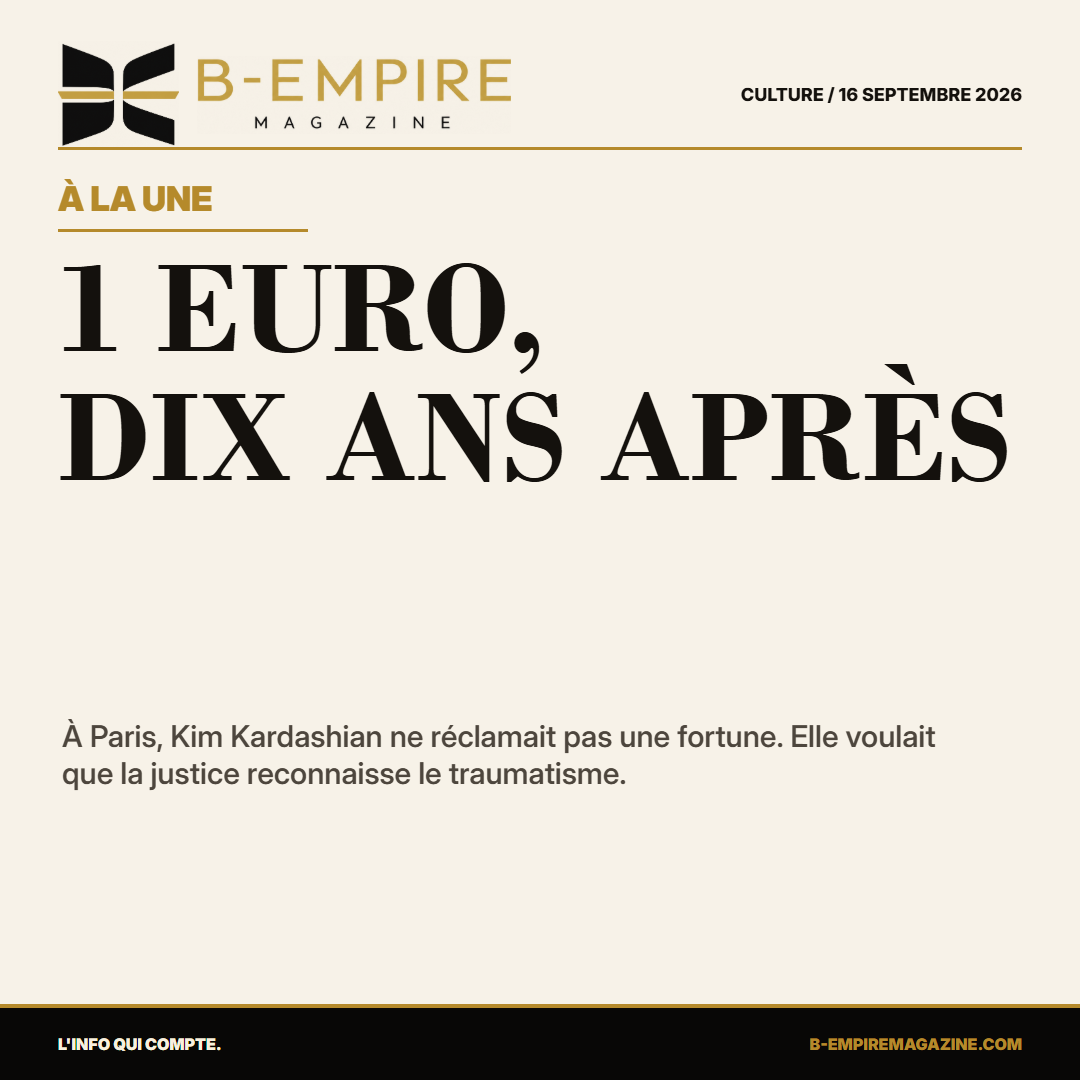
Just one euro, but a judgment worth far more. On September 15, 2026, a Paris court awarded Kim Kardashian the symbolic sum she requested after the armed robbery she endured in the French capital in 2016. Ten years after a night that made headlines around the world, the decision is not a story about money. It is an official recognition of lasting trauma behind the image of a celebrity whose wealth might otherwise obscure her vulnerability.
Associated Press and Reuters reported that Kardashian herself asked for one euro in damages. The men involved in the attack tied her up and held her at gunpoint in her Paris residence before escaping with jewelry, including an engagement ring valued at $4 million. At the time, the heist was described as the largest robbery of an individual in France in more than two decades.
Why Ask for Only One Euro?
The sum may look trivial beside the value of the jewelry and the fame of the victim. That is precisely what gives it power. A symbolic claim can show that the priority is not enrichment but public recognition of harm. Kardashian was not asking the court to price her fear like a diamond. She was asking it to affirm that the crime caused human damage that wealth, insurance and time could not erase.
In a joint statement shared with AP, Kardashian and her stylist Simone Harouche emphasized accountability, recognition and the chance to continue healing. That language shifts the center of the story. Since 2016, the case has often been told as spectacle involving luxury, social media, Fashion Week and a group of aging robbers. The verdict returns attention to the victims.
The Night the Public Image Broke
During the night of October 2 to 3, 2016, Kardashian was in Paris for Fashion Week. Men posing as police officers entered the residence where she was staying, restrained her and stole jewelry worth millions of dollars. The case immediately became more than a crime story. It exposed the risks faced by a celebrity whose movements, possessions and habits were visible in real time to hundreds of millions of people.
The robbery also changed the way Kardashian managed her public image. She spoke about believing she would die and about the impact on her family. Her testimony before the French court in 2025 showed that an extremely famous person can lose all control over the story of her own life in a matter of minutes. Fame makes an event global; it does not reduce terror or its consequences.
Forgiveness Does Not Erase Trauma
At the trial, Kardashian said she forgave Aomar Aït Khedache, described as the mastermind of the robbery. Reuters noted that she also made clear that forgiveness did not remove what she had experienced. The distinction matters. Forgiveness is an intimate choice; recognition of responsibility belongs to justice. The two can coexist without becoming the same thing.
In 2025, eight people were found guilty of roles connected to the heist. The sentences, shaped by the passage of time, the age and health of several defendants, prompted mixed reactions. The 2026 civil decision offers a different form of closure. It does not retry the criminal case. It records that the victims suffered harm and that the harm deserves an answer.
Paris, Luxury and the Security Question
The case remains tied to Paris because it touches one of the capital’s symbolic engines: luxury. Fashion Week attracts brands, fortunes, influencers, photographers and a worldwide audience. That visibility creates value, but it also creates a map of risk. Rare objects become content, private places become identifiable and signs of wealth circulate before security teams can adapt.
Since the robbery, luxury businesses and public figures have strengthened their protocols through delayed posting, tighter security, limited geolocation and greater discretion around valuable pieces. The Kardashian case became a global lesson about the boundary between digital exposure and physical safety. It showed that the attention economy does not stop at the screen.
A Tiny Judgment in an Enormous Story
The symbolic euro works because it reverses the normal scale of celebrity. Almost everything around Kardashian is measured in millions: followers, deals, audiences, jewelry, companies and valuations. Here, the smallest number becomes the most important. It says that justice was not asked to determine the price of a star, but to recognize the voice of a victim.
The decision also speaks to victims whose suffering is sometimes judged against their wealth, status or media exposure. Having more does not make a person invulnerable. Fame does not turn an attack into an episode of reality television. Asking for little does not mean the damage was small.
The Signal Paris Sends to the World
The judgment will not return the missing jewelry, erase the fear or remove ten years of legal proceedings. But it closes a loop with unusual clarity. French justice granted exactly what was requested: not a fortune, but an official symbol of responsibility.
One euro may seem like almost nothing. In this case it represents the essential point: trauma is not measured by the victim’s wealth or the value of the stolen goods. After the noise of the heist, the trial and the cameras, the conclusion fits in a coin. That is exactly why it resonates so loudly.