Luxury rarely enters a crisis under bright lights. It prefers quiet storefronts, carefully phrased results and words selected like precious materials. Yet the signal surrounding LVMH this week feels like a change in temperature that the entire industry can sense. According to the Financial Times, the group that embodied the post-pandemic boom has seen its market value fall back toward 213 billion euros, far from the peak that made it one of the most powerful listed symbols on the continent. This is not only a story about a weaker share price. It is the mirror of a larger question: what is a house of desire worth when part of its public no longer feels invited?
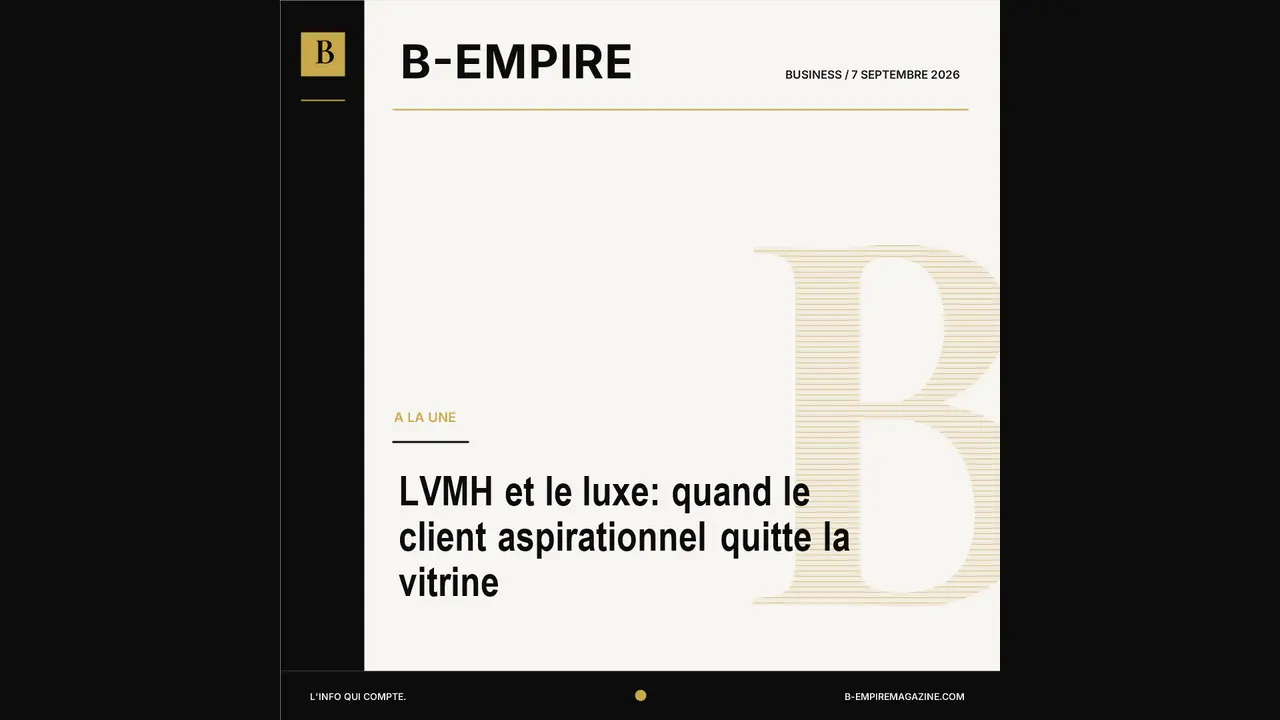
Since 2019, many luxury brands have lifted prices dramatically. The bet was clear: sell fewer objects at higher prices, protect scarcity, move closer to true high-end clients and rely less on shoppers exposed to economic cycles. For a while, the strategy looked brilliant. Profits expanded, queues outside boutiques told a story of cultural power, and iconic bags became emotional assets as much as accessories. But the model is now revealing its blind spot. When the aspirational customer leaves the room, that customer does not remove revenue alone. They also take away some of the noise, the social circulation and the collective dream that made the brand live beyond the circle of the ultra-wealthy.
The Quiet Exit Of The Aspirational Customer
The most striking point in the figures cited by business media is the erosion of the middle public. Bain estimates that tens of millions of consumers have left the luxury market since the recent peak. These are not necessarily buyers lost forever. They are often customers who still watch shows, follow campaigns, love fragrances, sunglasses, shoes or smaller leather goods, but no longer cross the financial threshold imposed by some houses. The nuance matters. Desire has not disappeared; the permission to buy has narrowed.
This aspirational public has long played an outsized role in the mythology of the sector. It bought less often than top clients, but it gave brands cultural density. It turned a launch into a conversation, a bag into a visible sign, a boutique into a necessary stop during travel. When that public steps away, brands may gain margin per item, but they risk losing presence. Luxury does not live on scarcity alone. It also lives on the feeling that scarcity deserves to be watched, discussed and desired by people who cannot always reach it.
China Is Changing The Language
China makes this shift even more visible. Reuters has observed that prestige beauty is gaining ground while high-end bags move with less certainty. This is not a simple cosmetic trade-off. It describes a luxury economy in which the buyer still wants excellence, ritual and discreet status, but in a category whose price remains psychologically easier to accept. A cream, a fragrance or an exceptional skincare product can offer daily access to refinement without demanding the same effort as a bag whose price has often risen much faster than wages or household confidence.
This evolution is dangerous for houses whose growth relies heavily on leather goods. It does not mean the iconic bag is dead, but it forces brands to rethink its role. The object can no longer be merely expensive, recognizable and rare. It must recover an obvious sense of quality, service, craft and storytelling. In a world where consumers compare more, resell more easily and gather information faster, aura is no longer enough. The house must prove that the price carries a story, not only a margin strategy.
Hermes And Richemont Show Another Discipline
The contrast with Hermes and Richemont explains why investors are reading the sector house by house. The Financial Times notes that companies focused on very high-end customers or jewelry have held up better. Jewelry has a particular advantage: it speaks of transmission, material, preserved value and rare gestures. It absorbs the price argument better because it can be read as heritage as much as adornment. Richemont, supported by Cartier and Van Cleef and Arpels, benefits from that stronger grammar at a time when some handbags appear to suffer from the fatigue of the over-raised accessory.
Hermes, meanwhile, remains protected by a discipline almost opposite to the current culture of acceleration. The house sells waiting, permanence and craft more than permanent novelty. That does not make it invulnerable, but it gives it rare coherence when the market questions the real value of products. The lesson is not that every brand should become Hermes. It is simpler: when the cycle turns, consumers sharply distinguish prices justified by a culture from prices justified by a habit of growth.
Luxury Has To Speak About Meaning Again
Bain stresses a point the sector can no longer treat as a slogan: experience and meaning are becoming more important than pure possession. Rare trips, dinners, places, personalized services and cultural moments are gaining weight. The client is not asking only for a logo; the client is asking for proof of attention. That demand changes the competition. A house no longer competes only with another house, but with a hotel, a concert, a wellness retreat, a gallery, a chef or a platform capable of producing a memory stronger than a purchase.
For LVMH, the challenge is immense because the group has become both laboratory and barometer for global luxury. Louis Vuitton, Dior, Tiffany, Bulgari, Sephora and the other brands in the portfolio do not all tell the same story, but they face the same question: how can prestige be maintained without turning the dream into a wall? The answer will probably not come from broad price cuts. It will come from a more precise architecture, where some products remain exceptional, where entry into the brand becomes sincere again, and where the client relationship is not reduced to a staged transaction.
Luxury has always worked through a tension between distance and desire. Too close, it loses magic. Too far, it becomes indifferent. The current phase shows that many houses pushed distance faster than desire. They assumed aspiration would automatically follow rising prices. But aspiration needs narrative, shared beauty and a form of symbolic generosity. Without that, the customer does not always rebel. The customer simply moves on.
What This Crisis Announces
For B-EMPIRE, the LVMH moment is less a collapse than a warning. Luxury is not falling apart; it is entering a period of sorting. Houses with real cultural depth, readable craft and durable relationships with their publics can emerge stronger. Those that confused elevation with exclusion will have to rebuild trust. The next growth phase will not be financial alone. It will be narrative, service-led, sensory and social. It will depend on the ability to make the client feel that they are not buying a price, but a place inside a story that still deserves to continue.
Sources
- Financial Times – LVMH sheds boom-time gains as luxury feelgood factor fades
- Reuters via MarketScreener – European luxury stocks slide as investors remain cautious
- Reuters via Investing.com – Prestige beauty outpaces high-end bags in China
- Bain and Altagamma – 2026 global luxury market spring update
- Fast Company – Luxury’s real crisis is desirability