


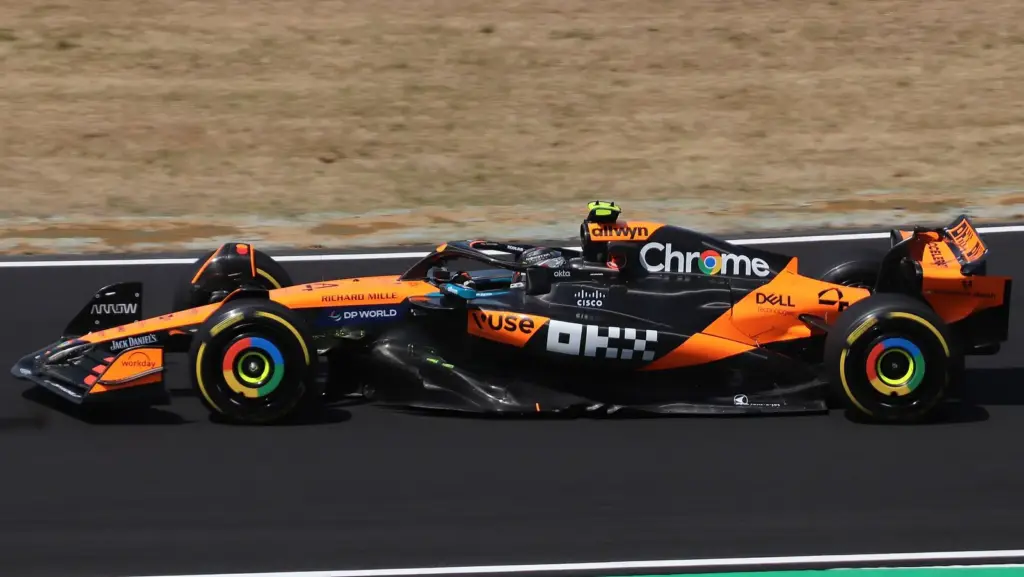
Interlagos has once again transformed Formula 1 into an open-air theater. Under intense rain, after long interruptions and two red flags, Lando Norris secured pole position for the 2026 São Paulo Grand Prix with a time of 1 minute 27.470 seconds. The McLaren driver outpaced George Russell by 204 thousandths and Kimi Antonelli by 625 thousandths. However, the raw standings tell only part of the story: penalties imposed on several favorites will reshape the grid and offer a race where every strategic choice could become decisive.
Norris’s pole was no accident. The Briton timed his lap perfectly, taking advantage of the moment when the track still allowed for aggressive driving on intermediate tires, just before the rain intensified and nearly closed the performance window. On a Saturday where visibility, grip, and weather conditions changed by the minute, he did what great occasions demand: go fast without making the mistake that ruins everything.
A Qualifying Session Turned Survival Test
The session began on a waterlogged circuit. Less than three minutes after the start of Q1, race control displayed the red flag, as conditions had become too dangerous. The FIA reported that drivers had already indicated soaked suits during their first outings. After a long wait, all 22 cars returned to the track on wet tires, amidst a cloud of spray that severely reduced visibility.
Times then began to drop as drivers discovered a more drivable line. Fernando Alonso, Max Verstappen, Nico Hülkenberg, Lewis Hamilton, George Russell, and Oliver Bearman each showcased their speed in turn. However, the hierarchy remained fragile: another downpour, a flag, or a single misstep off the dry line could overturn everything. Gabriel Bortoleto hit the wall in Q1, a harsh reminder of the price of error on this track.
Norris’s Lap at the Right Moment
In Q3, teams knew that the first laps could be the only truly exploitable ones. Alonso launched quickly, followed by Liam Lawson, who set an ambitious benchmark. Norris and Russell then took control. The McLaren driver stopped the clock at 1 minute 27.470 seconds, 0.204 seconds ahead of the Mercedes. When the rain intensified again, no further improvements were realistic.
This achievement is also a personal milestone. McLaren indicates that this is Norris’s 20th career pole position and his third consecutive in São Paulo. The British team thus secures its fourth pole of the season. The number matters, but the manner matters even more: Norris mastered a session stretched over nearly three hours, with a track that punished the slightest hesitation.
A Shaken Grid Before the Start
George Russell clocked the second-fastest time, but a five-place penalty will push him back. Charles Leclerc, who qualified fourth, will lose ten positions. Lewis Hamilton, Max Verstappen, and Sergio Pérez must start from the back of the grid due to penalties announced before the session. This cascade transforms Sunday’s scenario: some mid-field drivers will gain positions, while several champions will have to navigate through the pack.
Kimi Antonelli, third in qualifying, finds himself in an excellent position. Liam Lawson achieved a remarkable fifth-fastest time, ahead of Nico Hülkenberg and Frenchman Isack Hadjar. Oliver Bearman, Fernando Alonso, and Alexander Albon complete the top ten in qualifying. Once the penalties are applied, their effective placement could open a rare opportunity for a result far exceeding the usual hierarchy.
Piastri Trapped, Verstappen Condemned to Climb
The day was much more challenging for Oscar Piastri. The second McLaren driver only managed to secure 12th place after being denied an improvement due to the red flag caused by Rafael Câmara’s accident in Q2. Thanks to the penalties ahead of him, McLaren estimates he should gain a few positions on the grid, but his Sunday will start far from Norris.
Max Verstappen did not set a time in Q2 and was only 16th in the official session standings. His penalty places him at the back of the pack regardless. However, Interlagos has overtaking zones and weather capable of multiplying neutralizations. The Dutchman’s climb will be one of the great narratives of the race, especially if conditions remain changeable.
Why This Pole Could Change Everything for McLaren
Starting at the front in Interlagos never guarantees a victory. The first corner immediately tightens the pack, the climb to the straight demands traction, and weather variations can force a pit stop at the worst moment. Nevertheless, pole gives Norris a crucial strategic advantage: he can control the initial pace, avoid the spray from the cars ahead, and dictate the first cycle of stops if the track evolves.
McLaren also brought technical upgrades to Brazil. Team principal Andrea Stella believes they have delivered the expected gains during practice, while refusing to suddenly present their car as the fastest on the grid. This caution is telling: Saturday’s result stems as much from driving and reading conditions as from pure performance.
The Weather Trap Remains Open
The race is set to start on Sunday at 2 PM local time. The weather factor will remain under scrutiny until the last moment. A wet track at the start would favor Norris due to the clear air but would also increase the risk of safety cars, red flags, and improvised decisions. A dry track, on the other hand, would allow penalized cars to bet more on their race pace to climb back up.
Teams will need to avoid preparing too rigid a strategy. At Interlagos, rain can hit one sector before others. Fitting wet tires a lap too early costs time; waiting a lap too long can lead to losing control of the car. The narrow gaps between Norris, Russell, and Antonelli show that a single detail could shift the victory.
The Signal That No One Can Ignore
This pole is more than just a beautiful lap in the rain. It places Norris at the center of a Grand Prix already charged with tension, with a teammate pushed into the pack, rivals penalized, and an unusual grid. The McLaren driver seized the most challenging moment of the weekend. Now, he must convert this mastery into victory.
For spectators, all the ingredients are in place: a historic circuit, unpredictable weather, favorites forced to attack, and outsiders propelled forward. Under the deluge of Interlagos, Norris won the first act. The second could be even more spectacular.
Sources
- Formula 1, official report on the qualifications for the São Paulo Grand Prix, November 7, 2026.
- FIA, official classification and proceedings of the qualifications, November 7, 2026.
- McLaren Racing, team report and technical summary, November 7, 2026.