George Lucas built one of the most profitable imaginaries in modern history. On September 22, 2026, he will attempt something else: giving popular art a building, an institution, and legitimacy. The Lucas Museum of Narrative Art will finally open its doors in Los Angeles, in Exposition Park, after years of delays, debates, and construction. The official September 2 announcement turns this long-awaited project into an immediate cultural event. This is not only a museum for Star Wars fans. It is a manifesto about the way images tell the world.
The distinction is essential. In the public imagination, Lucas remains associated with lightsabers, spaceships, droids, and the commercial power of Lucasfilm. But the museum he co-founded with Mellody Hobson advances a broader ambition: to place illustration, comics, cinema, posters, book covers, and narrative visual art inside the same space of respect as more established museum forms. In other words, it brings images already known by millions into an architecture of prestige.
A Symbolic Billion for the Art of Storytelling
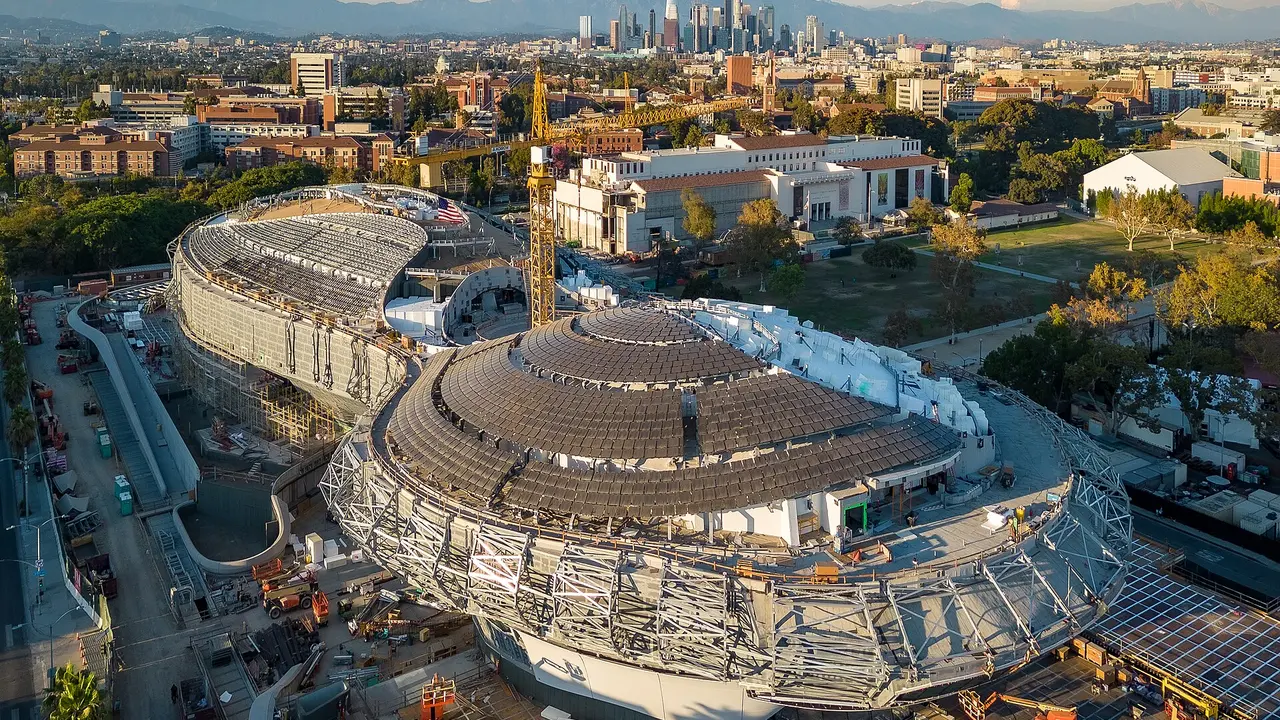
According to the Associated Press, the new museum is not a heritage extension of Star Wars. The saga has a place in the inaugural exhibition, but it represents only a fraction of the whole. The building designed by Ma Yansong of MAD Architects contains around 100,000 square feet of galleries inside a 300,000-square-foot structure. Museum releases describe more than thirty galleries, a free research library, continuous film screenings, a restaurant, and a 13-acre landscaped park by Studio-MLA.
That scale already says something. Lucas is not opening a memory shop around a franchise. He is installing a full cultural infrastructure. In the hierarchy of the arts, that difference matters. A temporary exhibition celebrates a phenomenon; a museum creates a lasting place. The project therefore asserts that popular images deserve storage, curators, archives, debates, students, tickets, patrons, and a tourist destination. It is the transformation of a collector’s passion into institutional power.
The unofficial figure often attached to the project, close to one billion dollars, gives this ambition an almost Hollywood dimension. But the amount is not only a display of wealth. It raises a strategic question: how much is the visual memory of an era worth? Platforms produce flows, studios produce universes, and social networks produce instant images. The museum slows down. It selects, classifies, illuminates, and gives duration to what sometimes seemed too commercial to enter the canon.
Star Wars as a Doorway, Not a Ceiling
The public will probably come looking for Star Wars. They will be right to do so: the inaugural exhibition Star Wars in Motion promises costumes, props, vehicles, and drawings from the first six films in the saga. The attraction power is immense. A piece connected to R2-D2 or C-3PO can function as a contemporary relic, able to cross generations without losing its emotional charge.
But the museum’s strength will be to turn that expectation into a shift. The Associated Press emphasizes that Lucas wants to give popular painters, commercial illustrators, comic artists, and poster creators a recognition long reserved for more noble categories. The collection will place Norman Rockwell, Maxfield Parrish, Frida Kahlo, Diego Rivera, Andy Warhol, science-fiction worlds, children’s drawings, and everyday visual narratives in dialogue. The bet is simple: to show that storytelling through images crosses cultures long before Hollywood, and far beyond it.
This is where the project becomes fascinating. Star Wars is no longer only the object. It is the key. The visitor enters through a planetary mythology, then discovers that narrative art has always been an emotional technology: it transmits values, organizes heroes, and gives a face to fear, desire, work, family, war, or freedom. Lucas uses his own legend to open a broader conversation about the images that manufacture societies.
Los Angeles Gains a Monument to Its True Language
The choice of Los Angeles is not accidental. The city is often seen as the capital of cinema, studios, and global entertainment. Yet it still lacks institutions capable of treating popular culture with a scale equal to its economic influence. The Lucas Museum arrives at the exact place where the industry produces myths, but where those myths have not always been studied with the seriousness granted to classical fine art.
Exposition Park reinforces that reading. The district already brings together scientific, sporting, and cultural institutions. The new museum adds a spectacular piece to that ecosystem, with a building described as futuristic, organic, and almost suspended. Ma Yansong’s architecture does not seek neutrality. It aims to create wonder before visitors even enter the galleries. For a museum devoted to visual storytelling, that choice is coherent: the building itself becomes an image to narrate.
This location also carries a social promise. The museum has announced preview days for members, a neighborhood preview day, and pricing that includes free admission for visitors under 18, active-duty military, personal aides, and EBT cardholders. That detail is not decorative. If the institution wants to defend the art of the people, it must avoid becoming a palace inaccessible to those whose imaginations it celebrates.
The Revenge of Images Long Considered Minor
The real subject of the Lucas Museum may be the end of an old snobbery. For a long time, commercial illustration, magazine covers, comic panels, film posters, and production objects were treated as sales tools rather than works of art. Their power was obvious to the public, but suspect to part of the art institution. Too popular, too readable, too close to the market.
The twenty-first century has moved that boundary. Luxury brands collaborate with artists from street culture, fashion recycles the codes of manga and video games, musicians build complete visual universes, and platforms turn franchises into global communities. Narrative image is no longer an accessory. It is the central economy of attention. By giving this grammar a museum, Lucas formalizes what audiences already knew: popular images are archives of collective desire.
This recognition can change the way creative industries describe themselves. A costume, a storyboard, a poster, or a cover is not merely a step toward a final product. Each is a site of thinking. Each condenses an era, a technique, and a relationship to the body, the hero, fear, humor, and the future. To preserve them is to preserve part of the public’s psychology.
A Museum for the Age of Franchises and Attention
The opening arrives at a moment when global culture is searching for new legitimacy. Studios are defending their franchises, platforms are rationalizing investment, museums are looking for new publics, and artificial intelligence is disrupting image production. In this landscape, the Lucas Museum can become a strategic place: a space where commercial culture is not only consumed, but analyzed.
The risk will be to smooth popular culture too much by placing it inside the museum. A poster, comic, or film prop draws part of its energy from mass circulation, use, and noise. Behind glass, it gains prestige but can lose friction. The curatorial team’s challenge will therefore be to preserve movement: to tell how these images lived in children’s bedrooms, bookstores, theaters, shop windows, screens, and conversations.
If the museum succeeds, it will not be only a monument offered by George Lucas to his own memory. It will become an institution capable of linking high culture, mass culture, and the business of storytelling. In a city that built part of its power on images, this is more than an opening. It is a recognition: pop culture is no longer waiting to be invited into the museum. It is building its own.
Sources
- Associated Press, reporting on the Lucas Museum opening and its ambition beyond Star Wars, September 2, 2026.
- Lucas Museum of Narrative Art, official release on the public opening of September 22, 2026, September 2, 2026.
- Los Angeles Times, account of the years of construction and the museum’s cultural ambition, September 2, 2026.
- Lucas Museum of Narrative Art, presentation of the inaugural exhibition Star Wars in Motion, May 4, 2026.