


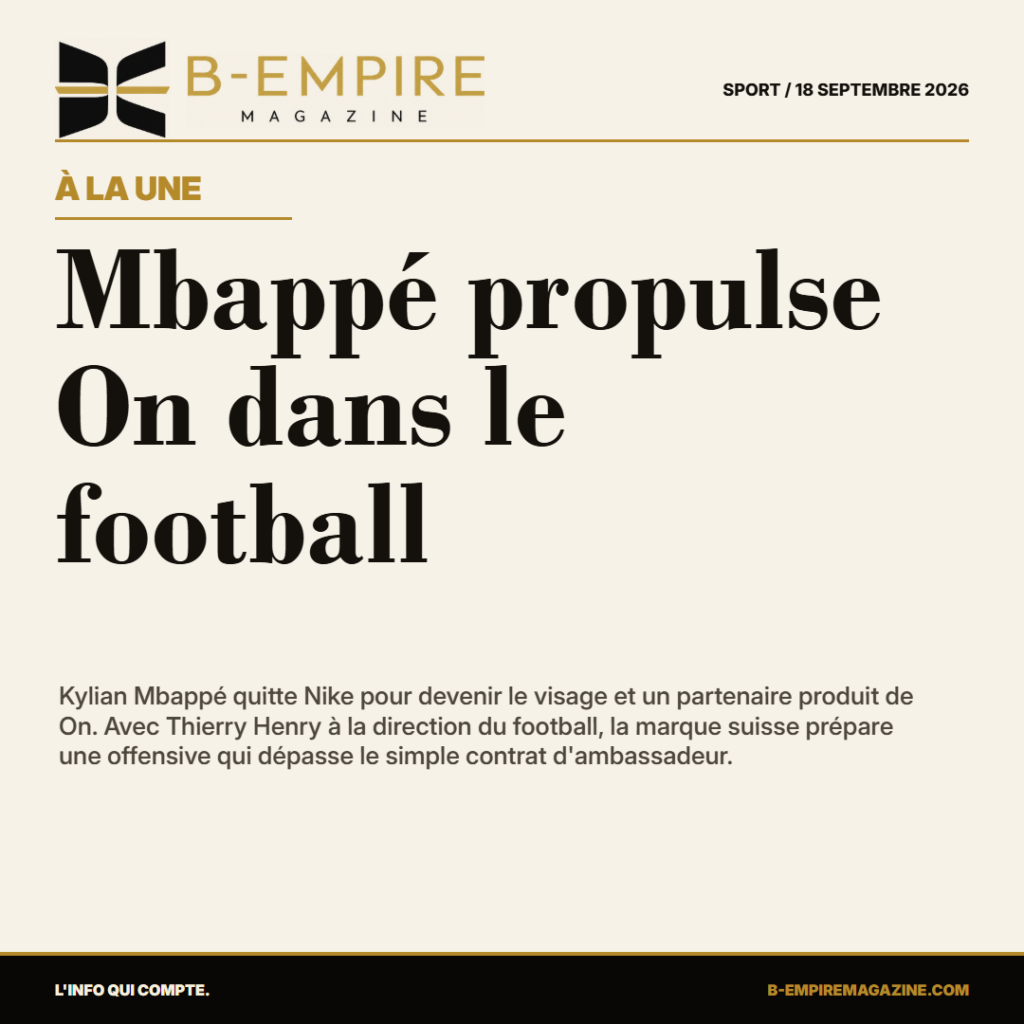
On has chosen the most spectacular possible entrance into football. The Swiss brand officially announced a partnership with Kylian Mbappé on September 18, 2026, making him both a global ambassador and a collaborator with its product teams. Thierry Henry, who has been involved in the project since late 2025, has been named Director of Football. This double recruitment does not look like an ordinary advertising campaign. It immediately places On at the center of the global conversation about footwear, performance and football culture.
A break that doubles as a market declaration
Mbappé’s departure ends a relationship of almost twenty years with Nike, one that began when he was still a child. The length of that association gave the player a special place within the American company’s football universe. By choosing On, the France captain is therefore doing more than changing his boot supplier. He is helping a company previously identified with running and tennis claim a position in the world’s most followed sport.
For On, the message is unambiguous. A gradual entry featuring a few promising players would have reduced risk, but it would also have limited impact. By placing Mbappé at the heart of the launch, the company turns its arrival into an event. It is buying less a moment of visibility than a form of cultural permission: the right to be taken seriously by players, retailers and supporters before its complete range even reaches the market.
Mbappé as a design partner, not only a face
On’s announcement emphasizes the player’s direct work with development and testing teams. His experience is expected to shape the company’s future football footwear and apparel. That detail is strategic. The market does not lack celebrities wearing logos; what it lacks are new products capable of persuading professionals on grip, stability, touch, weight and comfort.
On wants to transfer to football the method that built its reputation in running: combining Swiss engineering, proprietary technologies, recognizable design and athlete feedback. LightSpray, a technology already used to manufacture some running shoes rapidly, may provide a foundation for a different production approach. The challenge will be proving that visible innovation is more than aesthetic and that it answers the specific demands of changes of direction, acceleration and physical contact on a pitch.
Thierry Henry as an architect of credibility
Thierry Henry’s appointment adds a second form of legitimacy. Mbappé represents current performance and global reach; Henry contributes his understanding of the game, championship experience and ability to speak across generations. His title of Director of Football suggests a mission broader than that of an ambassador. He can influence athlete selection, project culture, product development and the way On addresses football communities.
The role also helps prevent the launch from depending entirely on one star. A brand entering a new sport must build a language, a network and a durable presence. Henry can connect elite performance, street culture, academies and football history. The extension of On’s partnership with Swiss player Sydney Schertenleib also shows that the project is already seeking to move beyond an isolated men’s campaign.
The Federer model applied at another scale
On understands the power of a foundational partnership. Roger Federer’s arrival in 2019 as an investor and partner helped the company move from running specialist to international premium brand. The Mbappé agreement repeats elements of that method by connecting a major personality to the construction of a category instead of simply asking him to promote a finished product.
Several media outlets report that the new arrangement includes an equity stake and a long-term commitment, although On has not published the financial terms. This model aligns the player’s interests with the company’s interests. It may transform the conventional relationship between equipment supplier and athlete: commercial success no longer produces only bonuses or royalties, but can increase the value of the partner’s own holding.
A dominated market that is not standing still
Nike and Adidas retain enormous advantages in football through their agreements with clubs, national teams, players and competitions. They also possess decades of research, distribution and cultural loyalty. On cannot reproduce that infrastructure in one season. A younger company can, however, attack the leaders’ blind spots through lighter production, premium design, selective releases, direct consumer relationships and an innovation-led story.
Competition has already become more diverse. Puma remains a major force, while Skechers and other brands have recruited established players. On’s arrival confirms that football footwear is becoming an entrepreneurial battleground again. Consumers still demand performance, but they also seek identity, narrative and a degree of exclusivity. The Swiss company must preserve that positioning while reaching the scale needed to pay for research, manufacturing and athlete contracts.
The risk of a promise moving faster than the product
The announcement creates enormous expectations before the planned commercial rollout in 2027. That is a media advantage but also a source of pressure. The first boots will be examined by professional players, equipment specialists and teenagers who know every detail of rival products. A comfort or durability problem could quickly turn curiosity into skepticism.
On will also have to reconcile premium scarcity with sporting accessibility. Football is played in major stadiums, but also in local clubs, schoolyards and on fields with very different surfaces. A brand becomes credible only when its product performs away from campaign images. Mbappé’s presence opens the door; quality, price and distribution will determine whether the public walks through it.
The athlete becomes a growth platform
This deal ultimately illustrates a profound shift in sports marketing. The greatest athletes are no longer merely advertising surfaces. They become product partners, shareholders, cultural tastemakers and sometimes market architects. Their value lies in their audience, but also in their ability to accelerate trust in a company attempting something new.
By recruiting Mbappé and giving Henry an operational role, On is building a football division around two complementary forms of intelligence: that of a player at the peak of his career and that of a former champion who has become an observer of the game. The bet is expensive and ambitious, but coherent. To challenge the giants, the Swiss brand could not settle for one more boot. It needed to explain why its arrival might change how football is designed, worn and imagined.