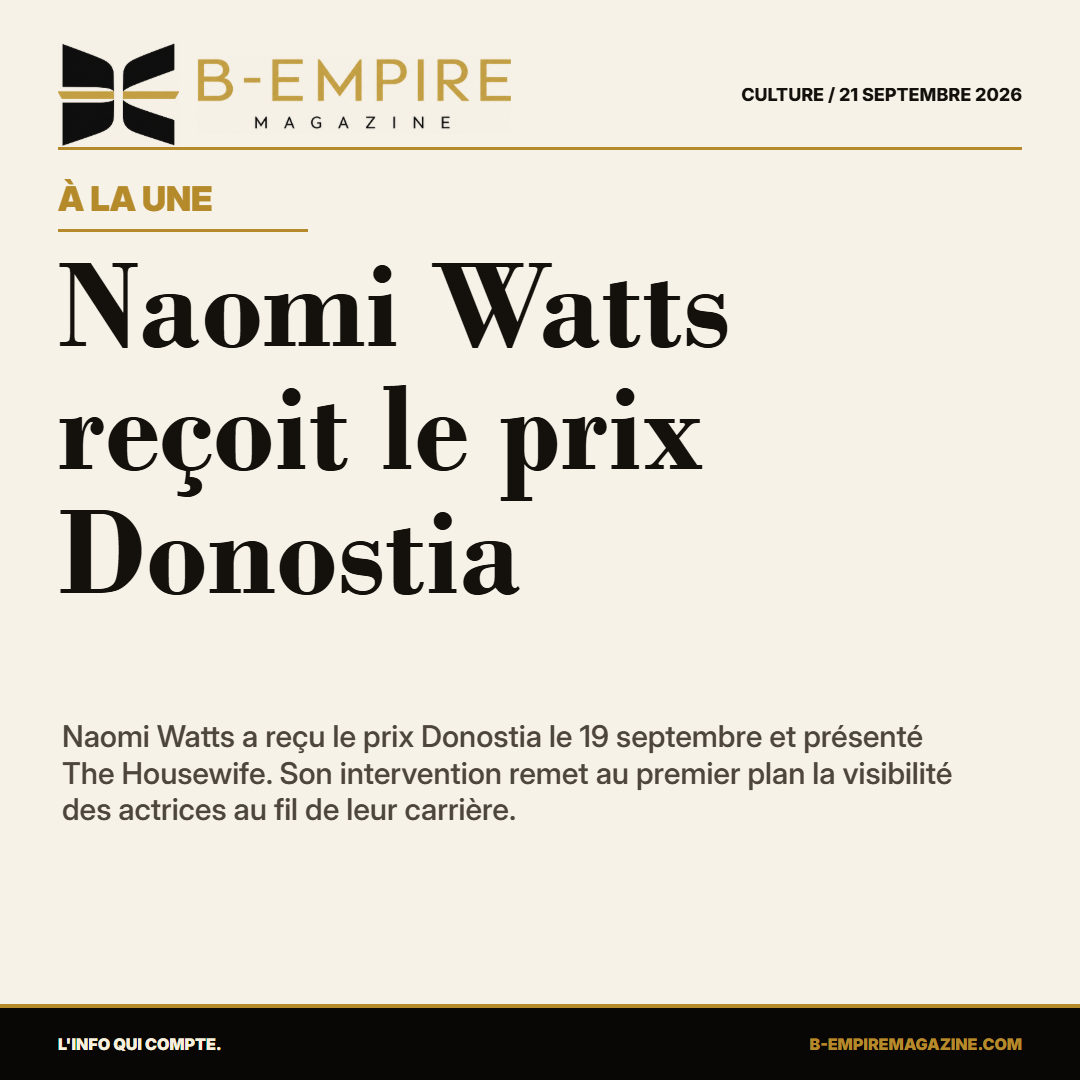
A career award can celebrate the past while raising a very current question: what stories are still offered to actresses as they grow older? Naomi Watts received the second Donostia Award of the 74th San Sebastian Film Festival on 19 September 2026. The ceremony took place at the Kursaal, where filmmaker J. A. Bayona presented the honour. The actress and producer dedicated it to David Lynch, whose Mulholland Drive marked a turning point in her international career. She also spoke about the need for women of her generation to see themselves represented on screen. Those remarks gave the evening a significance beyond the recognition of a filmography.
An honour that does not end a career
The Donostia Award recognizes a trajectory, not a single performance. The festival notes that Watts has worked across independent film, mainstream productions, television and producing. She has received two Academy Award nominations, for 21 Grams and The Impossible. A list of titles helps place an actress, but it can also freeze her image around a few celebrated roles. Receiving an award while she continues to act and produce is a reminder that a performer’s work does not stop when an institution decides to summarize it. The tribute matters most when it also encourages curiosity about what she is doing now.
Her dedication to David Lynch gave the evening a particular place in film memory. The festival describes 2001’s Mulholland Drive as the work that brought Watts international recognition. That does not reduce her later career, or the artistic collaboration itself, to a commemorative line. A trajectory is built with directors, but also through an actress’s own decisions, choice of characters and ability to move between formats. The ceremony recognized a living artist still involved in making films, not simply a figure from a period that can be neatly closed.
Women’s visibility at the centre of the speech
In the festival’s account, Watts directly connected the award to the place given to women her age on screen. A single festival programme cannot prove or disprove the broader point. It asks us to examine what characters are written, who gets a story of their own and who is confined to a supporting function. Honorary awards can create a paradox: they give an actress considerable visibility while directing attention to past achievements, when present opportunities are the question. The significance of Watts’s intervention is that she refused to let applause stand in for an answer.
The issue reaches beyond one famous performer. As careers lengthen, producers, writers, platforms and festivals collectively decide which ages are allowed complexity, desire, ambiguity and adventure. Watts did not present a statistical study of women’s roles in San Sebastian; it would be wrong to attach numbers to a speech that contained none. She stated a demand for representation from her experience as an actress. The serious response is to examine the actual range of characters being offered, rather than to turn a ceremonial remark into proof that the problem has already been solved.
The Housewife, a new film to discover
The award ceremony was followed by a screening of The Housewife, the debut feature by Canadian director Ben Shirinian. According to the official description, the film is set in 1964 and inspired by a true event. A young journalist discovers that a man suspected of being a former Nazi may be hiding in New York and becomes close to the suspect’s wife. Watts appears alongside Tye Sheridan, Luke Evans, Michael Imperioli and Lena Olin. These details describe the story as announced by the festival, not how the film stages it. They do not justify treating the characters as identified real people or assessing the work’s historical accuracy without examining its sources and approach.
The pairing of a career prize with a first feature is revealing. The actress’s fame brings attention to the work of a new director, while the new film keeps the evening from closing on a retrospective alone. That guarantees neither The Housewife‘s artistic success nor its future reception. To assess its treatment of the subject, viewers will need to consider the point of view, the space given to the suspect’s wife, its relationship to historical facts and the way it builds tension. A festival synopsis cannot replace a review written after seeing the film.
The ceremony and what follows it
San Sebastian had already given Werner Herzog a Donostia Award at this year’s opening. Watts’s distinction is the edition’s second, bringing two very different careers into the same symbolic space. It would be reductive to compare them as if they were competing. The festival is instead a place where older and newer work can meet, sometimes in a single evening. The question is not only who deserves a trophy, but what an institution makes visible around it: collaborators, first-time directors and the debate over access to roles.
For B-EMPIRE, the significance of 19 September lies in that productive tension. Confirmed facts include the Donostia Award for Naomi Watts, her tribute to David Lynch, her remarks on representation and the screening of The Housewife. The film’s quality and the effect of those words on industry practice remain open questions. A long career deserves celebration; it also deserves not to be presented as finished. By asking for more space for women of her generation, Watts turned an evening of recognition into an invitation to watch which roles are written next.