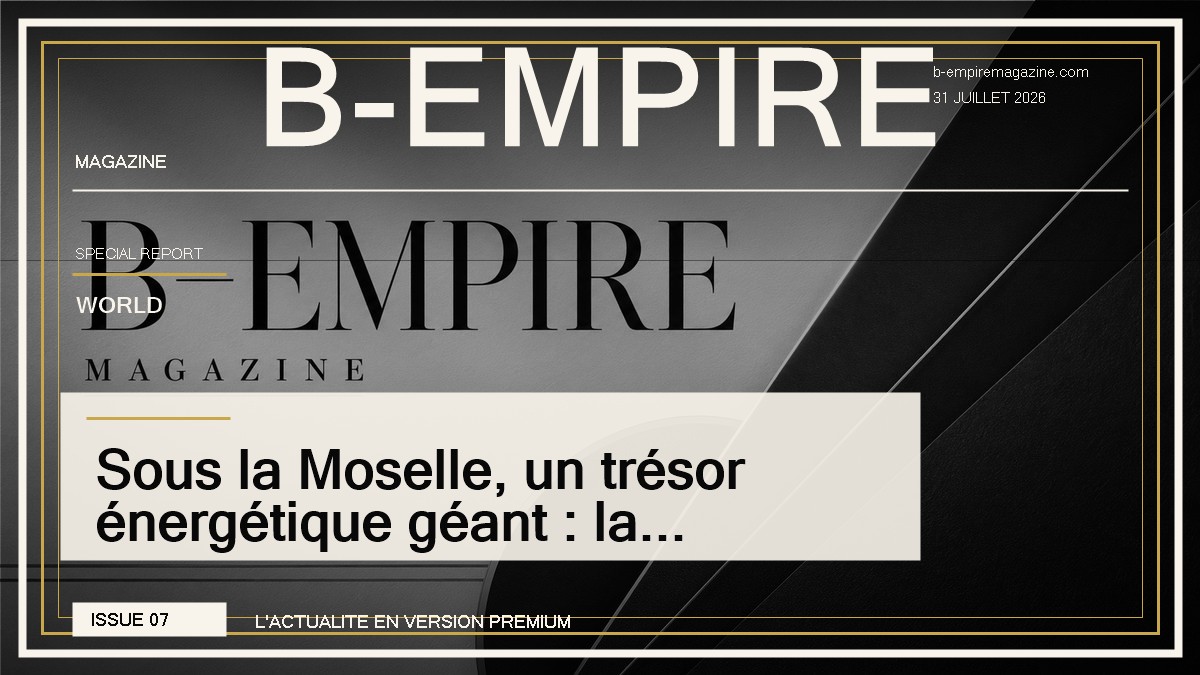
The next great energy battle in Europe could begin more than 2,000 meters beneath an old French coal basin. In Moselle, a dedicated drilling for natural hydrogen has confirmed concentrations deemed exceptional by La Française de lâÃnergie. The company and scientists involved in the REGALOR II program estimate that the Lorraine subsoil could contain up to 34 million tons of hydrogen. If this potential is confirmed and technically recoverable, France would possess a resource capable of influencing the decarbonization of steel, chemicals, fertilizers, and certain heavy transport sectors.
The figure is striking, to the point of fueling the idea of the largest natural hydrogen deposit identified in the world. However, it is crucial to immediately clarify the distinction between a geological promise and an industrial revolution: 34 million tons represent an estimate of the resource in place, not a certified commercial reserve. It remains to be determined what proportion can be extracted, at what flow rate, at what cost, and with what environmental impact. This tension between colossal potential and decisive uncertainties makes Moselle one of the most fascinating energy dossiers of the moment.
A Deep Drill That Changes the Scale of the Project
The PTH-2 well, drilled in Pontpierre as part of REGALOR II, has reached 3,655 meters. La Française de lâÃnergie presents it as the deepest drilling ever specifically conducted to search for natural hydrogen. The analyses communicated in June report a concentration of 49.6% hydrogen at 2,426 meters, following the detection of gas at several levels of the subsoil.
This measurement adds a concrete element to a story that began several years earlier. In the Folschviller well, researchers had observed that the concentration of hydrogen increased with depth. The CNRS explained that the gas could be generated by reactions between water and iron-rich minerals. The new drilling does not close the scientific debate, but it strengthens the hypothesis of a large-scale hydrogen-producing system in the Moselle basin.
Why Natural Hydrogen Attracts the World
Hydrogen is already essential to the global economy. It is used notably in refining and the production of ammonia, a base for many fertilizers. However, most of the hydrogen used today is produced from fossil fuels, with significant CO2 emissions. So-called green hydrogen, produced by electrolysis using renewable electricity, offers a low-carbon pathway, but it remains costly and requires a lot of electricity.
Natural hydrogen, sometimes referred to as white hydrogen, changes the logic: it is present or forms directly in the subsoil. If it can be extracted with little energy and without major emissions, its cost and carbon footprint could be lower than those of many industrial methods. This explains the surge in research in France, the United States, Australia, Spain, and Africa.
However, the promise is not automatic. A high concentration in a sample does not guarantee a continuous reservoir, sufficient pressure, or sustainable flow. Hydrogen is a light molecule, difficult to contain and prone to migration. The geology of the trap, the porosity of the rocks, and the potential regeneration rate of the resource will determine the actual value of the project.
34 Million Tons: A Figure That Must Still Pass the Test of Reality
The estimate of 34 million tons provides a picture of the basin’s potential, but it should not be confused with the volume that will eventually reach the market. In mining terminology, a geological resource becomes a reserve only when its extraction is demonstrated to be technically and economically viable under specific conditions.
The next steps will therefore be less spectacular than the announcement but far more important: production tests, flow rate measurements, pressure evolution, gas composition, reservoir modeling, and environmental monitoring. It will also be necessary to check for the potential presence of other gases, assess purification needs, and define the infrastructure required to transport hydrogen to industrial consumers.
The French Senate itself reminded in a scientific note published in July that the figure of 34 million tons was put forward after the drilling in Pontpierre and that academic work still needed to be validated. This caution does not diminish the significance of the result. On the contrary, it protects the project from overly rapid communication that could create impossible expectations.
A Possible Industrial Comeback for the Former Mining Basin
The local dimension is as powerful as the global stakes. The closure of coal has left a deep economic and social scar in Lorraine. A natural hydrogen project could reuse skills in drilling, geology, maintenance, and subsoil management. It could also attract hydrogen-consuming companies close to the resource, thus limiting transport costs and difficulties.
La Française de lâÃnergie obtained in January 2026 the exclusive research permit for the Trois-Ãvêchés, valid for five years. The project also benefits from a strategic cross-border environment, close to Germany, Luxembourg, and Belgium. For Europe, which seeks to reduce its dependence on imported hydrocarbons and preserve its heavy industry, Moselle could become a large-scale laboratory.
The Signal That France Cannot Ignore
France already has a low-carbon electrical advantage thanks to nuclear and hydroelectric power. A domestic source of natural hydrogen would add a new piece to this architecture. It could serve primarily where direct electrification is difficult: iron ore reduction, chemistry, synthetic fuels, or certain maritime and aviation uses.
However, it would be misleading to present hydrogen as a universal replacement for oil, gas, or electricity. Each conversion incurs losses, and the direct use of electricity often remains more efficient for cars, heating, or many processes. The value of the Moselle discovery will therefore also depend on the discipline with which the resource is directed toward the sectors that truly need it.
The Four Tests That Will Decide Whether the Promise Becomes a Revolution
- Flow Rate: a well must produce enough gas, steadily, to justify investments.
- Recoverable Volume: only a portion of the geological resource may be technically accessible.
- Total Cost: drilling, purification, compression, and transport must remain competitive compared to industrially produced hydrogen.
- Environmental Impact: water, soils, leaks, and well integrity must be subject to transparent monitoring.
Moselle may hold a global energy treasure, but the real news is not that a revolution is already secured. It is that France now has enough clues to test it seriously. If the tests confirm a sustainable flow and competitive extraction, a territory marked by the end of coal could find itself at the heart of a new geography of European energy. If the results disappoint, the drilling will still have advanced a science that is still young.
In either case, the world will be watching Lorraine. For behind the impressive figures lies an essential question: can the energy transition also come from the depths of the Earth, without reproducing the climate costs of the old fossil world?
Sources
- Le Monde â investigation into the deposit and industrial hopes in Moselle
- La Française de lâÃnergie â results of the PTH-2 well communicated on June 23, 2026
- CNRS Le Journal â geological mechanisms and initial estimates in Lorraine
- Parliamentary Office for the Evaluation of Scientific and Technological Choices â note on natural hydrogen, July 2026