
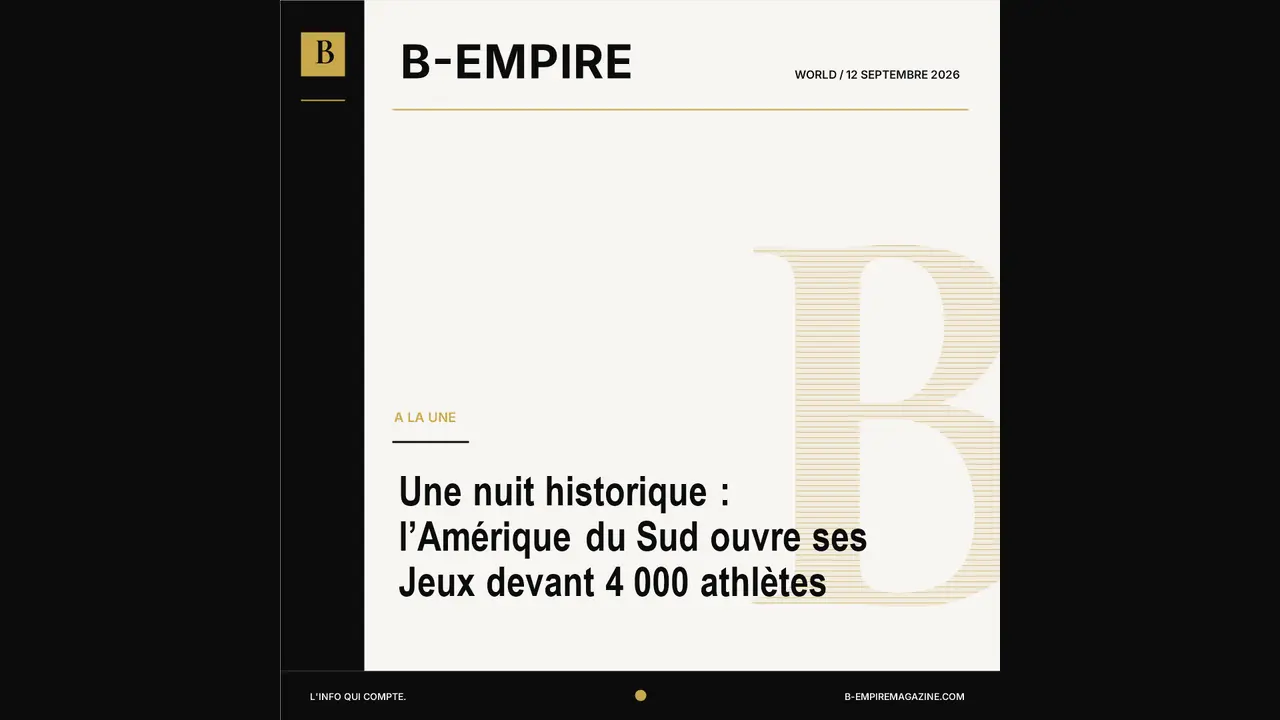
This Saturday, September 12, the National Flag Monument in Rosario will not just be a backdrop: it will become the beating heart of South American sport. The XIII South American Games Santa Fe 2026 will open in Argentina with over 4,000 athletes from 15 countries. Until September 26, Rosario, Santa Fe, and Rafaela will host a continental competition whose ambition far exceeds mere medals.
The kickoff will take the form of a free show combining music, theater, dance, mapping, giant screens, and live images. In front of one of Argentina’s most symbolic monuments, artists from several generations will narrate the sporting disciplines and the identity of the province. This opening aims to send a simple message: for two weeks, Santa Fe intends to become an international showcase.
4,000 Athletes and 15 Countries Gathered in Argentina
The numbers reflect the significance of the event. According to the organizers and local authorities, more than 4,000 athletes representing 15 countries will participate in the Games. The program covers 43 sports and 60 disciplines, primarily distributed between Rosario, Santa Fe, and Rafaela, with Buenos Aires and Mar del Plata as invited sub-sites.
This geography already constitutes a uniqueness. The event is not concentrated in a single city: it relies on three hubs, three communities, and several new or renovated infrastructures. For the province of Santa Fe, the challenge is as much about coordinating competitions as it is about facilitating the movement of spectators, delegations, and media attention.
The South American Games belong to the continental sports ecosystem led by ODESUR. They provide a major stage for disciplines that rarely receive such exposure between two Olympic Games. For many athletes, this competition represents a structural step: the opportunity to gauge their regional level, gain experience, and enhance their visibility ahead of the next major international events.
Rosario Transforms Its Monument into a Giant Stage
The inaugural ceremony is scheduled for 6 PM at the National Flag Monument in Rosario. The choice of location immediately gives a popular and national dimension to the event. Access is free, while a significant traffic and security arrangement accompanies the evening in the city center.
The staging will involve more than 70 artists on stage, and over a hundred participants according to the perimeter set by the authorities. Soledad Pastorutti, Abel Pintos, Juan Carlos Baglietto, Luck Ra, Cacho Deicas, Valentino Merlo, and AgustÃn Rada Aristarán are among the announced artists. The musical arrangements are entrusted to Lito Vitale, with a direction designed to create a dialogue between sports performances and cultural narratives.
The mapping projected onto the monument, the lights, the screens, and the live capture will extend this narrative. The goal is not to replicate an Olympic ceremony on a smaller scale, but to create an identifiable local signature. Sport serves as the common thread, while Argentine music and the history of Santa Fe give the show its personality.
The Bet of an Event That Lasts Beyond Medals
Behind the celebration lies an infrastructure bet. The preparation for the Games has accelerated the renovation or creation of sports facilities in the three cities. In Santa Fe, the athletics track at the High-Performance Center has notably been upgraded, while Rosario and Rafaela have developed new competition and reception spaces.
The real test will begin after September 26. A major event succeeds sustainably when its facilities remain accessible, when local clubs can use them, and when young people discover new disciplines. The legacy is therefore measured not only by the number of visitors over fifteen days but by the ongoing sporting life that follows.
The organizers have also planned Fan Fests with concerts, DJs, cultural activities, digital experiences, and family entertainment. This programming broadens the audience beyond competition enthusiasts. It responds to a global transformation in sport: major events no longer sell solely results but a complete experience combining spectacle, city, culture, and online content.
Why These Games Matter for the Entire Continent
South America boasts world-renowned champions in football, tennis, athletics, cycling, and combat sports. Yet, much of its sports ecosystem remains less visible on the international stage. The Santa Fe Games offer a common platform for Argentina, Brazil, Chile, Colombia, Peru, Uruguay, and other delegations from the continent.
This pooling has sporting, diplomatic, and economic value. Delegations share the same venues, federations meet their counterparts, and host cities demonstrate their capacity to organize a complex event. In a period where the costs of mega-events are increasingly contested, the multi-city model of Santa Fe will be closely observed.
It offers both a promise and a risk. Distributing the Games allows for the pooling of facilities and territorial benefits. But it also requires more refined logistics and a strong enough common identity to avoid the impression of a dispersed event. The ceremony in Rosario plays precisely this role: to provide a unique image for a competition spread across multiple territories.
An Event to Follow from France and Europe
For the French and European audience, these Games are an opportunity to look beyond the usual sports circuits. They may reveal athletes destined to appear later in world championships, the Pan American Games, or on the Olympic stage. They also allow for a better understanding of the sporting depth of a continent often reduced to its football.
The opening ceremony itself has international circulation potential. The musical performances, monumental decor, and mapping images are designed for television, streaming, and social media. A local stage in Rosario can thus become, in a matter of minutes, a viral object watched in Paris, Madrid, Miami, or São Paulo.
The World is Watching Santa Fe
The 2026 South American Games therefore open with a dual ambition: to crown the best athletes on the continent and to prove that a regional event can produce a global image. More than 4,000 athletes arrive with their dreams, rivalries, and stories. Around them, three cities seek to transform fifteen days of competition into a sustainable legacy.
The first verdict will come this Saturday night when music, light, and sport meet at the foot of the Flag Monument. Then, the podiums will take over. If Santa Fe succeeds in its bet, these Games will not just remain another edition: they will become the moment when an entire province used sport to speak to the world.
Sources
- Municipality of Rosario, official program of the opening ceremony, September 2026
- Government of Santa Fe, figures and organization of the opening, September 9, 2026
- Santa Fe 2026, official presentation of the inaugural show, September 3, 2026
- Telefe Santa Fe, infrastructures and preparation for the Games, September 11, 2026