
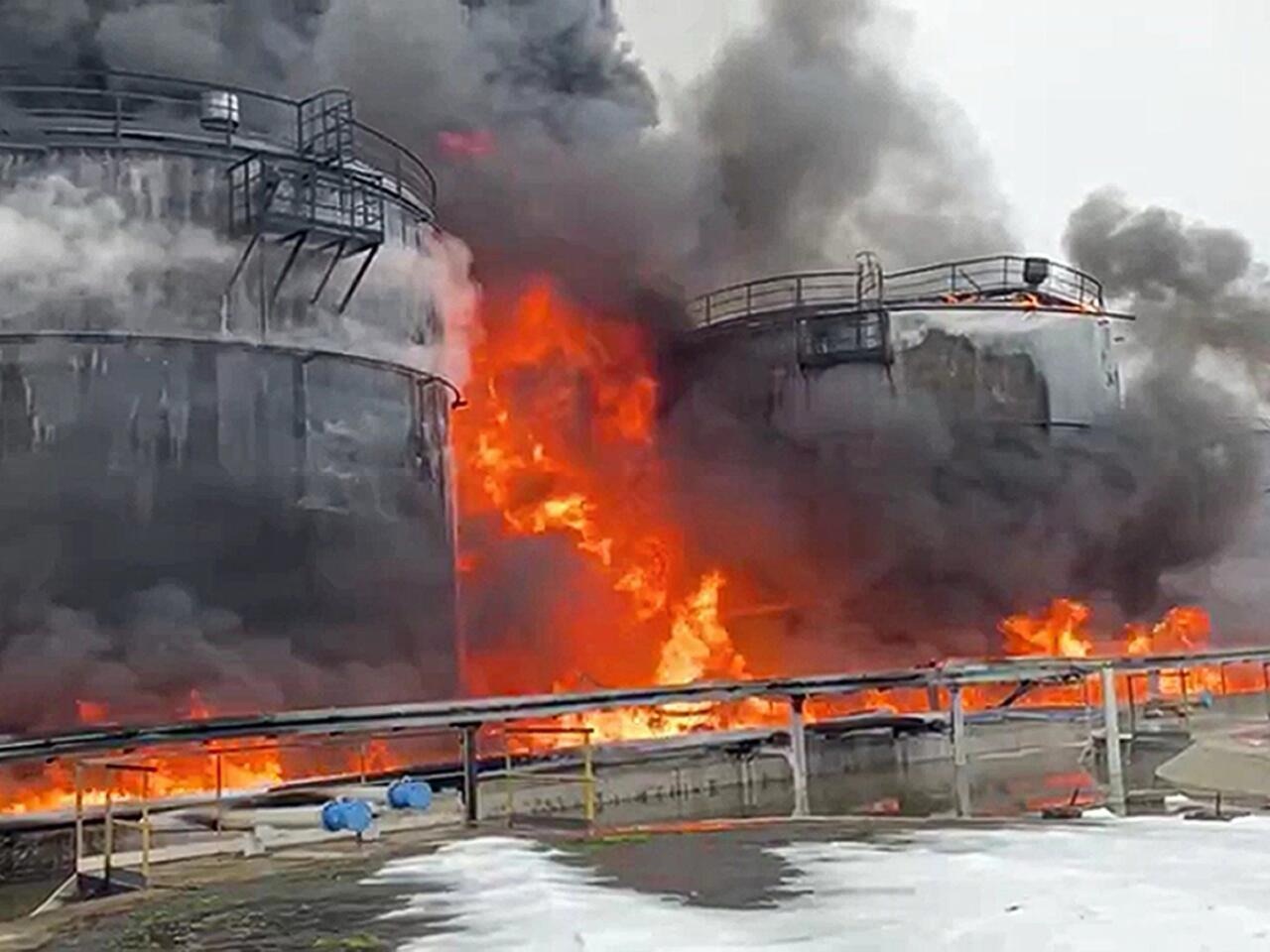
Two sites, nearly 2,000 kilometers apart, and a single message directed at the Kremlin. Ukraine claims to have struck two major Russian refineries overnight, one in the Perm region, over 1,500 kilometers from Ukrainian territory, and the other in Ryazan, closer to the border. While the exact extent of the damage remains to be independently confirmed, the operation marks a new phase in Kyiv’s campaign against the energy heart of Russia.
The timing adds further significance to these strikes. They occurred just hours after Volodymyr Zelensky’s visit to Washington and his closed-door meeting with Donald Trump. On the ground and in capitals, Ukraine seeks to demonstrate that it retains the initiative: producing its own long-range weapons, targeting strategic infrastructures, and increasing the economic cost of the war for Moscow.
Perm and Ryazan, two targets of considerable industrial weight
According to the Associated Press, the attacks triggered fires at a Lukoil refinery located in the Perm region and at another facility in Ryazan. Ukrainian authorities estimate that the two sites together have an annual capacity of about 220 million barrels. This figure does not measure the damage caused overnight, but it illustrates the importance of these infrastructures in the Russian energy apparatus.
The Perm refinery is particularly notable for its distance. Hitting a target located more than 1,500 kilometers from Ukraine forces Russia to defend not only its borders and western regions but also industrial assets deeply embedded within its territory. This strategic depth, long considered a decisive advantage, becomes more challenging and costly to protect against mass-produced drones.
In Ryazan, Governor Pavel Malkov reported that six people had been hospitalized following a drone attack and that debris had caused fires at unspecified industrial sites. This account does not confirm all the details put forth by Kyiv. However, it establishes that an attack did indeed reach the region and caused human and material damage. In a war saturated with communication, this nuance is essential: operational claims remain to be verified, but the event itself is not merely virtual.
The real target: fuel, revenue, and logistics
A refinery does not produce crude oil; it transforms it into gasoline, diesel, kerosene, and other essential products for both the economy and the armed forces. By targeting these facilities, Ukraine seeks a multiple effect. It aims to reduce fuel availability, disrupt military logistics, force companies to finance repairs, and push Moscow to further disperse its air defenses.
This strategy differs from a classic battle for a few kilometers of territory. A relatively inexpensive drone can compel Russia to protect hundreds of high-value sites, from refineries to depots, ports, and pumping stations. Even when an attack does not permanently halt production, it can impose inspections, slow down industrial chains, increase insurance costs, and create ongoing uncertainty.
Kyiv claims that its campaign has already contributed to a fuel crisis in Russia. This assertion must be placed within a broader context: maintenance of facilities, sanctions, logistical restrictions, domestic demand, and decisions by the Russian government. It would be excessive to attribute every price tension to a single series of strikes. However, their repetition transforms a one-off risk into structural pressure.
After Washington, Zelensky wants to prove that Ukraine remains a strategic investment
In Washington, Volodymyr Zelensky met with Donald Trump and then over sixty senators from both parties, according to the AP. He also engaged with representatives from Lockheed Martin after receiving a delegation from Raytheon in Kyiv. The stakes go beyond the delivery of new systems: Ukraine seeks to obtain licenses, develop joint production, and exchange its acquired drone expertise for Western air defense capabilities.
The campaign against the refineries serves this demonstration. Kyiv wants to convince its partners that it does not solely rely on imported weapons. Its teams have developed devices capable of covering very long distances, circumventing some defenses, and striking economic targets chosen for their value. For Washington and European capitals, this return on experience has become a military asset in itself.
A global impact on oil to watch without succumbing to panic
For markets, the decisive question is not merely whether a refinery burned for a few hours. It is whether Russia can maintain its exports of refined products, fuel its domestic market, and quickly repair the affected units. A limited interruption can be absorbed. Conversely, a succession of shutdowns at several major sites can strain certain regional diesel and aviation fuel flows.
France and Europe are no longer dependent on Russian energy as they were before the 2022 invasion, but they remain exposed to global prices. Diesel, maritime freight, aviation, and agriculture react to tensions on refined products, even when they are not purchased directly from Moscow. A lasting shock would transmit through international markets, transport costs, and refiners’ arbitrage.
However, one must avoid an automatic conclusion about an immediate spike in oil prices. The price of crude also depends on global production, stocks, Asian demand, OPEC+ decisions, and tensions in the Middle East. The strikes on Perm and Ryazan are a risk signal, not proof that a global energy shock is already underway.
Russia faces the puzzle of dispersed defenses
The Russian Ministry of Defense claimed that 295 Ukrainian drones were shot down overnight over several Russian regions and occupied Crimea. This volume, if accurate, demonstrates the scale reached by the drone war. It also shows the limit of an interception rate presented as high: only a few devices need to get through for a vulnerable industrial site to suffer a fire or shutdown.
Moving air defense systems around the refineries means removing them from elsewhere. Building physical protections, jamming communications, multiplying emergency teams, and adapting industrial procedures takes time and money. The Ukrainian objective appears to be precisely to create this permanent dilemma, without claiming that a single attack can paralyze the Russian economy.
The signal Moscow can no longer ignore
Perm changes the perception of distance, Ryazan reminds of the vulnerability of major industrial nodes, and Washington adds a diplomatic dimension to the whole. Russia retains immense military and energy power. But it can no longer consider its industrial rear as completely out of reach.
The future will depend on three elements: the actual duration of the interruptions, the repair capacity of the refineries, and the frequency of new strikes. If the facilities resume operations quickly, the effect will remain primarily symbolic and tactical. If several major sites are repeatedly hit, the campaign could weigh more heavily on fuels, the Russian budget, and political calculations surrounding the war. This is where the real challenge lies: transforming technological reach into sustainable strategic pressure.
Sources
- Associated Press, July 29, 2026: strikes on Perm and Ryazan, announced capacities, Russian reactions, and diplomatic context.
- Presidency of Ukraine: official communications on Volodymyr Zelensky’s visit to Washington and defense cooperation.
- International Energy Agency: benchmark data and analyses on global oil and refined product markets.
- Council of the European Union: European framework for sanctions and reduction of energy dependence on Russia.