
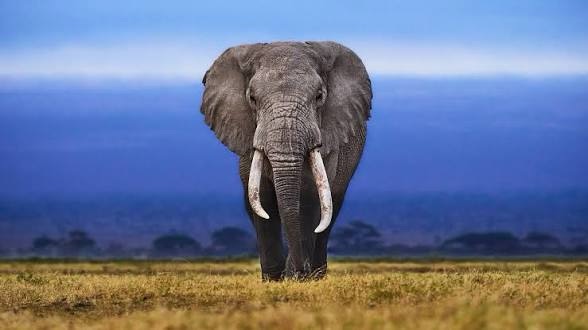
Fifteen elephants have died within a month in southern Kenya, near Amboseli National Park. Preliminary laboratory results have detected cyanide, and authorities suspect contamination from tomatoes grown near areas frequented by the animals. The image is as brutal as it is unexpected: one of the world’s most famous elephant sanctuaries finds itself at the center of an investigation where poison, agriculture, livestock security, and coexistence between human populations and wildlife intersect.
The Kenya Wildlife Service, responsible for wildlife protection, has not publicly identified the source of the contamination or named any suspects. At this stage, it is essential to resist hasty conclusions. What is established, according to information provided by its Director General Erustus Kanga and reported by the Associated Press, is the preliminary presence of cyanide in the analyses and the death of fifteen elephants in the areas surrounding Amboseli.
Fifteen Deaths in One Month: What the Investigation Has Established
The animals were found in several areas around the park, notably near the Kimana sanctuary and the Kuku ranch. An initial communication from the Kenya Wildlife Service reported that ten elephants showed signs of partial paralysis before dying within two days. Five others had already been discovered dead, their carcasses partially consumed by scavengers.
The majority of the victims were females and calves, a significant detail for herd dynamics. In elephants, family groups are structured around females, who pass on migratory routes, water sources, and survival behaviors. The loss of several females is not merely a numerical count; it can disrupt entire families for the long term.
Initial analyses conducted on samples had detected a potentially toxic substance, while other tests had not identified the sought-after toxins. The results subsequently announced by Erustus Kanga have directed the investigation towards cyanide present in tomatoes from nearby farms. Environmental investigations still need to examine crops, water sources, and other possible exposure pathways to accurately reconstruct the contamination chain.
Cyanide Detected in Tomatoes, but No Guilt Established
Cyanide is an extremely toxic substance, particularly for elephants, as noted by the Director General of the Kenya Wildlife Service. However, its detection does not yet answer essential questions: how did the substance end up on the tomatoes? Was the contamination intentional, accidental, or related to another practice? Did all the animals consume from the same location? Authorities have not yet provided any definitive answers.
There are precedents in Kenya, where farmers have previously been suspected of poisoning elephants that came to destroy their crops. This context explains why the possibility of a conflict between human activities and wildlife is being examined. However, it does not allow for accusations against neighboring farmers in this case. Any honest presentation must maintain this distinction between a known history and responsibilities that remain to be established.
The Kenya Wildlife Service asserts that the toxic substances found in the elephants do not currently pose a threat to human health. However, its alert targets a broader circle than just wildlife: goats and cattle also graze in the affected areas. If contamination remains in the environment or in accessible crops, the consequences could impact the herds upon which local families depend.
Amboseli, a Global Symbol Under Kilimanjaro
Amboseli is not just any park. Located in southern Kenya, near the Tanzanian border, it offers one of the most iconic images of East Africa: herds of elephants moving across the savannah with Kilimanjaro in the background. The Kenya Wildlife Service presents it as a major destination for observing large groups of elephants and over 400 species of birds.
However, the protected area constitutes only a part of the ecosystem. Elephants move beyond the administrative boundaries of the park, through community lands, ranches, migration corridors, and agricultural operations. This mobility is essential for their survival, but it regularly places the animals in contact with fields, livestock, and villages.
The Kenyan national elephant plan for 2023-2032 estimated the population of the Amboseli ecosystem at around 1,641 individuals. More recent data cited by local media mention over 2,000 elephants identified by researchers. Regardless of the counting method, the same challenge appears: protecting a significant population in a territory where land use is multiplying.
Behind the Poison, the Conflict Between Agriculture and Wildlife
For a visitor, an elephant is a natural wonder. For a farmer whose field can be ravaged overnight, it also represents an immediate economic threat. This dual reality is at the heart of the human-wildlife conflict. Families sometimes bear the direct costs of global conservation: lost crops, threatened livestock, risky displacements, and delayed compensation.
The pressure intensifies when drought reduces vegetation and water points. At the end of 2025, residents of Kajiado County protested after four people were killed by elephants in one week. Experts then linked the increase in encounters to the scarcity of resources. The Kenya Wildlife Service had promised to enhance prevention and response speed.
Solutions exist, but they require time and funding: appropriate fencing, alert systems, GPS monitoring, protected corridors, less attractive crops for elephants, response teams, and rapid compensation for losses. The Kenya Wildlife Service has already tested agricultural projects in the Amboseli ecosystem and used tracking collars to keep certain large males away from crops.
A Shock for Biodiversity and the Tourism Economy
The conservation of elephants is also an economic issue. Parks and reserves make Kenya a global tourist destination, attracting visitors whose spending supports accommodations, guides, transportation, artisans, and local jobs. Each major crisis in Amboseli undermines the reputation of a natural heritage that directly contributes to the country’s prominence.
The Kenyan elephant population has increased in recent years, rising from 36,280 individuals in 2021 to 42,072 in 2025, according to official figures. This success against poaching does not mean that the battle is won. As animal populations recover in fragmented landscapes, coexistence with residents becomes the next frontier of conservation.
This case thus serves as a reminder of an uncomfortable truth: saving a species is not just about preventing illegal hunting. It also requires ensuring space, reducing risks around crops, and ensuring that neighboring communities genuinely benefit from the presence of wildlife. Without local economic justice, protection decided in Nairobi or celebrated abroad remains vulnerable.
The Signal That Kenya Cannot Ignore
The immediate priority is scientific and judicial: confirm the results, locate the source of the cyanide, secure fields and water points, monitor livestock, and determine any responsibilities. Transparency will be crucial, as information has evolved rapidly between the initial unexplained deaths and the lead of contaminated tomatoes.
In the long term, the death of fifteen elephants must serve as an alarm. Amboseli is a global symbol, but its future hinges on very concrete decisions made around farms, pastures, and migration routes. Protecting wild herds without safeguarding human livelihoods would lead to a deadlock.
The world often looks to Amboseli for its beauty. It must now also look at it for the complexity of its balance. Fifteen elephants have vanished in a month; the investigation will reveal whether a deliberate act, an accident, or a chain of negligence caused their deaths. But the message is already clear: when the boundaries between park, agriculture, and livestock are not secured, a simple harvest can become the breaking point of an entire ecosystem.
Sources
- Associated Press â cyanide detected, contaminated tomatoes, and risks to livestock, July 29, 2026.
- Associated Press â initial findings, paralysis, and areas where elephants were found, July 28, 2026.
- Kenya Wildlife Service â National Elephant Action Plan for Kenya 2023-2032.
- Kenya Wildlife Service â official presentation of Amboseli National Park.
- IUCN â sustainable coexistence and root causes of human-wildlife conflicts, May 2025.