After Eight Years, BepiColombo Arrives at Mercury : A Historic Rendezvous
After eight years of travel, the European and Japanese BepiColombo mission is set to be captured by Mercury. Two orbiters, an extraordinary trajectory, and five major scientific enigmas are at the heart of this historic rendezvous.
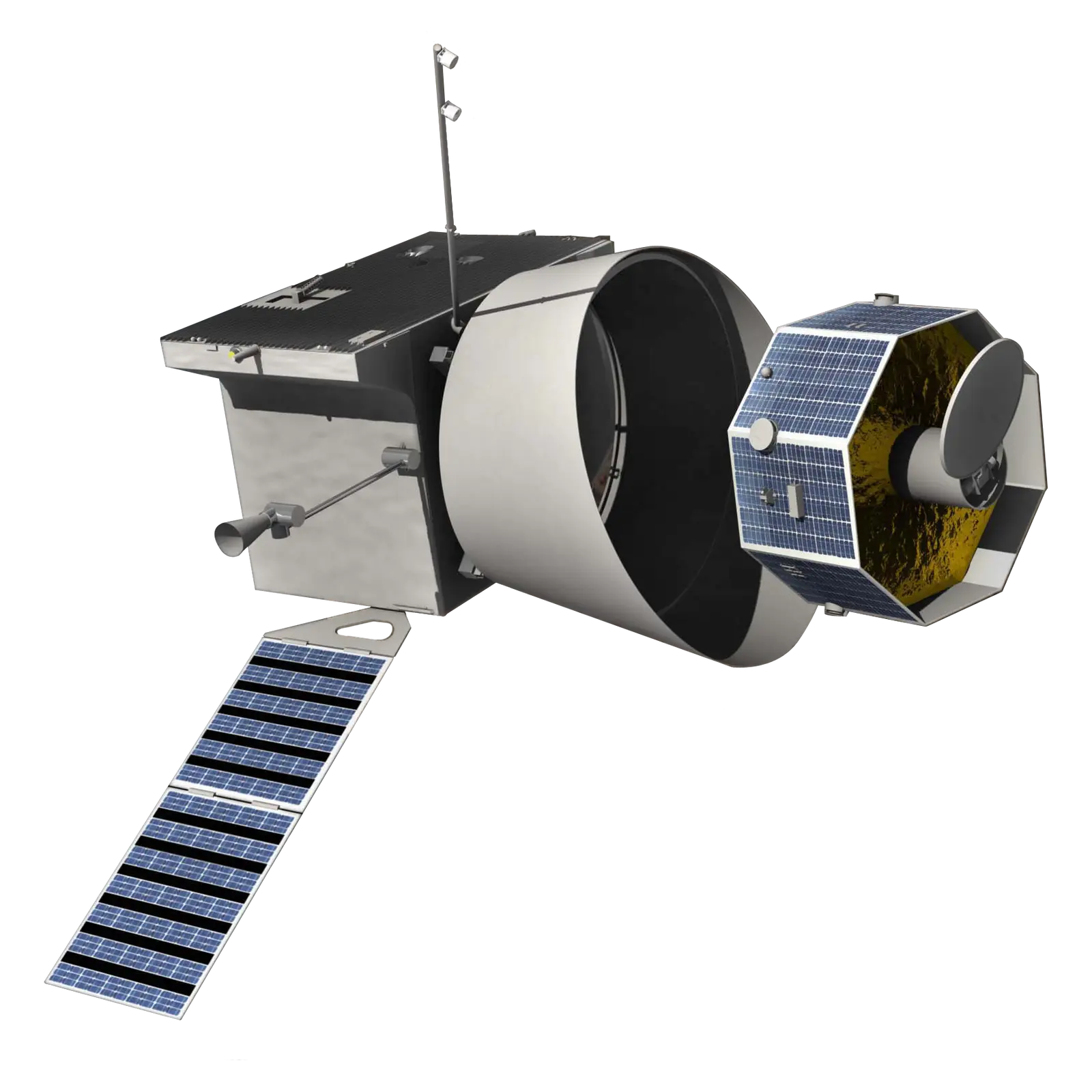
Eight years of travel, nine planetary flybys, and billions of kilometers to reach the planet closest to the Sun. On November 21, 2026, BepiColombo approaches the most anticipated rendezvous in its history: the joint mission of the European Space Agency and the Japanese agency JAXA is set to be captured in orbit around Mercury. Behind this maneuver lies much more than a technical feat. Europe and Japan are about to open a new window on the least understood planet of the inner solar system.
As of this writing, the ESA presents the orbital insertion as the decisive step on November 21 and has not yet published the final confirmation of the maneuver on its tracking page. This caution is essential: in deep space, a rendezvous is only deemed successful when ground teams have received and analyzed the telemetry. However, the mere fact that BepiColombo has reached this gateway to Mercury already marks the culmination of an odyssey that began on October 20, 2018, in Kourou, French Guiana.
Why Reaching Mercury is So Difficult
Mercury is relatively close to Earth on a solar system scale, yet it is one of the most challenging destinations to reach. As a probe dives toward the Sun, it accelerates significantly. It must lose enough energy to avoid overshooting the planet or falling too close to our star. Sending a vehicle into orbit around Mercury thus requires a long, precise, and counterintuitive gravitational choreography.
BepiColombo utilized a flyby of Earth, two of Venus, and six of Mercury to gradually modify its speed and trajectory. These nine close passes served as cosmic brakes. The mission did not take eight years because Mercury is extraordinarily distant, but because it was crucial to arrive at the right place, at the right time, and with a speed compatible with orbital capture.
Heat adds another constraint. Near Mercury, spacecraft must withstand direct solar radiation and energy reflected from a scorching surface. The materials, instruments, solar panels, and thermal control systems have been designed to operate in an environment that would quickly disable a conventional satellite.
Two Probes to Observe One Planet
The uniqueness of BepiColombo lies in its architecture. The mission carries two scientific orbiters that are still traveling together. The Mercury Planetary Orbiter, or MPO, is under the responsibility of the ESA. Mio, the Mercury Magnetospheric Orbiter, is developed by JAXA. Both devices are set to be captured around Mercury before separating on December 9 and 10, 2026, according to the schedule published by the European agency.
This approach will allow simultaneous observation of the surface, interior, exosphere, and magnetic environment of the planet from different orbits. The MPO will notably map the composition and topography of Mercury. Mio will study its magnetic field and how it interacts with the solar wind. The combination of measurements is expected to provide a more dynamic view than that produced by a single spacecraft.
The Five Mysteries BepiColombo Aims to Solve
Mercury remains a planet full of contradictions. It has an immense metallic core relative to its size, a very dark surface, and an unexpected magnetic field for such a small world. Despite extreme temperatures, deposits of ice could persist in the depths of polar craters that never see direct sunlight.
Researchers want to understand how Mercury formed, why it contains so much metal, whether it is still geologically active, where its dark color comes from, and how its magnetic field operates. These questions do not only concern one planet. They touch upon the models of formation of rocky worlds, thus relating to the history of Earth, Venus, Mars, and exoplanets close to their star.
NASA’s MESSENGER, the first and so far only mission to have orbited Mercury, revolutionized our understanding before crashing into the planet in 2015. BepiColombo returns with more recent instrumentation and, above all, with two complementary platforms. The mission will be able to compare the surface observed today with data from MESSENGER and search for changes that have occurred over the past decade.
A European, Japanese, and French Success
BepiColombo also tells a story of international cooperation that is rare in its duration. The ESA leads the mission with JAXA, while scientific and industrial teams from several countries contribute to the instruments and operations. France plays a concrete role in this story: the probe launched from the Guiana Space Centre in Kourou aboard an Ariane 5, giving the journey a French and European starting point.
Control relies on deep space antennas capable of picking up an extremely weak signal from hundreds of millions of kilometers away. During this phase, there is no possibility of real-time intervention. Commands are prepared in advance, and then teams wait for the data to traverse space before knowing exactly how the vehicle has reacted.
The Arrival is Just the Beginning
Even after the capture around Mercury, the mission will still need to pass several stages. MPO and Mio must separate in December. The shield protecting the Japanese orbiter will then be released, while the European orbiter will gradually lower and adjust its trajectory. The ESA anticipates MPO’s arrival at its final scientific orbit on March 10, 2027.
The main scientific phase is expected to begin in April 2027. Thus, the most spectacular images and initial measurements will not all arrive immediately. This wait is part of the project: the insertion on November 21 opens a sequence of several months of separation, commissioning, and calibration before both probes can work together at full capacity.
The Signal the Space World Cannot Ignore
At a time when public attention often focuses on reusable rockets, the Moon, and Mars, BepiColombo reminds us of another dimension of space power: the ability to maintain a scientific program for nearly twenty years, from its conception to its operation. The mission combines propulsion, navigation, thermal resistance, diplomatic cooperation, and fundamental research.
If the upcoming steps proceed as planned, two probes will soon simultaneously observe a world that humanity has only explored through a few missions. Mercury will no longer just be the small, fast point glimpsed at twilight. It will become a laboratory for understanding how rocky planets are born and evolve in the vicinity of a star.
After eight years of travel, the suspense now focuses on the signals received by ground controllers. BepiColombo has traversed the inner solar system to pose a simple yet immense question: what does Mercury truly hide? The answer will begin to take shape in 2027, but the story pivots on this November 21.