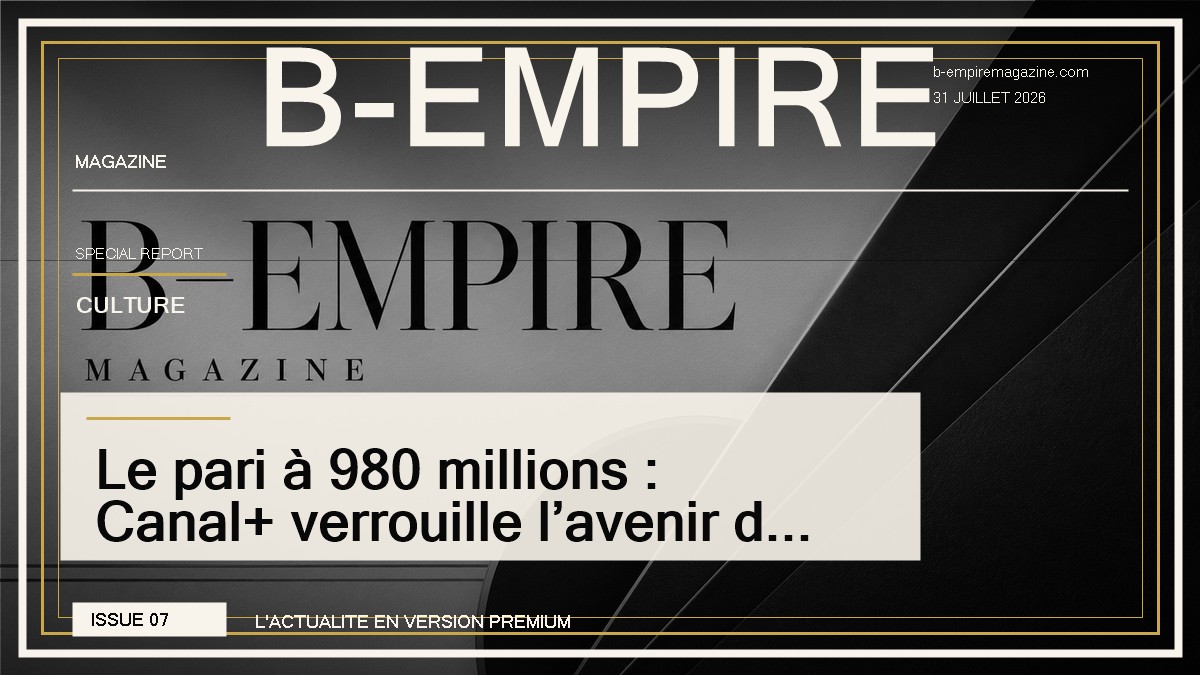
The figure resembles a declaration of power: â¬980 million over five years. Starting in 2028, Canal+ promises to invest this amount in French and European cinema. In an industry weakened by competition from platforms, rising costs, and uncertainty surrounding theaters, this agreement is not merely a budget line. It could determine which films will be produced, how they will be viewed, and whether Europe will maintain an industry capable of competing with Hollywood.
The agreement announced on July 27 concerns Canal+ as well as Ciné+ OCS and is set to run until 2032. It was signed with the main professional organizations of French cinema, including the Liaison Bureau of Cinematographic Industries, the Liaison Bureau of Cinema Organizations, and the Civil Society of Authors, Directors, and Producers. Its average amount approaches â¬196 million per year, a level significantly higher than the commitments planned for the period 2025-2027.
A Giant Check That Changes the Horizon of Cinema
In March 2025, Canal+ had concluded an agreement guaranteeing at least â¬480 million over three years: â¬150 million in 2025, â¬160 million in 2026, and â¬170 million in 2027. The new cycle thus raises the average annual effort to nearly â¬200 million. This progression gives producers rare visibility in a sector where film financing is often pieced together from broadcasters, public aid, distributors, international sales, and private contributions.
The amount will not be paid to a single fund and does not guarantee the success of each work. It is intended to support pre-purchases and investments in a variety of French and European productions. However, the five-year duration reduces uncertainty. Independent companies will be able to develop more ambitious projects, engage talents earlier, and negotiate their financing plans with a more solid foundation.
Why Canal+ Is Betting So Much on Films
This promise is not only cultural; it responds to a business logic. Recent cinema remains a powerful draw for paid subscriptions. By financing films upfront, Canal+ secures privileged access to works capable of retaining its audience, enriching the offerings of Ciné+ OCS, and nurturing an international ecosystem in which StudioCanal already occupies a major position.
The group claims more than 40 million subscribers and a broad presence in Europe, Africa, and Asia. Its partnership with MultiChoice, its distribution power, and the StudioCanal catalog thus transform a French agreement into an international asset. A film co-produced or pre-purchased in France can then circulate in multiple territories, be sold abroad, join digital bundles, and strengthen a European brand against American studios.
Media Chronology at the Heart of the Compromise
The joint statement emphasizes the need to preserve an “ambitious” media chronology. This system organizes the order and schedule of a film’s release after its theatrical debut: video on demand, pay channels, subscription platforms, and then free television. In exchange for its investments, Canal+ traditionally benefits from a quick window, which adds value to its subscription.
The debate is sensitive. The theaters want to maintain a strong exclusivity period to protect ticket sales. Global platforms demand more flexibility. The channels that finance creation want to be able to offer films to their customers quickly. The â¬980 million agreement sends a clear signal: Canal+ agrees to pay more over time but intends to remain at the center of the French distribution model.
An Assurance Against Netflix, Disney+, and Prime Video
France has mandated major streaming services to contribute to local production. This policy has brought new capital into the ecosystem, but it has also intensified the battle for scripts, stars, and rights. Netflix, Disney+, and Prime Video possess global power, recommendation algorithms, and the ability to launch a work simultaneously in many countries.
Canal+ responds with a different advantage: a long-standing relationship with producers, a deep understanding of the French market, a historical role in pre-financing, and a combination of television, streaming, distribution, and production. The â¬980 million thus serves as much to defend creation as to prevent competitors from solely capturing the most attractive works.
A Powerful Agreement, But Not a Blank Check
French cinema emerges from several months of tension. In the spring, hundreds of professionals expressed their concerns about Vincent Bolloré’s influence in media and culture. Canal+’s management reacted strongly, provoking a crisis with part of the profession. The new agreement restores an economic perspective, but it does not eliminate questions about the concentration of financing and distribution resources.
The more an actor becomes indispensable, the more its editorial choices weigh on the entire sector. The question thus concerns not only the amount invested but also the diversity of beneficiaries: debut films, auteur cinema, animation, documentaries, blockbuster productions, regional works, and independent companies. The quality of the agreement will be measured by the actual variety of supported projects.
What Viewers Could Really Gain
For the public, the effect will not be immediate. The first films of the 2028-2032 cycle are still to be written, financed, or shot. However, a more stable programming can allow for the emergence of new directors, secure risky productions, and maintain a European offer that is not limited to genres deemed most profitable by platforms.
The stakes go beyond France. European cinema suffers from a market fragmented by languages, borders, and different broadcasting habits. A group capable of financing, distributing, and promoting works on a continental scale can accelerate their circulation. However, this power must serve the films rather than homogenize them.
The Signal That Europe Cannot Ignore
At a time when Hollywood is consolidating and tech giants dominate global attention, Canal+’s commitment asserts that a European model remains possible: upfront financing, theatrical release, protection of diversity, and exploitation across multiple windows. This model is complex, sometimes contested, but it retains a crucial advantage: it shares the risk even before the film exists.
The â¬980 million will not save every theater or every producer by itself. However, it offers the sector a rare resource: time. Five years to create, negotiate, and adapt the French model to global competition. If this money truly nourishes diversity and ambition, the announcement of July 27 could be seen as the moment when European cinema decided not to relinquish its future to algorithms alone.
Sources
- Groupe Canal+ â New Agreement Between Canal+ and French Cinema, July 27, 2026.
- Le Monde â Canal+ to Invest â¬980 Million in French and European Cinema, July 26, 2026.
- Groupe Canal+ â Agreement 2025-2027 with French Cinema, March 3, 2025.
- Le Monde â Context of French Cinema Financing, May 18, 2026.