
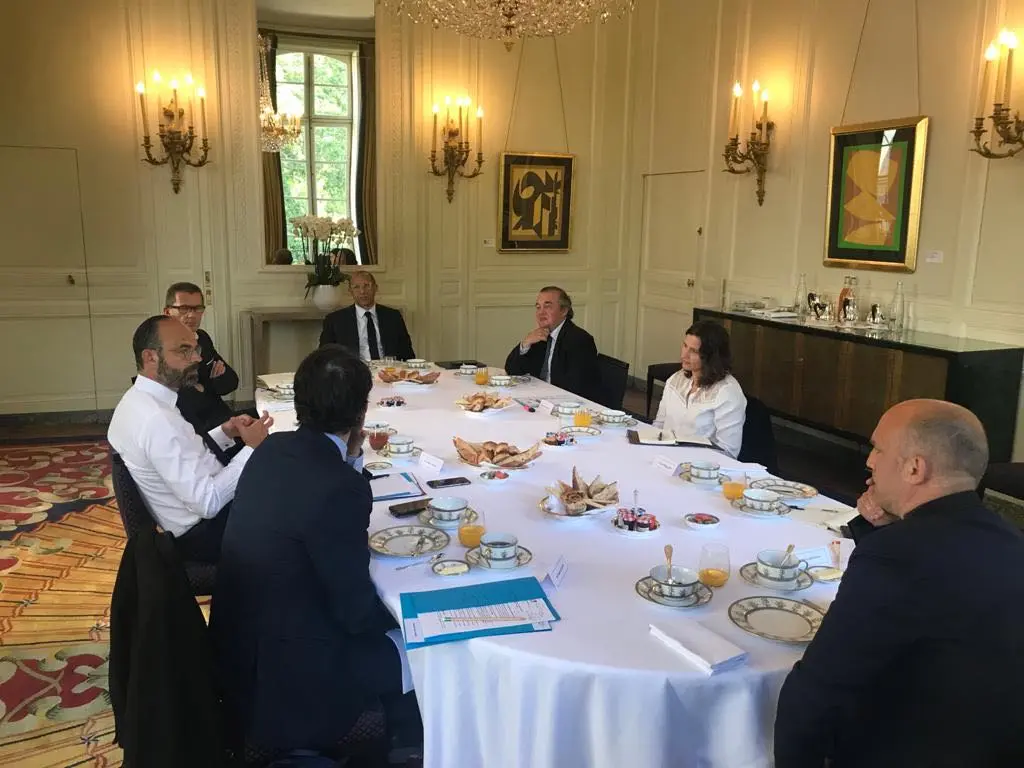
The world of football now knows the three men who want to shape its future. FIFA has officially announced the candidacies of Gianni Infantino, Frenchman Philippe Diallo, and Japanese Kohzo Tashima for the presidential election on March 18, 2027, in Rabat. Behind this list of three names lies a much broader battle: continuity of power, European revolt, Asian ambitions, and shaken trust in the governance of the planet’s most popular sport. For the first time in a long while, the election no longer resembles a mere formality.
The official announcement from FIFA, published after the closure of candidate submissions, changes the nature of the campaign. Statements of intent give way to three compliant candidacies, proposed by member associations. The incumbent president must now defend his record against two leaders from major footballing powers, each capable of turning the vote into a referendum on the direction taken by the institution.
Three Candidates, One Global Battle
The vote will take place during the 77th FIFA Congress on March 18, 2027, in the Moroccan capital. The 211 member national associations are called to vote. This principle theoretically gives each federation an equal voice, regardless of the size of its league, its commercial wealth, or its track record. Therefore, a candidacy cannot win solely with the support of large European or Asian nations; it must build a coalition across several continents.
Gianni Infantino starts with the considerable advantage of being the incumbent president. Having led FIFA since 2016, he has built a network over the course of congresses, competitions, and development programs. Opposing him, Philippe Diallo embodies UEFA‘s choice and a French attempt to present an alternative. Kohzo Tashima, honorary president of the Japanese Federation, offers a third way and, for now, refuses to withdraw in favor of the European candidate.
Philippe Diallo: Europe’s Unexpected Bet
Philippe Diallo’s candidacy marks a significant break in this election. President of the French Football Federation, the 63-year-old leader had not been presented for months as the natural candidate for the FIFA presidency. His name emerged when the European associations represented on the UEFA Executive Committee and the FIFA Council asked him to carry their voice. UEFA announced unanimous support from these European representatives.
Diallo then validated his candidacy through the FFF’s governing bodies. His message focuses on restoring trust, combating divisions, and advocating for a governance deemed more transparent. According to Associated Press, he aims to repair a “broken” trust and rid football of the “poison of division.” This rhetoric directly targets the confrontational climate surrounding Infantino’s power.
The Frenchman possesses an obvious political asset: he does not present himself as an isolated figure but as the representative of a European bloc determined to challenge the incumbent president. His challenge is equally clear. Europe accounts for only a portion of the votes, and a victory requires convincing in Africa, Asia, the Americas, and Oceania. Support from Paris or UEFA provides a launching pad, not a majority.
Infantino Remains the Favorite, But His Record Becomes the Issue
Gianni Infantino has profoundly impacted FIFA. Under his presidency, the men’s World Cup expanded to 48 teams, revenues increased, and new projects extended the international calendar. His supporters highlight financial redistribution, opening up to more countries, and the organization’s ability to generate unprecedented resources for football development.
However, his opponents denounce a concentration of power, an inflation of competitions, and an increasingly contentious relationship with certain European institutions. The debate surrounding the commercialization of World Cup-related assets has intensified criticism of FIFA’s financial trajectory. Diallo seeks to transform these controversies into an electoral question: should the institution continue the same strategy or change its approach?
The incumbent president remains difficult to beat because FIFA elections are not only played out in European public opinion. They are won federation by federation, through regional alliances and the trust accumulated with countries for which international funding programs represent a crucial resource.
Kohzo Tashima: The Man Who Could Change Everything
Kohzo Tashima’s presence prevents the election from being reduced to a Franco-Swiss duel. The former president of the Japanese Federation has extensive experience in sports governance and a keen understanding of Asian balances. His candidacy is particularly interesting given that the Asian Confederation has been described as favorable to Infantino: Tashima must therefore win votes beyond traditional regional apparatuses.
His continued candidacy could either divide the votes for change or, conversely, force the two main camps to look towards Asia. Le Parisien reports that the Japanese does not plan, “for now,” to withdraw to favor Diallo. This position gives Tashima immediate strategic weight. Even if he does not appear to be the favorite, he can influence themes, alliances, and the outcome of the vote.
Why This Election Goes Beyond Football
FIFA organizes events that mobilize billions of spectators, states, broadcasters, sponsors, and host cities. The choice of its president affects club schedules, the development of women’s football, revenue distribution, requirements imposed on host countries, and the role of private investors. It also touches on human rights, environmental issues, and sports diplomacy.
The next presidency will have to manage the post-2026 World Cup landscape, the expansion of competitions, tensions with leagues, and the physical saturation of players. It will also need to prepare for the major upcoming deadlines while responding to federations demanding more resources. Each electoral promise will thus be judged on a difficult equation: to grow world football without turning its calendar into an uncontrollable machine.
France Plays a Rare Card
For French football, Diallo’s candidacy represents a major institutional moment. France has immense sporting and cultural influence, but it has not often placed one of its leaders at the center of such an open global campaign. European support offers immediate visibility, while French political backing can facilitate the necessary diplomatic meetings.
This closeness to public authorities must, however, be handled with care. The voting federations want to hear a universal project, not just a European offensive against Infantino. Diallo will need to speak to smaller leagues, to territories where infrastructure is lacking, and to confederations that fear that a rebalancing of power will primarily benefit wealthy nations.
The Signal That Cannot Be Ignored
With four months to go until the vote, no outcome is guaranteed. Infantino remains the favorite due to the strength of his network and his control over institutional tempo. Diallo benefits from a European momentum and a narrative of change. Tashima, on the other hand, has the capacity to disrupt calculations and draw attention to the political weight of Asia.
The essential fact is already clear: the FIFA presidential election of 2027 will be contested. On March 18 in Rabat, federations will not only choose a president. They will decide whether they want to extend the Infantino era, entrust the break to Frenchman Philippe Diallo, or open an Asian pathway with Kohzo Tashima. The world of football is now watching a campaign where every alliance can change everything.
Sources
- FIFA, official announcement of the three candidacies and election date, November 19, 2026.
- UEFA, European support for Philippe Diallo’s candidacy, November 16, 2026.
- Associated Press, Philippe Diallo’s project and governance issues, November 17, 2026.
- Le Monde, profiles and power dynamics among the three candidates, November 19, 2026.
- Le Parisien, Kohzo Tashima’s continued candidacy, November 20, 2026.