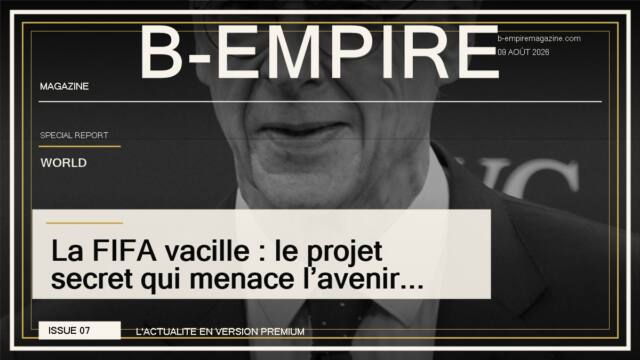
The world of football has crossed a red line. UEFA has declared that it has lost confidence in FIFA‘s leadership and its president, Gianni Infantino, following the failure of a project intended to open a portion of the World Cup‘s commercial revenues to private investors. FIFA has abandoned the initiative under pressure, but this retreat has not extinguished the fire; it has merely shifted it to a much more explosive question: Can Infantino still govern global football with Europe’s trust?
The confrontation is not merely about a financial arrangement. It touches on the symbolic ownership of the World Cup, the control of its billions, and how a non-profit organization makes decisions that affect 211 federations. For France, a member of UEFA and a central nation in global football, this crisis is not distant. It directly concerns the French Football Federation, its future revenues, its international representation, and the place of sport in the public interest.
The Project That Triggered a Global Revolt
According to the Associated Press, Gianni Infantino wanted to create a commercial structure called FIFA Forward Enterprise. The project would have allowed for the sale of a minority stake in an entity responsible for exploiting the commercial activities of FIFA’s major competitions, including the World Cup. Reports suggest a 21% stake and an extremely high potential valuation, bringing private equity to the heart of the planet’s most powerful sporting product.
For proponents of such an operation, the idea may have seemed appealing: to obtain billions immediately, accelerate commercial growth, and distribute more money to federations. However, its opponents saw a major risk. Once investors were embedded in the structure, their priority would have been profitability. Schedules, formats, media markets, and the fan experience could then have faced even more intense commercial pressure.
UEFA believed that the governance and soul of football could not become negotiable assets without sufficient transparency. The European dissent quickly took the form of an exceptional threat: the 55 member federations of UEFA were prepared to withdraw from FIFA competitions if the plan proceeded. Without European teams, no World Cup could maintain its current sporting, media, and commercial value.
Infantino Retreats, but UEFA Does Not Sign Peace
FIFA ultimately announced that it would not proceed further. On paper, the abandonment of the project could have allowed for a return to calm. However, UEFA chose to escalate the pressure. In a particularly harsh statement, the European body welcomed the withdrawal of the arrangement while asserting that it had lost confidence in FIFA’s current leadership.
The message is aimed directly at Gianni Infantino. UEFA accuses him of failing to uphold the promises of transparency made upon his election as president in 2016. The matter has thus become personal and institutional. It is no longer about correcting a flawed project, but about establishing how it was prepared, who supported it, what financial interests were at stake, and why the governing bodies of world football were not involved sooner.
A European Victory That Opens a Power Crisis
Europe has won the first round by demonstrating that it can block a strategic transformation of FIFA. However, this victory makes the future more delicate. UEFA cannot, on its own, depose the FIFA president. Infantino retains the formal support of a large number of federations in Africa, Asia, the Americas, and Oceania, largely thanks to development programs funded by World Cup revenues.
The crisis could thus produce a long cold war. On one side, UEFA possesses the most powerful teams, clubs, players, and audiovisual markets. On the other, FIFA relies on a global coalition where each association has a voice. To transform a statement of distrust into a change in leadership, Infantino’s opponents will need to convince well beyond Europe and propose a credible alternative to finance the development of football.
Why Private Investors Are So Concerning
Private equity is already present in sports: leagues, media rights, commercial companies, and club-related assets attract funds seeking returns. However, the World Cup represents a different entity. It is not limited to a catalog of rights. It is based on the history of national teams, the public funds mobilized by host countries, the work of federations, and the loyalty of billions of supporters.
Giving up a share of its commercial exploitation would have created a permanent tension between two logics. The first is to protect the universality and integrity of the tournament. The second seeks to rapidly increase revenues, potentially leading to more events, premium offers, higher prices, and advertising spaces. The 2026 World Cup had already reignited criticism over ticket costs, logistical excesses, and the growing spectacle surrounding matches. This project arrived in a climate where the public was already questioning how far FIFA wanted to push monetization.
What France Stands to Gain or Lose
The French Football Federation finds itself at the center of a delicate balance. As a member of UEFA, it benefits from European sporting and economic power. As a member of FIFA, it also participates in a global system whose competitions and redistributions finance football at all levels. A lasting rupture between the two institutions would create uncertainty regarding schedules, competitions, and revenues.
France also has a political responsibility. Its national team is one of the strongest sports brands in the world, its players fuel the biggest European clubs, and Paris remains a major center of football business. A French position in favor of audits, collegial decisions, and the publication of financial interests could weigh in the debate without reducing it to a personal war.
The Three Questions FIFA Must Answer
The first concerns transparency: which investors were approached and what concessions were they demanding? The second concerns the procedure: which leaders and federations were actually involved in preparing the arrangement? The third concerns strategy: does FIFA want to continue to commercialize its competitions more and more, or set limits intended to protect their sporting and popular dimensions?
These answers will determine whether the matter remains an abandoned project or becomes the beginning of a succession crisis. UEFA now promises to hold those responsible accountable. National federations will need to decide whether they are satisfied with the withdrawal of the plan or if they demand a deeper reform of governance.
The Signal That No One in Football Can Ignore
Gianni Infantino built his power on growth: more teams, more matches, more revenues, and more money redistributed. For the first time, this mechanism encounters a collective refusal capable of stopping it. The withdrawal of the project proves that FIFA is not all-powerful. UEFA’s statement of distrust shows above all that the personal authority of its president is now contested at the highest level.
The football world is thus looking less at the project that has just fallen than at the balance of power it reveals. The World Cup has not been sold. But the very idea that it could be has fractured global governance and posed an impossible question to close: who truly owns football when its value reaches tens of billions?
Sources
- Associated Press, UEFA’s statement of distrust and governance issues, August 1, 2026.
- Associated Press, FIFA’s abandonment of the project to open to private investors, August 1, 2026.
- Le Monde, European boycott threat and power dynamics with FIFA, July 31, 2026.
- FIFA, official presentation of the commercial strategy after the 2026 World Cup, July 2026.