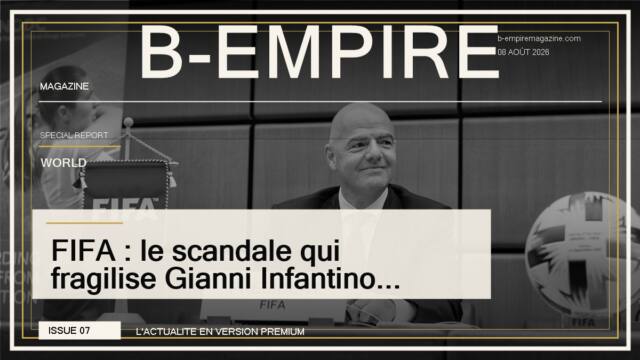
The World Cup had barely concluded when FIFA plunged into a crisis capable of reshaping power at the top of football. Gianni Infantino had to abandon a spectacular project: creating a company valued at around $20 billion, tasked with exploiting FIFA’s major competitions and open to external capital of up to 20%. The retreat did not extinguish the fire; it unleashed criticism, exposed internal divisions, and raised a question that the sports world can no longer avoid: who truly controls its most valuable tournament?
The issue transcends a battle of executives. It touches on the economic ownership of both the men’s and women’s World Cups, the redistribution to 211 national federations, and the independence of an organization that presents itself as the universal guarantor of the game. Following the popular triumph of the 2026 World Cup, FIFA hoped to tell a story of growth. It must now defend its methods, transparency, and the legitimacy of its president.
A $20 Billion Project Stopped in Its Tracks
The project, dubbed FIFA Forward Enterprise, was intended to consolidate the commercial activities related to the governing body’s major competitions. According to an explanation published by Reuters, the future subsidiary would have been valued at approximately $20 billion. Private investors could have acquired up to 20% of its capital, while member federations would have received a stake and additional funding.
On paper, the promise was powerful: to transform the growth of global football into immediate resources for associations. However, the mechanism fundamentally changed the nature of the system. Financial actors would have a direct interest in the revenues generated by the World Cups and other competitions. For opponents, this was not merely an accounting operation but a sustainable opening of sports heritage to a logic of private yield.
The backlash was so swift that the plan was abandoned on August 1. Yet, this withdrawal was not enough. Attention immediately shifted from the content of the project to its preparation: who had been consulted, which officials were aware of the details, and why so many football personalities claimed to have discovered it through the press?
A Rift Opens Within FIFA Itself
The discomfort became public when executives and advisors distanced themselves. Carlos Cordeiro, former president of the American Federation and FIFA advisor to the White House working group on the World Cup, resigned in protest. His departure gave an institutional dimension to an opposition that had previously been dominated by confederations and external observers.
Mattias Grafström, FIFA’s Secretary General, later described the sequence as regrettable in a message to staff and emphasized the definitive abandonment of the project. Le Monde reported that employees were divided between discomfort and anger, with some blaming management for keeping much of the administration in the dark. For an international organization, this internal distrust is particularly dangerous: it threatens the ability to govern well beyond a single issue.
Arsène Wenger Places Independence at the Heart of the Debate
Arsène Wenger’s reaction resonated strongly in France. As FIFA’s Director of Global Football Development, the former Arsenal manager stated that he had not participated in the project and learned about it through the media. He defended the idea of an independent FIFA, committed to transparency and integrity, while deeming the withdrawal essential.
This stance matters because Wenger is neither an external adversary nor a peripheral official. His global stature and role within the institution lend weight to the central reproach: a decision likely to transform the economy of football had progressed without sufficiently broad debate. For French and European supporters, his intervention makes tangible a financial affair that might otherwise seem abstract.
Europe Leads the Revolt, but Pressure Becomes Global
UEFA played a driving role in rejecting the project. The major European federations wield considerable sporting and commercial weight, but their opposition also raises an old tension: FIFA represents all regions of the world, while Europe concentrates a significant share of clubs, players, broadcasters, and the most powerful revenues.
This time, however, the dissent is no longer limited to a FIFA-UEFA duel. British Prime Minister Andy Burnham stated that Infantino was no longer the right person to lead the organization, according to the Associated Press. League leaders, federation officials, and employees have also expressed their concerns. The broader the critical coalition grows, the more the FIFA president risks losing the argument of mere European resistance to global redistribution.
Why Private Investors Are So Concerning
Private capital is not new to sports. It finances clubs, leagues, broadcasting rights, and infrastructure. However, the World Cup occupies a different place. It does not belong to a closed championship or a traditional business: it relies on national teams, domestic schedules, players released by clubs, and a history built by generations of supporters.
A minority shareholder would not solely control the competitions, but they would logically seek profitability. This could increase pressure to multiply events, raise the value of rights, favor certain markets, or alter the distribution of profits. Proponents of a partnership would argue that new capital could accelerate development in less wealthy countries. The real issue thus lies in the guarantees: governance, veto rights, duration of agreements, transparency of valuations, and protection of non-commercial missions.
The Post-2026 World Cup Was Meant to Solidify Infantino
The timing makes the crisis more explosive. The 2026 World Cup in North America has confirmed the immense commercial capacity of the competition. FIFA itself celebrated an exceptional economic potential. In this context, transforming this growth into an investment vehicle could have appeared as the next step in a strategy of expansion pursued for several years.
However, the success of the tournament also strengthens the counter-argument: why relinquish a share of a growing asset? Without a widely shared independent evaluation, without transparent consultation, and without consensus on the use of funds, such an ambitious operation could be perceived as a rushed privatization. The manner in which the issue emerged ultimately overshadowed the financial logic that its promoters sought to defend.
Infantino’s Future Now Rests on Trust
Gianni Infantino has led FIFA since 2016 and remains a formidable political tactician. He retains significant support among the federations to which the organization distributes essential funding. A scandal, even a resounding one, does not automatically lead to a downfall. However, the upcoming FIFA presidential election, scheduled for March 2027, transforms every break in alliances into a signal to watch.
Three signals will determine the next steps. First, the management’s ability to publish a credible timeline of the project and its abandonment. Second, the potential opening of legal or ethical reviews. Finally, the position of confederations outside Europe, whose support is decisive in the “one federation, one vote” system. If discontent spreads in Africa, Asia, or South America, the crisis will change nature.
World Football Has Just Drawn Its Red Line
The abandonment of FIFA Forward Enterprise already constitutes a major fact: in the face of a rapid revolt, the most powerful president in football has retreated. However, this victory for the opposition does not close anything. It opens a deeper debate on the boundary between commercial growth and collective control, between redistribution and financial dependence, between the efficiency of a strong executive and the necessity of shared decision-making.
For supporters, the essence can be summed up in one sentence: the World Cup cannot be treated as an ordinary asset. Its value comes precisely from what it brings together nations, cultures, and stories that no one can buy alone. FIFA has avoided immediate rupture by withdrawing its project. It must now prove that it has understood the message.
Reliable Sources
- Reuters â structure, valuation, and functioning envisaged for FIFA Forward Enterprise
- Associated Press â abandonment of the project and reaction from the British Prime Minister
- Le Monde â internal tensions, timeline, and reactions within FIFA
- FIFA â official statements on the economic impact of the 2026 World Cup