

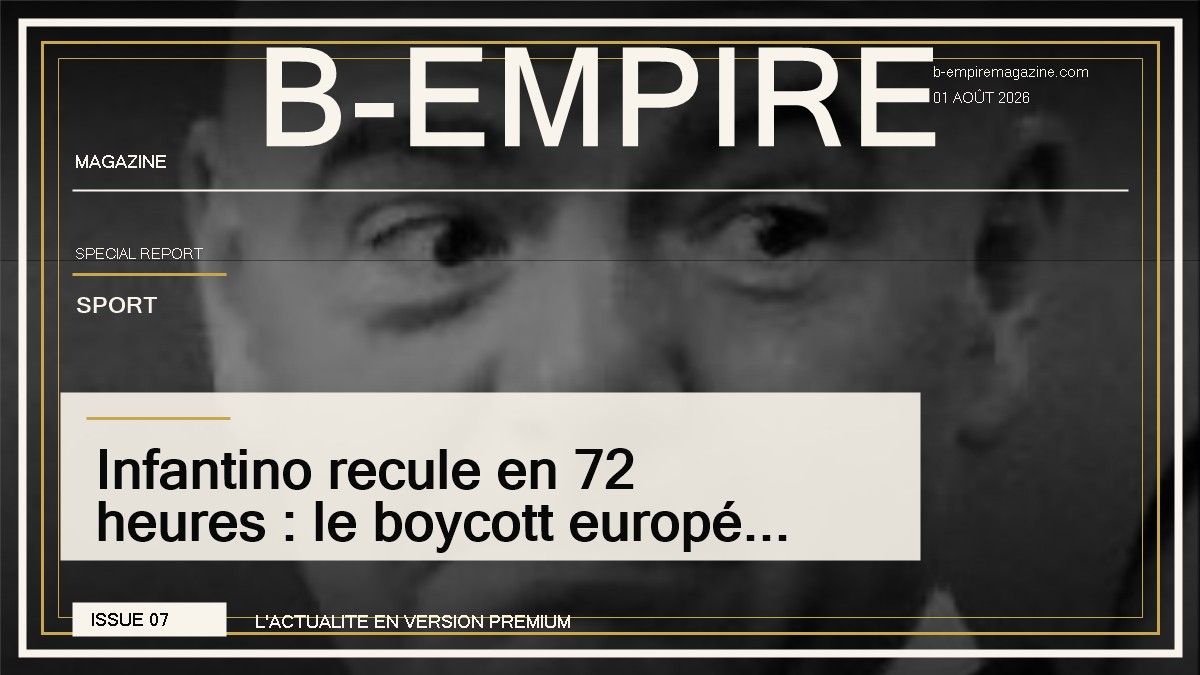
It took just three days for a show of strength to turn into a spectacular retreat. Gianni Infantino has abandoned his plan to open a portion of the company intended to concentrate FIFA‘s commercial revenues to private investors. The threat of a boycott launched by UEFA and its 55 federations, including France, has thus achieved what critics and internal warnings had failed to impose: the halt of an operation that would have permanently changed the economic ownership of the World Cup.
The turnaround is significant. On Tuesday, July 28, FIFA was still presenting FIFA Forward Enterprise as the engine for a new global growth, promising to increase investments in football development to over $10 billion. By the night of July 31 to August 1, the Associated Press announced that Infantino would not pursue the project. In between, European football wielded the most powerful weapon in its recent history: no UEFA selection would participate in FIFA competitions as long as the plan remained alive.
The Plan That Was to Redefine the Economy of World Football
The scheme envisioned by FIFA’s leadership was based on the creation of FIFA Forward Enterprise, a subsidiary grouping the major commercial and event operations of the organization. FIFA claimed it would retain exclusive control over competitions, scheduling, and sporting decisions. However, up to 20% of the capital of this new structure could be opened to a group of private investors.
The valuation mentioned around $20 billion immediately gave the operation a historic dimension. Investors would have gained indirect exposure to the revenues from the men’s and women’s World Cups, the Club World Cup, and other commercial assets of FIFA. In exchange, Infantino promised federations a spectacular increase in their allocations: up to $40 million in the next cycle, compared to about $10 million under the status quo, according to reports from several European media outlets.
On paper, FIFA presented the project as a development accelerator. Its opponents saw it as a partial privatization of the collective heritage of football, with an unavoidable question: what would happen when the return requirements of external investors conflicted with scheduling, player health, fan access, or the balance between small and large federations?
The Boycott Threat That Changed Everything
The UEFA response was swift and unanimous. The 55 European national associations rejected the transfer of economic interests in FIFA competitions and announced they would cease to participate if the project advanced. The threat encompassed the men’s and women’s World Cups, youth tournaments, and all other events organized by FIFA.
This unity changed the balance of power. Without France, Spain, England, Germany, Italy, Portugal, or the Netherlands, a World Cup would have lost a significant portion of its sporting, audiovisual, and commercial value. The pressure was no longer coming solely from Europe: Concacaf and the Asian Confederation had also expressed their opposition to the process. The project intended to attract capital was then threatening to destroy the very asset that this capital was meant to enhance.
The timeline will remain a lesson in power. FIFA had the money, the brand, and the contractual control of competitions. The federations had the teams, the players, and the sporting legitimacy. Once they agreed to assume the risk of a break, the financial mechanics became untenable.
A Rift Even Within Infantino’s Inner Circle
The retreat also occurs in an unusual climate of internal dissent. Kevin Lamour, a senior FIFA executive based in Zurich and a former member of Infantino’s inner circle, publicly defended the organization’s employees. He claimed that staff had been misled about the nature and progress of the project, while calling on other officials to speak out.
This stance undermines the narrative of a controlled consultation. Such a profound change in the commercial structure of world football could not appear as a decision prepared by a few leaders and advisors without open debate. The issue was therefore not only the presence of private funds. It also concerned the method, transparency, the identity of potential beneficiaries, and the real role assigned to the 211 member associations.
What UEFA’s Victory Changes for France
For the French Football Federation, the immediate result is clear: the threat of a break with FIFA recedes. The Blues, the French women’s teams, and youth selections should not have to choose between European solidarity and participation in global competitions. However, the episode leaves a political question: how to prevent a comparable project from resurfacing in another form?
France also has a direct economic interest to defend. The value of French football does not solely come from the revenues paid by governing bodies. It relies on training clubs, licensed players, local authorities, broadcasters, and fans. If global competitions become financial products, the pressure to multiply matches, increase prices, and favor the most profitable markets can trickle down to Ligue 1 and the schedules of international players.
Infantino Loses a Battle, Not Control of FIFA
However, it would be excessive to present this setback as the end of Infantino’s power. The FIFA president retains considerable influence, a global network of federations benefiting from the Forward program, and the ability to propose new reforms. His central argument â increasing revenues to finance football in all regions â remains powerful, particularly among associations with few commercial resources of their own.
The battle will therefore shift. European federations will need to explain how they wish to finance the growth of world football without opening the door to a privatization of competitions. FIFA will have to prove that the withdrawal is complete and sustainable, and not merely a tactical pause. As for investors, they will continue to view football as a global industry with rare, predictable, and emotionally powerful revenues.
The Signal Football Has Just Sent to Finance
The message from the weekend transcends the person of Gianni Infantino. A competition is not merely a future stream of television rights, tickets, and sponsorship. Its value depends on the trust of selections, players, and the public. By threatening to withdraw their participation, European federations reminded that this trust constitutes an asset that no one can buy without consent.
The FIFA Forward Enterprise project was meant to demonstrate that football could attract even more capital. Its abandonment demonstrates something else: even in a sport that has become a global industry, sporting legitimacy can still triumph over financial power. The victory is clear, but it now opens a period of scrutiny. For after such a rapid retreat, the real test will be whether FIFA’s governance changes â or if only the form of the next project will be more difficult to combat.
Sources
- Associated Press â Infantino abandons the project after global backlash, August 1, 2026.
- Associated Press â Internal dissent and Kevin Lamour’s stance, August 1, 2026.
- El PaÃs â FIFA retreats in the face of opposition from UEFA, Concacaf, and AFC, July 31, 2026.
- FIFA â Official presentation of the FIFA Forward Enterprise project, July 28, 2026.


