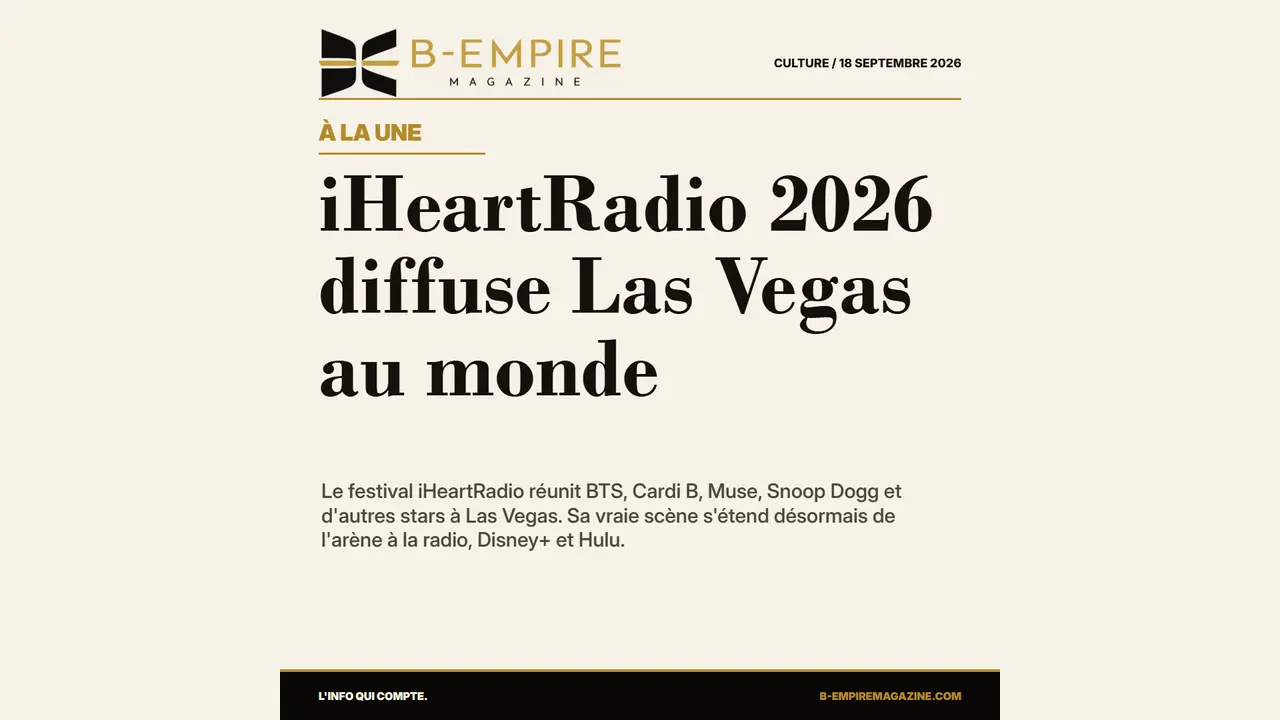
In Las Vegas, the iHeartRadio Music Festival is no longer content with filling an arena: it is orchestrating one event for the venue, radio and global streaming at the same time. The 2026 edition opens on September 18 at T-Mobile Arena with a lineup bringing together BTS, Cardi B, Goo Goo Dolls, Kenny Chesney, Weezer and Zara Larsson. The second night, on September 19, is set to feature Benson Boone, Ciara, Lainey Wilson, LE SSERAFIM, Major Lazer, Muse, Snoop Dogg and The Smashing Pumpkins, among others. Ryan Seacrest hosts both nights.
The variety of names is striking, but the more important innovation lies in distribution. Performances air live across iHeartMedia stations in more than 150 American markets, while Disney+ and Hulu serve as the official streaming destinations. The event combines the historic power of radio, the exclusivity of a major arena and the international reach of subscription platforms. It is no longer merely a music weekend; it is a demonstration of convergence.
A Lineup Designed to Cross Audiences
Bringing together BTS, a K-pop group with a global community, Cardi B, alternative-rock veterans such as Weezer and Goo Goo Dolls, country figure Kenny Chesney and European pop star Zara Larsson is not random. The lineup is less interested in defining one musical identity than in creating a sequence of entry points. Each artist activates a different audience, cultural territory and set of social platforms.
The second night follows the same logic with Muse and The Smashing Pumpkins for rock, Snoop Dogg for legacy hip-hop, Major Lazer for global electronic culture, Lainey Wilson for contemporary country, Ciara for R&B-pop and LE SSERAFIM for K-pop. The mixture may look incompatible with the traditional model of a festival built around a genre community. Yet it fits iHeartMedia perfectly: program distinct worlds, then connect them through national infrastructure.
Radio Becomes the Backbone of Live Distribution
In the digital economy, radio is sometimes described as an old medium. The iHeartRadio Music Festival reveals a more complicated reality. The station network offers local promotional power, daily frequency and a habitual relationship with listeners. A national live broadcast turns that architecture into a backbone: a concert organized in one city can be experienced simultaneously across hundreds of coverage areas.
Disney+ and Hulu add images, home access and international scale. Subscribers can watch both nights without buying an arena ticket, subject to territorial availability. The system does not replace the physical experience; it multiplies it. Scarcity remains in Las Vegas, through artist presence, collaborations and surprises. Scale lives on screens and airwaves.
The Concert as a Platform Product
For Disney+ and Hulu, the festival supplies something series and films cannot reproduce: a real-time appointment, open to surprise and capable of attracting communities that are already mobilized. Live content strengthens the value of a subscription during a defined window. It also creates synchronized social conversation, as clips, reactions and artist names circulate while the show is happening.
For iHeartMedia, the partnership extends the brand beyond audio. The company produces the livestream and retains its role as editorial organizer. It can offer advertisers several levels of activation: visibility inside the arena, presence across radio programming, integration into the digital experience and association with artists spanning multiple generations. Capital One is the presenting partner, while a long list of brands supports the event.
BTS as a Global Accelerator
BTS’s presence on the first night gives the 2026 edition particular reach. The group returned after a break connected to its members’ mandatory military service and released ARIRANG, its first original group album since reuniting. Its participation turns an event historically centered on the American market into an appointment followed by an exceptionally organized international audience.
That community does more than watch. It translates, archives, shares schedules across time zones, analyzes performances and amplifies each moment on social networks. For platforms, this behavior carries significant value: it lowers discovery costs and turns the audience into a secondary distribution network. For other artists appearing that night, proximity to BTS can create cross-exposure that would be difficult to reproduce at a single-genre festival.
A Model That Redefines Festival Scale
T-Mobile Arena’s capacity sets the event’s physical size, but it no longer defines its real audience. The festival exists in several versions: a premium show for people in attendance, a radio program for listeners in motion, a video stream for subscribers and viral material for social platforms. Each has its own rhythm and value model.
For B-EMPIRE, the 2026 iHeartRadio Music Festival shows that the next battle in live entertainment is not only about ticket sales. It concerns the ability to organize rights, brands, communities and technology around a shared moment. Las Vegas supplies the setting; radio provides reach; Disney+ and Hulu turn two nights into a global product. The most powerful festival may no longer be the one that hosts the largest crowd, but the one that can distribute live energy without losing the feeling of an event.