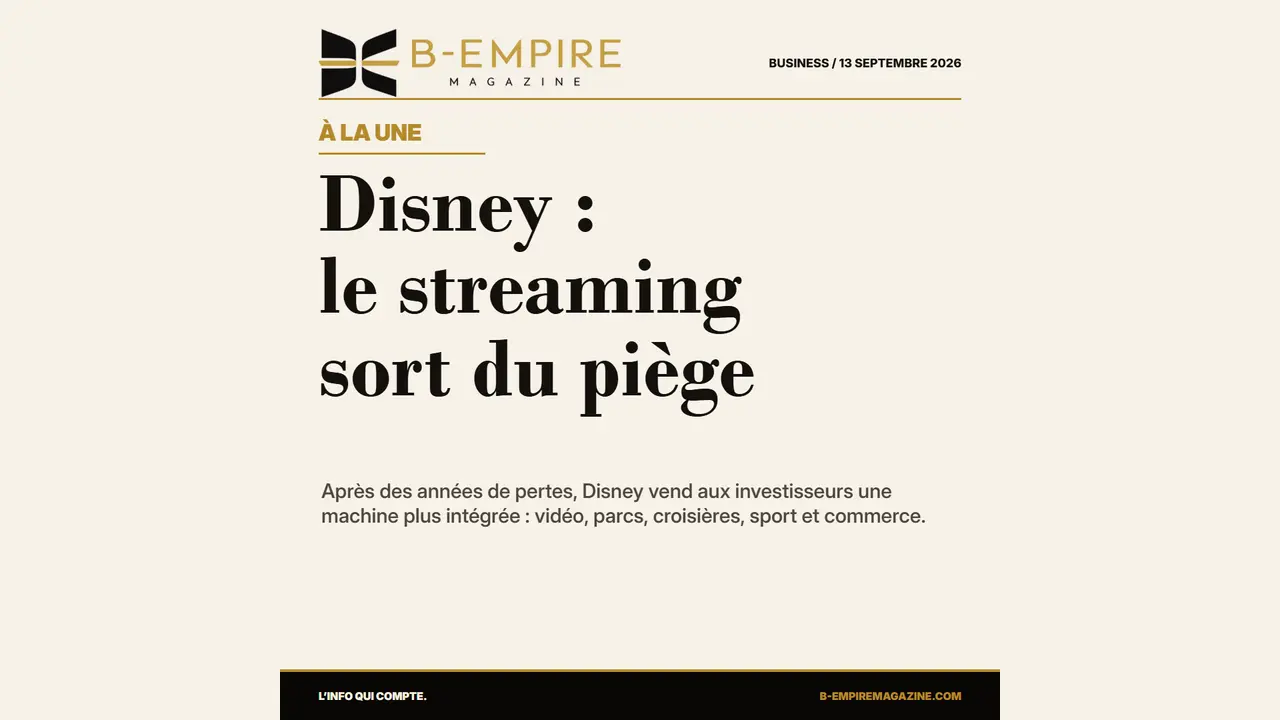
Disney wants to convince Wall Street that its streaming business is no longer a sinkhole, but a gateway into the brand’s entire ecosystem. At the Goldman Sachs Communacopia + Technology conference on September 9, 2026, Hugh Johnston, chief financial officer of The Walt Disney Company, presented a less fragmented company: Disney+, Hulu, ESPN, parks, cruises, franchises and commerce are now meant to operate as one customer-value machine.
The thesis is simple, but consequential. For years, investors judged video platforms by subscribers, losses and the content war. Today, Disney is trying to shift the conversation toward profitability, loyalty and total revenue per fan. Investing.com, in its summary of the conference, notes that Disney+ reached a 13% operating margin in the latest quarter after a long period of losses. Management wants to move from a defensive story centered on cost reduction to a more balanced growth story.
Streaming Becomes Infrastructure
The major difference from Netflix or purely video platforms lies in the depth of Disney’s universe. For Disney, a subscription is not only access to series and films. It is a door to characters, parks, merchandise, cruises, games, sporting events and family experiences. Johnston stressed, according to several transcripts of the conference, the ambition to make Disney+ a more integrated product, able to connect video, engagement, live television and commercial opportunities.
This repositioning changes the platform’s role. Disney+ should no longer be only the digital storefront for expensive content. It must become a relationship tool: reducing churn, increasing time spent, recommending franchises, preparing trips, selling experiences and giving Disney a more direct understanding of its audiences. In this logic, streaming is not the end of the chain. It becomes the command center of customer relationship.
Parks Remain the Emotional Vault
Disney’s model keeps an advantage few media groups can copy: physical places where imagination becomes real spending. Parks and cruises give the company an economic depth that purely digital platforms do not have. They turn nostalgia, characters and franchises into hotels, tickets, restaurants, trips and souvenirs. Johnston presented experiences as one of the growth pillars, with investments meant to support attendance and spending per visitor.
This dimension is strategic in a saturated entertainment market. Many platforms can buy series. Few can turn a story into a complete family trip. Disney’s strength is to move the same desire between screen, park, ship, store and memory. If that movement becomes smoother through technology, the value of each fan can rise without the company relying only on a permanent increase in subscriber numbers.
Live Sports as an Advertising Magnet
Another strong point from the conference concerns sports. Fortune reports that Hugh Johnston described live sports as a critical driver of customer value in a market where advertisers still seek large, simultaneous audiences. Sport remains one of the few kinds of content people want to watch live, without delay, with high attention. For Disney, ESPN therefore becomes more than a channel: it is a weapon in the battle for engagement and premium advertising.
Live sports also have defensive value. In a world where series are watched on demand, films move quickly and social platforms fragment audiences, sports events preserve scarcity. They create appointment viewing. They justify subscriptions, bundles, ad formats and partnerships. Disney is not merely trying to preserve ESPN as a historic asset. It wants to integrate it into a broader architecture in which sport, streaming and brand work together.
The One Disney Promise
The One Disney formula is not just an internal slogan. It answers a classic weakness of large conglomerates: owning powerful assets without always making them speak to one another. If Disney+ recommends a trip, if a park extends a series, if ESPN feeds the platform, if Hulu completes the adult offer and if commerce becomes more natural, then the company can sell a more complete relationship than its rivals.
Execution will be difficult. Too much integration can make the experience heavy. Too much commerce can tire the fan. Too many notifications can turn magic into a marketing tunnel. Disney will therefore need to find the right balance: enough connection to increase value, enough restraint to preserve enchantment. In premium entertainment, data should remain invisible when it serves the customer well.
AI Between Efficiency and Imagination
The conference transcripts also mention artificial intelligence as a tool for productivity, cost control and better resource allocation. For Disney, AI can play a role in recommendation, personalization, workflows, marketing and some internal processes. The most delicate question will not only be economic. It will be creative: how can Disney use AI without banalizing the identity of a company founded on story, characters and emotion?
Disney has an immense intellectual property library. AI can help navigate it, distribute it and better understand behavior. But Disney’s value does not come only from its files; it comes from the cultural trust accumulated around its worlds. Efficiency must not crush singularity. The risk, for a group of this size, is becoming too rational in a business that sells the irrational: attachment, memory and wonder.
A Test for All Hollywood
The Disney case interests all of Hollywood because it points to one possible way out of the streaming wars. The first phase was conquest: launch a platform, accumulate subscribers, spend massively on content. The second phase was correction: raise prices, add advertising, crack down on password sharing and cut costs. Disney wants to enter a third phase: use streaming as a backbone that activates the entire portfolio.
This strategy could give a decisive advantage to groups with several coherent businesses. It could also widen the gap with smaller players unable to offer a full experience. Entertainment is becoming an ecosystem business. Films, series, parks, games, sport, travel and products are no longer separate lines. They become pieces of the same journey.
Why It Matters
For B-EMPIRE, Disney illustrates the mutation of cultural capital. The brand is no longer trying only to sell content. It wants to orchestrate a fan life, from the living-room screen to the trip, through live sport, products and memories. If the strategy works, Disney will not only be a more profitable media company. It will become a global experiences platform able to turn every interaction into cumulative value.
The challenge is immense: preserving magic while speaking the language of margins, data and returns. But that is precisely where the luxury of contemporary entertainment is being defined. The companies that win will not only be those producing the best content. They will be those that know how to turn an audience into a community, a community into a habit, and a habit into an empire.