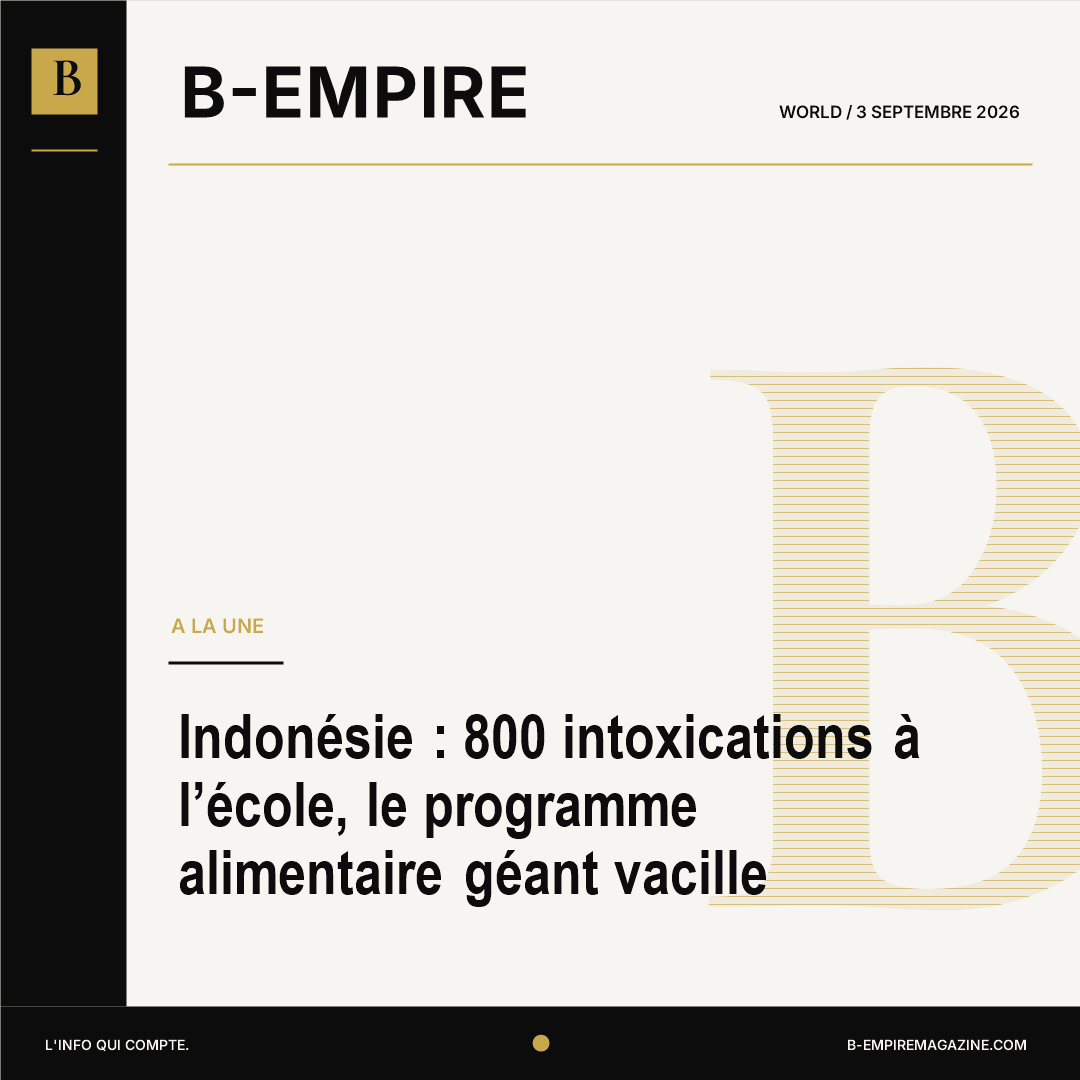
A program designed to combat hunger finds itself at the center of a new national health alert. In Indonesia, more than 800 students and teachers fell ill this week in three separate incidents linked to free meals distributed by the state. Nausea, vomiting, and abdominal pain led dozens of victims to the hospital, while kitchens were suspended and authorities opened investigations.
The scale of the toll is striking, but more importantly, it reveals deeper issues. The Makan Bergizi Gratis program, or MBG, is one of the most visible promises of President Prabowo Subianto. It aims to reduce malnutrition, support education, and improve child development. Its expansion has been remarkable: over 62 million students and pregnant women are now said to receive these meals, according to figures reported by Reuters and The Guardian.
Three Outbreaks, Over 800 Sick
The largest outbreak was reported in Sidoarjo, East Java. The Guardian, citing Reuters and local authorities, reported that 566 students were sick, with 88 hospitalized. In Nganjuk, also in East Java, 49 students showed symptoms after a meal that included fried rice, chicken, and tofu.
In Agam, West Sumatra, 237 students and teachers were also affected. Eggs are suspected in this incident, but investigations are still underway to determine the exact cause. Combined, these three outbreaks exceed 850 individuals. The numbers may evolve as patients are accounted for and authorities consolidate data.
The regional government of Agam has suspended meal distribution pending an evaluation. The kitchen associated with the Sidoarjo outbreak has also been shut down. These decisions represent an immediate response, but they do not resolve the central question: how to ensure a safe cold chain, cooking, storage, and delivery at the scale of an archipelago of over 280 million inhabitants?
Prabowo’s Flagship Program Under Pressure
Launched to address a real problem, the initiative relies on immense ambition. Indonesia wants to prevent children from studying on empty stomachs and reduce growth stunting related to undernutrition. Prabowo Subianto reminded Parliament that a hungry child cannot learn effectively and that the country cannot accept that one in four children suffers from stunting.
This social objective explains why the executive refuses to abandon the program despite the controversies. However, each new poisoning erodes family trust. The issue is no longer presented as an isolated anomaly: recurring complaints concern food quality, delivery times, tray washing, and storage conditions. The National Nutrition Agency itself attributed previous incidents to inadequate storage and late delivery of cooked meals.
A Giant Logistics Operation Becomes a Political Risk
Distributing tens of millions of meals each day is not just a social policy. It is an industrial operation that requires controlled purchasing, certified kitchens, trained staff, rapid transportation, and traceability capable of immediately tracing back to the source of an incident. A failure in a single link can affect multiple schools within hours.
The Indonesian cabinet secretariat announced at the end of August a tightening of controls. Out of 27,485 preparation units called SPPG, 833 had been closed, and another 455 were to be permanently shut down for failing to meet hygiene requirements and technical regulations. The government also indicated that 249 unit heads had been dismissed for various violations, including episodes of food poisoning.
These measures demonstrate that authorities acknowledge the existence of failures. They also highlight the difficulty of the challenge: closing non-compliant kitchens improves safety but temporarily reduces distribution capacity. Conversely, accelerating volumes without sufficient certification increases health risks. The program thus finds itself caught between two legitimate imperatives: feeding quickly and feeding safely.
Figures Fueling a Credibility Battle
An independent education monitoring network estimates that 37,600 people may have suffered food poisoning related to free meals as of August 8, according to The Guardian. This figure comes from a non-governmental organization and should be presented as an estimate, not as an official consolidated toll. Nevertheless, it gives an idea of the gap between national communication and the experiences reported on the ground.
The president defended the initiative by emphasizing that the cases represent an infinitesimal fraction of the billion meals served. Mathematically, a low rate can be compatible with a high number of victims when the scale is gigantic. Politically, this comparison is risky: for the affected parents, each hospitalization weighs more than a national percentage.
The crisis also impacts governance and budgeting. The program has already faced accusations of corruption and leadership changes. In June, the former head of the national nutrition agency was arrested in a corruption investigation, according to the Associated Press. In July, a new change at the head of the agency raised questions about the stability of its management.
Why This Crisis Goes Beyond Indonesia
Many countries use school canteens to combat hunger, improve attendance, and support local producers. The Indonesian experience is becoming a global case study: it shows that a nutritional policy can rapidly gain scope while remaining vulnerable if the capacity for control does not progress at the same pace.
For European partners, NGOs, and companies specializing in agri-food, cold chain, traceability, or health analysis, the situation underscores the importance of invisible infrastructures. A free plate depends not only on a budget and political will. It relies on thousands of verifiable actions, from supplier selection to the exact time of consumption.
Decisions That Will Determine If Trust Can Return
The results of analyses conducted in Sidoarjo, Nganjuk, and Agam will be crucial. They must identify the foods or procedural breaches involved, clarify responsibilities, and allow for corrections applicable throughout the network. The swift publication of these findings would be an initial test of transparency.
The second test will focus on the kitchens. Authorities will need to explain how many units actually hold a valid hygiene certificate, how they are audited, and how frequently sanctions are followed by effects. The third will concern the victims: medical follow-up, family information, and potential compensation mechanisms will be closely monitored.
Indonesia does not face a choice between feeding its children and protecting them. The success of the program depends precisely on its ability to accomplish both missions simultaneously. With over 800 people sick in just a few days, the urgency is no longer to defend a flattering statistic but to prove that the country’s largest social promise can be as safe as it is ambitious.
Sources
- Reuters â Latest Indonesian free-meal poisoning outbreaks affect over 800, September 3, 2026.
- The Guardian â More than 800 students and teachers suffer food poisoning, September 3, 2026.
- Indonesian Cabinet Secretariat â closure of non-compliant units, August 28, 2026.
- Associated Press â corruption investigation related to the nutrition program, June 3, 2026.