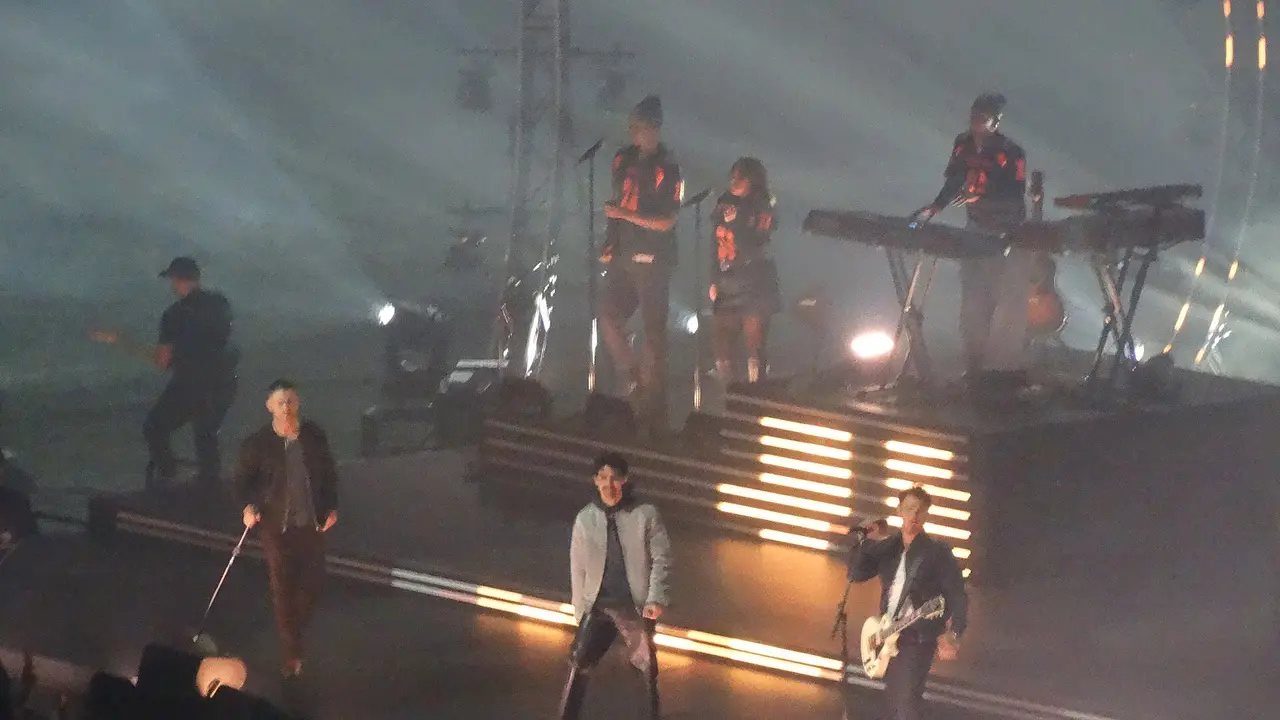
On August 20, 2026, the Jonas Brothers reignite Burning Up at Madison Square Garden, and this return is not merely a souvenir for first-generation fans. The trio opens a run in New York titled The Burning Up Tour All Over Again, with three shows listed at the iconic venue on August 20, 21 and 22. According to People, the idea, first imagined as a limited celebration of the tour that accompanied the Camp Rock era in 2008, expanded into a 45-city tour after strong demand. That is exactly where the story becomes interesting: nostalgia is no longer just an emotion, it is commercial infrastructure.
Kevin, Joe and Nick Jonas are not arriving on stage with a simple revival. They are arriving with a complete architecture: a catalogue already loaded with feeling, a new generation exposed to Camp Rock 3, ticketing powered by platforms, major distribution partners and a live economy looking for stories stronger than the simple album-tour cycle. Burning Up is therefore becoming a cultural product again, but also a way to measure the value of pop memory.
Nostalgia Is No Longer a Return, It Is a Strategy
In 2020s pop, nostalgia has changed status. It is no longer the refuge of artists at the end of the road. It has become a premium language, able to reconnect several audiences at once. Adults who discovered the Jonas Brothers through Disney Channel now buy tickets with purchasing power they did not have as teenagers. Younger fans arrive through TikTok, Disney+, live clips and family stories passed down by a generation that grew up with the band.
The tour title says it all: All Over Again. It does not only promise to repeat the past. It promises to replay it with contemporary means. The songs keep their emotional charge, but the environment has changed: sales move through presale ecosystems, moments circulate in vertical clips, fans compare setlists in real time, and every date becomes potential content. Nostalgia is therefore not decoration. It is the engine of a media machine.
Madison Square Garden as a Power Signal
Starting at Madison Square Garden is never neutral. MSG’s official page confirms three consecutive nights, with shows at 7:30 p.m. and doors at 6:30 p.m. That choice gives the tour a grammar of prestige: New York, the canonical venue, the short-residency effect, the feeling of an event. For a band associated with youth television and highly popular choruses, this staging matters. It turns a Disney memory into an adult appointment.
Live Nation and Ticketmaster also list the August 20 date at the Garden, confirming the event’s place in the major North American live circuit. Live music has become one of the most decisive sectors for pop artists: it sells tickets, of course, but also status, scarcity and social proof. In an era when recorded music circulates through subscriptions, the concert remains the moment when a community becomes visible.
Camp Rock 3 and the Smart Recycling of Franchises
The timing strengthens the move even further. Entertainment Weekly devoted a cover story to the return of Camp Rock 3, presented as a new entry in the Disney franchise with the Jonas Brothers back in the Connect 3 universe and Demi Lovato tied to the symbolic passing of the torch. The Burning Up tour therefore lands in an environment where the band’s story is being updated on screen. That is not accidental: film, streaming and the stage support one another.
The return of musical franchises follows a clear logic. A brand such as Camp Rock offers an immediate vocabulary: songs, costumes, memories, characters, teenage rivalries and images already printed in collective memory. But the danger would be to remain trapped in a museum. The strength of the Jonas Brothers operation lies in its double movement: honoring the Disney age without remaining imprisoned by it, and using that past to sell a current pop experience.
Ticketing as a Cultural Thermometer
People reports that the tour expanded after a strong public response, with a general sale announced around August 21 and early access linked in part to Spotify Premium. That detail matters. It shows how live music now connects with platform data. The most active fans, those who listen, save and share, also become the first commercial audiences. Ticketing no longer merely sells: it ranks, segments and rewards.
This evolution can irritate, because it complicates access to tickets and can make every fan feel they must prove loyalty to an algorithm. But it also says something about the industry: an artist with a durable emotional base can mobilize multiple partners. In the Jonas Brothers’ case, the fanbase is not only large. It is cross-generational, digital and deeply narrative. It does not come only to hear a hit. It comes to recover a version of itself.
The Return of Pop Groups Into Adulthood
The Jonas Brothers occupy a particular place. They have moved through media childhood, hiatus, parallel careers, reunion, mature albums and anniversary tours. Many artists built by teenage machines lose credibility as they grow older. They have turned that transition into material. Their image rests precisely on the tension between the highly coded memory of the Disney years and the experience of adult men, fathers, entrepreneurs and stage musicians.
That tension can make Burning Up more interesting than a simple celebration. The public does not only want to see a choreography or a chorus again. It wants to measure the time that has passed. It wants to see what happens to songs written for teenage excitement when they are sung by bodies, voices and audiences that have changed. Nostalgia works when it accepts that distance. If it pretends nothing has moved, it rings false. If it looks time in the face, it becomes powerful.
A Very Contemporary Economy of Memory
The Jonas Brothers case points to a broader trend: the 2000s have become a major cultural mine. Artists, studios and promoters know that the period is now old enough to create longing, but close enough to remain highly usable by platforms. Clips, memes, archives and reboots circulate easily. Pop memory is no longer stored in photo albums. It is indexed, shared, remixed and sold.
For B-EMPIRE, the point is not to mock that mechanism. It is to understand it. The public is not only buying a ticket to relive 2008. It is buying an experience in which its own biography becomes spectacle. Promoters sell the concert, but also the permission to become a fan again with less shame, more means and a wider community. That is the paradoxical maturity of pop culture: it grows up by learning how to commercialize its adolescence.
What to Remember
The Burning Up Tour All Over Again shows that pop nostalgia has entered a sophisticated industrial phase. The Jonas Brothers are not merely relaunching an old chapter. They are assembling live music, Disney, platforms, ticketing, archives and virality into one object. Madison Square Garden works as the showcase, Camp Rock 3 as the narrative relay, and the 45-city tour turns emotion into a calendar.
The best reading of this return is therefore double. Yes, there is pure pleasure, familiar songs, fans singing loudly and a pop act that embraces its warmth. But there is also a lesson in cultural business: in 2026, the most profitable past is the one that knows how to become present again. The Jonas Brothers understand that. Burning Up no longer burns only as a memory. It heats an entire economy.
Sources
- People – Jonas Brothers announce 45-city Burning Up Tour All Over Again, August 18, 2026.
- Madison Square Garden – Jonas Brothers: The Burning Up Tour All Over Again, accessed August 20, 2026.
- Live Nation – Jonas Brothers at Madison Square Garden, accessed August 20, 2026.
- Entertainment Weekly – Camp Rock 3 Jonas Brothers cover story, August 2026.
- Ticketmaster – Jonas Brothers Madison Square Garden dates, accessed August 20, 2026.