
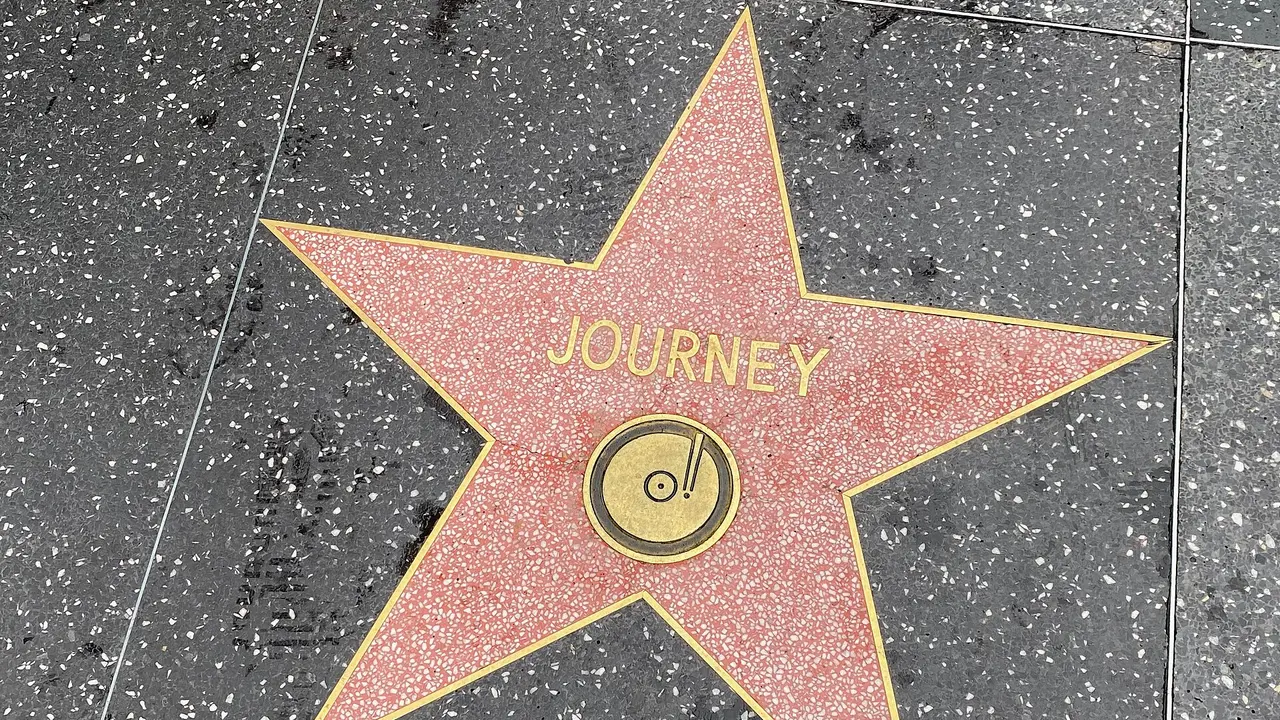
The world may soon hear Journey say goodbye. After more than fifty years of universally recognized choruses, the band is preparing the final leg of its Final Frontier Tour, a massive 2026 tour that is set to conclude on November 28 at the Chase Center in San Francisco. The city where it all began could thus host its last chapter. And when the first notes of Don’t Stop Believin’ resonate, it will no longer be just a concert: it will be a real-life test of the collective memory of rock.
The Associated Press reported on August 18 that this final segment is set to kick off in September in Los Angeles before traversing Phoenix, Seattle, Chicago, Atlanta, Nashville, Baltimore, Philadelphia, Detroit, Boston, Cleveland, Denver, and Las Vegas. The final return to San Francisco will conclude over 100 concerts performed throughout the year. Neal Schon, co-founder and guitarist of the band, acknowledges that this date will be particularly emotional as Journey was born in the San Francisco Bay in 1973.
Why These Farewells Go Beyond Nostalgia
Journey belongs to that rare category of bands whose songs have survived beyond their original era. Faithfully, Open Arms, Separate Ways, Any Way You Want It, and especially Don’t Stop Believin’ no longer live solely in the discotheques of long-time fans. They circulate in TV series, movies, weddings, stadiums, karaoke bars, and playlists of new generations.
The Chase Center reminds us that Journey has sold over 100 million records worldwide, placed 19 singles in the Top 40, and achieved 25 gold or platinum albums. Their Greatest Hits is certified fifteen times platinum in the United States, while Don’t Stop Believin’ has surpassed one billion streams. These figures tell a story of exceptional longevity, but more importantly, a successful transition from a record economy to a constant attention economy.
Over 100 Concerts: The Power of Catalog Rock
A tour of such magnitude also constitutes an impressive economic operation. Heritage artists have a decisive advantage: their audience already knows the songs and comes seeking a specific emotion. The promise is clear, the marketing risk is limited, and the ticket’s value rests on the possibility of experiencing something that may never happen again.
Journey often plays for over two hours and does not merely line up its hits. According to the Associated Press, the band also dives into deeper cuts from its catalog, such as Of a Lifetime, from its early days, or tracks from Raised on Radio. This depth transforms the tour into a living retrospective: casual fans receive the anthems, while loyal followers rediscover rarer fragments of the band’s history.
San Francisco, The Perfect Closure
The choice of San Francisco for the finale is not merely a sentimental gesture. Journey formed in this city in 1973, around musicians linked to Santana. Returning to the Bay after a journey of more than half a century gives the tour a natural dramaturgy: departure, global conquest, transformations, conflicts, rebirth, and then a return to the origin point.
The official schedule of the Chase Center confirms a concert on Saturday, November 28, 2026, at 7:30 PM. The venue presents the date as the conclusion of the tour and a celebration of the songs, memories, and moments that continue to connect multiple generations. This phrasing is significant: Journey is no longer just selling a repertoire, but the role that this repertoire has played in the lives of listeners.
Arnel Pineda, A Symbol of Global Rebirth
The modern history of Journey is inseparable from Arnel Pineda. The Filipino singer was discovered on YouTube by Neal Schon before joining the band in 2007. His journey has given the group a second life on stage and a profoundly international dimension. A musician from Manila, discovered through a global platform, has become the voice of an American catalog sung on all continents.
This trajectory explains why Journey’s farewells can resonate far beyond the United States. They also tell the story of the globalization of popular culture: a song born in California can become an anthem in Europe, Asia, Africa, or the Middle East; a Filipino singer can take on a rock heritage and open it to a new audience; an online video can reconfigure the fate of a historic band.
Will the Last Concert Really Be the Last?
Caution is necessary. The Associated Press speaks of what could be the band’s last tour together, and the history of rock is filled with farewells followed by reunions. Final tours are often definitive at the time of their announcement, only for public demand, the health of the artists, internal relationships, or a new opportunity to change the perspective.
This uncertainty does not detract from the strength of the moment. It amplifies it. Each date becomes potentially the last chance to see this lineup, each performance an archive being created. For fans, waiting for a hypothetical reunion means risking missing the current conclusion. For the concert industry, this tension naturally increases the urgency and emotional value of the tickets.
A Signal for the Entire Music Industry
The Final Frontier Tour illustrates the central place that catalogs have taken in the music economy. Streaming has made classics permanently available, but concerts transform them into rarity. Anyone can launch Don’t Stop Believin’ in seconds; no one can exactly replicate an entire venue singing the chorus with the musicians who have carried it for decades.
Thus, major historical bands have become bridges between two models. Their music generates daily listens on platforms, while their physical presence justifies long tours, premium offerings, and major venues. Nostalgia is no longer a passive gaze into the past. It has become a global commercial infrastructure, fueled by family transmission, social networks, and audiovisual practices.
The World Will Sing Before the Lights Go Out
Journey no longer needs to prove that its songs can endure. The real challenge of this final stretch lies elsewhere: to show how a collective work survives changes in voices, formats, generations, and technologies. More than fifty years after its inception, the band continues to fill arenas with songs that the audience transforms each night into a shared autobiography.
On November 28, San Francisco could thus witness a historic night. There may be other concerts, other lineups, or other comebacks. But the current promise is one of a circle closing in the city where it all began. And at the moment of the last chorus, the band’s most famous song will take on a poignant irony: Journey may say goodbye while asking the world to never stop believing.