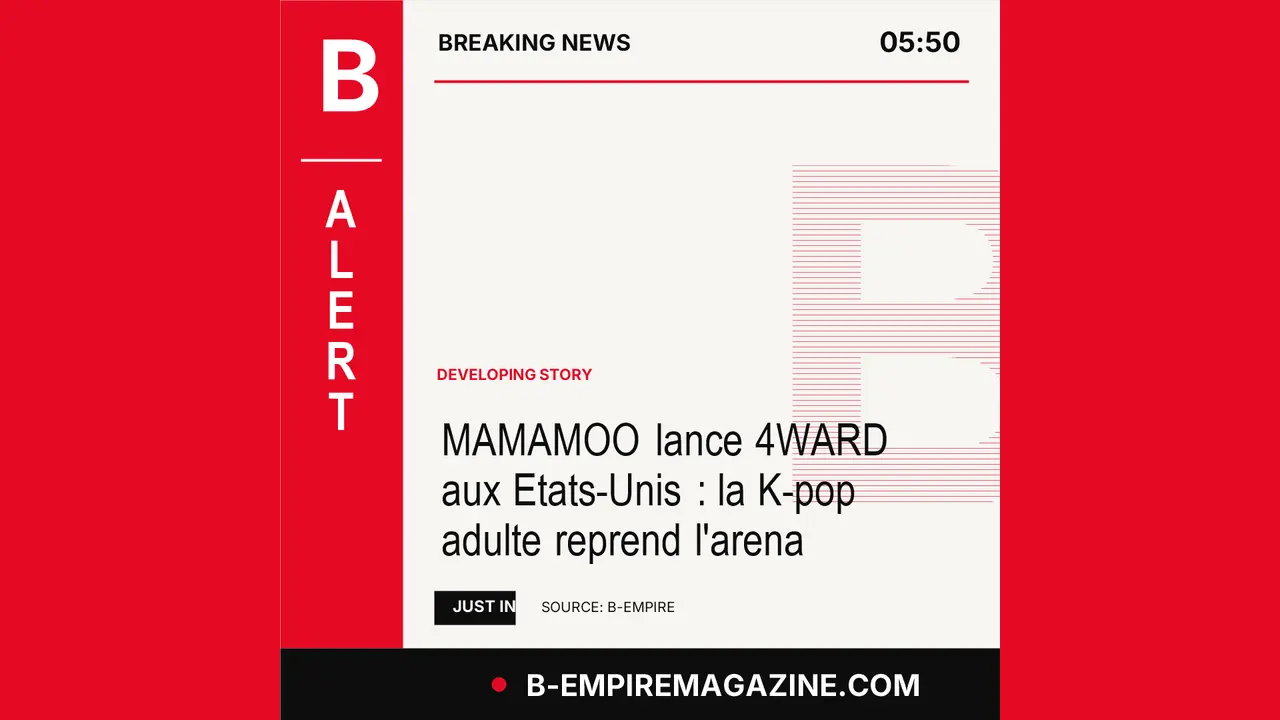
MAMAMOO launches its 2026 U.S. tour on August 12 at UBS Arena in Belmont Park, near New York, with a promise that goes beyond a simple nostalgic return: four adult voices in K-pop are taking the road together again, after years of solo trajectories, to test the strength of a group that has never looked like the genre’s most standardized machines.
The official tour site lists seven U.S. dates: Belmont Park on August 12, Chicago on August 15, Fort Worth on August 18, Cedar Park on August 21, Los Angeles on August 25, San Jose on August 27 and Kent, near Seattle, on August 30. Ticketmaster and Live Nation confirm the UBS Arena opening at 7:30 p.m., while H-E-B Center presents the run as a monumental return for Solar, Moonbyul, Wheein and Hwasa, linked to the group’s twelfth anniversary and the 4WARD world tour.
A reunion that does not sound like a parenthesis
MAMAMOO’s reunion carries particular value because the group has never been only an addition of faces. Its brand rests on voices, harmonies, stage presence and a form of confidence that has often distinguished MAMAMOO in a K-pop ecosystem obsessed with perfect choreography and permanent youth. Returning to the stage after solo projects therefore does not mean restarting an old formula. It means measuring what these four identities can still produce together.
Solar, Moonbyul, Wheein and Hwasa have each built their own space: performance, rap, vocal power, R&B, fashion, television and solo attitude. The risk in this kind of return is always that the collective may feel less urgent than the individual careers. But MAMAMOO has a rare advantage: the public never loved only the group’s concept. It loved the interaction between four musical personalities able to contradict each other, complete each other and hold a stage without disappearing inside the production.
The American market as a maturity test
The choice of rooms says a great deal. UBS Arena, Wintrust Arena, Dickies Arena, H-E-B Center, Crypto.com Arena, SAP Center and accesso ShoWare Center do not form a minimal symbolic tour. These are venues capable of absorbing significant demand, with VIP packages, soundcheck experiences and a highly structured fanbase economy. The official VIP page offers multiple levels, from merch access to send-off, photos and soundcheck. K-pop live has become a complete commercial architecture.
For B-EMPIRE, this is the most interesting business dimension. MAMAMOO is not returning only to recall a catalog. The group is entering an economy where the concert experience around the ticket matters almost as much as the ticket itself. Fans buy a moment of proximity, a memory, social proof and a place inside the story of the return. This logic is not unique to K-pop, but K-pop has industrialized it with unique precision.
An independent route inside a giant system
Complex noted at the time of the announcement an important detail: the U.S. tour is promoted by Mammoth Live and Sugar Monkey Live, rather than by the most dominant Live Nation or AEG circuits as primary promoters. That information matters because it shows that global K-pop is not only a matter of majors, platforms and mega-agencies. More specialized promoters can capture powerful niches if they understand fan culture, VIP ticketing and community geography.
In MAMAMOO’s case, that approach may even reinforce the point. The group has always occupied a slightly separate place: popular enough to play big, singular enough to keep an intense relationship with fans, and mature enough not to depend on one viral cycle. A well-calibrated tour can therefore become more profitable and more legible than a race for total domination of the American market.
K-pop after hyper-growth
The MAMAMOO run arrives at a moment when K-pop has to prove something other than its ability to launch new groups. The genre has won the battle for global visibility. The next question is duration: which artists can age, separate temporarily, return, reconfigure their audience and retain strong live value? MAMAMOO offers a credible answer because its main asset is not only image. It is musical competence.
That competence gives the group a different relationship with time. A vocal song, a strong harmony or a performance less dependent on effects can sustain a return. Fans who grew up with MAMAMOO are not only looking for a reproduction of their memories; they may also want to see what the group becomes after solo experience, after industry changes and after K-pop has become more global, faster and more competitive.
Why this story matters
The start of the 4WARD U.S. tour matters because it shows K-pop capable of moving from an adolescent model to a legacy model without losing its energy. MAMAMOO is not selling only a comeback. The group is selling proof that female artists can maintain stage power, an international base and a fan economy after exploring individual identities.
For B-EMPIRE, the stakes are cultural as much as commercial. Global pop is full of opportunistic returns. This one has something more solid: known voices, a patient audience, ambitious venues and a tour structure that turns reunion into a live asset. At UBS Arena, MAMAMOO is not only replaying its past. The group is testing the next phase of adult K-pop: less centered on permanent novelty, more attentive to duration, technique and the loyal intensity of fans.