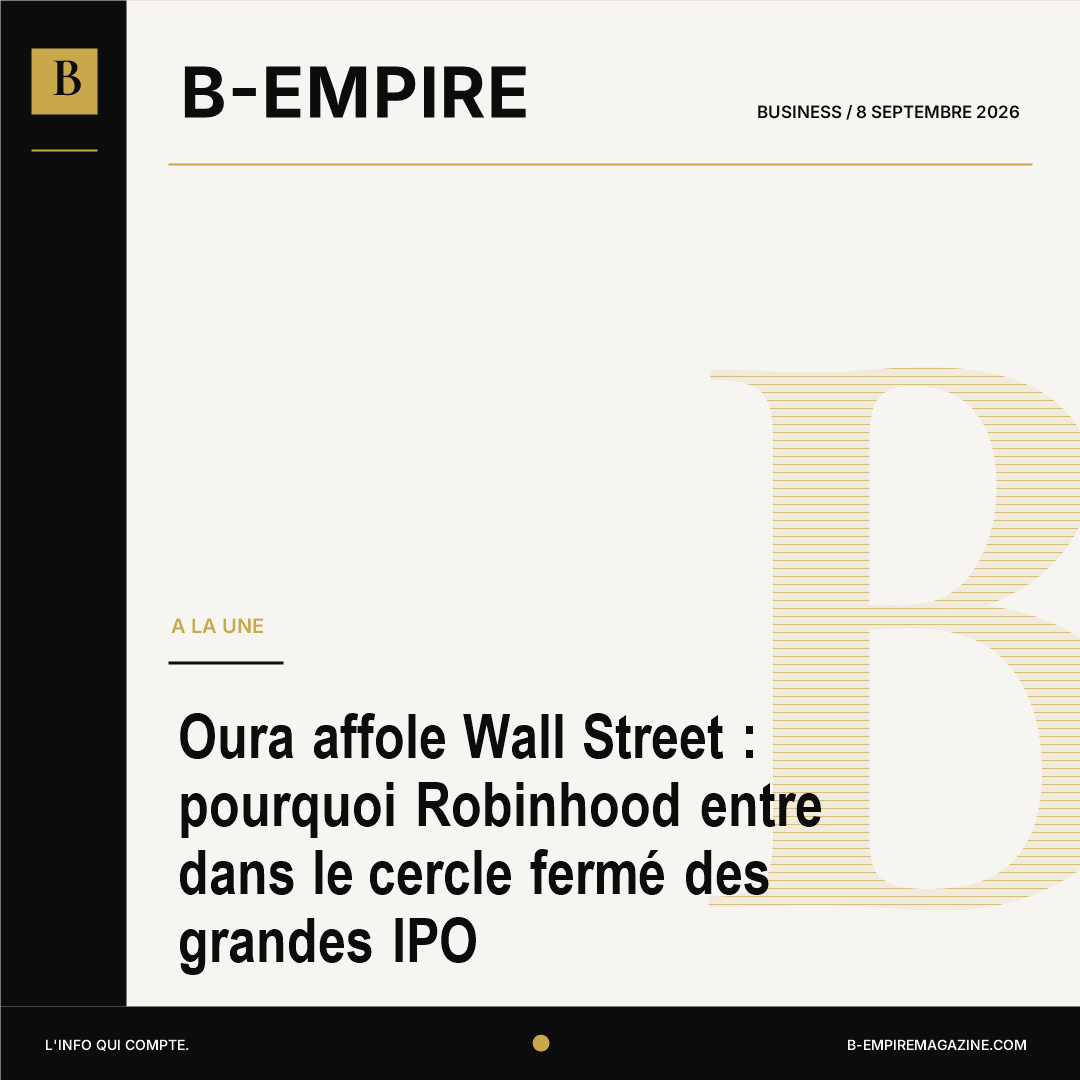
A ring weighing just a few grams is opening a door that Robinhood has never crossed before. Oura, the Finnish-American manufacturer of connected rings, is preparing for its entry into Nasdaq under the symbol OURA. Among the syndicate of banks handling the operation appears an unexpected name: Robinhood Markets. For the first time, the platform made famous by smartphone trading is officially participating in the underwriting of an initial public offering (IPO).
Robinhood’s position remains modest compared to Goldman Sachs, Morgan Stanley, JPMorgan, Allen & Company, Bank of America, and Jefferies. However, the symbolism is powerful. The company no longer wants to merely distribute shares to its users after the major banks have organized the operation. It now wants to sit at the table where the price, demand, and allocation of shares are decided. And it chooses for its debut one of the most closely watched IPOs of the season.
Oura Unveils Growth That Changes Dimensions
The S-1 document filed on September 3 with the Securities and Exchange Commission provides the most accurate snapshot ever published of the company. For the nine months ending June 30, 2026, Oura reports $1.21 billion in revenue, a 74% year-over-year increase. Net income reaches $60.8 million, compared to $1.6 million in the comparable period.
The scale of change is spectacular. Born in Oulu, Finland, over ten years ago, Oura has transformed a niche object into a global platform for tracking sleep, activity, stress, and various physiological indicators. The company had five million paying members as of June 30, double the number from a year earlier. It also states that it sold approximately 3.6 million rings over the past twelve months.
These figures explain Wall Street’s appetite. The model no longer relies solely on the sale of a device. Oura combines hardware with a recurring subscription, boasting a weighted average retention rate of about 85% over twelve months. This combinationâphysical product, software, and regular revenueâis precisely what markets value when they believe in the strength of a tech brand.
Robinhood’s First Major Test as an Underwriter
Until now, Robinhood primarily offered access to IPOs: its clients could request shares allocated by the banks managing the operations. Becoming an underwriter changes its position. Even if placed at the bottom of a syndicate of eighteen institutions, the broker gains a voice in the allocation mechanism and can seek to reserve more shares for its own users.
This first step follows the acquisition of the necessary authorizations for this activity in June 2026. It confirms Robinhood’s strategy: to transition from a public trading app to a full-fledged financial group. Stocks, cryptocurrencies, retirement products, advisory services, funds exposed to private companies, and now IPO underwriting gradually compose a much broader offering.
The operation also creates a relationship to watch. Jason Warnick, former CFO of Robinhood, is appointed to join Oura’s board of directors after the IPO. Additionally, a fund launched by Robinhood already has exposure to Oura. Nothing in these connections is sufficient to establish a conflict, but they impose transparency at a time when retail investors may be encouraged to participate in the offering.
Connected Health Becomes a Financial Industry
The Oura IPO goes beyond the duel of brokers. It raises a central question: should a wearables company be valued as an electronics manufacturer or as a subscription health platform? Oura collects signals on sleep, heart rate, temperature, and recovery. Over time, this mass of data can fuel prevention services, research, or medical support, provided strict privacy rules are observed.
The market is immense, but so is the competition. Apple, Samsung, Google, and many specialists have substantial resources. The category of smart rings is no longer an empty territory. Oura will need to continue convincing that its discreet format, battery life, and quality of analysis justify both the price of the device and the subscription cost.
The fifth generation of the ring, launched this year, must support this narrative. According to Oura, it is 40% smaller than the previous version. This miniaturization matters: in a product worn day and night, comfort becomes a commercial advantage as important as software power. However, each new generation also brings risks of quality, warranty, and industrial costs that the prospectus reminds investors of.
A Valuation Expected Above $11 Billion
The filing with the SEC does not yet set the number of shares offered or their price. Therefore, it would be premature to present a definitive valuation. However, market estimates suggest a level above the approximately $11 billion retained during the last major private funding round, and some scenarios have proposed a transaction that could raise up to $3 billion.
This expectation sets the bar very high. The revenue growth and operating profit tell a success story, but the investor must read the entire prospectus. Oura has notably recorded a heavy accounting loss related to the buyback of preferred shares from former investors. This exceptional operation does not solely reflect the daily performance of the company, but it reminds us that the financial structure of a unicorn can be more complex than its sales.
Why This IPO Could Change Access for Millions of Savers
If Robinhood secures more shares for its users, the operation could bring retail investors closer to the first day of trading, long dominated by institutional clients. This promise aligns with the historical identity of the platform. However, it does not eliminate volatility or risk: a more democratic allocation is not a guarantee of performance.
For Oura, the challenge is to prove that it can retain its subscribers, protect intimate data, and maintain its growth in the face of giants. For Robinhood, it is about demonstrating that a player born on mobile can seriously participate in the architecture of Wall Street. Both brands sell, each in its own way, an idea of personal access: one to its own health, the other to financial markets.
This is why this file deserves to be followed well beyond the day of listing. If the operation succeeds, a connected ring will have served as a passport for Robinhood to enter the club of underwriters, while Oura will have transformed nights of sleep into one of the most fascinating financial stories of 2026.