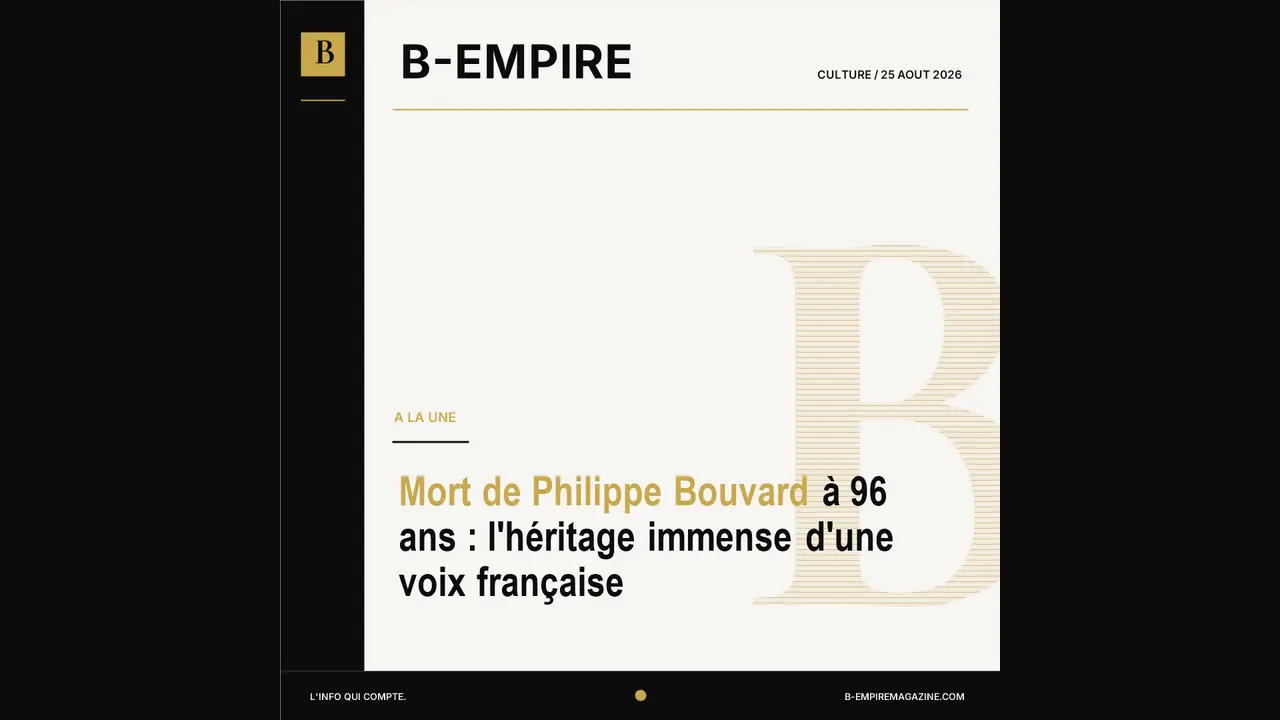
A familiar voice of France has fallen silent. Philippe Bouvard passed away on Monday, August 24, 2026, at the age of 96, at his home in Cannes. His wife announced the news to RTL, the station with which he had built an exceptional and lasting relationship. A journalist, host, writer, and talent scout, he was not just a famous figure; he had helped invent a French way of blending information, entertainment, humor, and popular conversation.
His passing marks the end of one of the longest and most unique careers in French media. For over sixty years, Philippe Bouvard occupied print media, radio, and television with an instantly recognizable tone: an insatiable curiosity, biting irony, and a knack for memorable phrases. President Emmanuel Macron paid tribute to him, honoring a columnist who had animated the pages, airwaves, and screens for more than seven decades.
Philippe Bouvard is dead: What we know
Philippe Bouvard passed away in the morning of August 24, in Cannes, as indicated by his wife to RTL. The station announced the passing of one of its historical faces and voices. AFP, Le Monde, Le Figaro, and several major French media outlets subsequently confirmed the information. No specific medical cause has been made public, and it is important to respect this factual perimeter.
Born on December 6, 1929, in Coulommiers, Seine-et-Marne, Philippe Bouvard had officially left the airwaves at the beginning of 2025, after approximately sixty years in radio. Until the end, he maintained a way of speaking about himself without solemnity, using self-deprecation as a shield against the status of a monument that was already being attributed to him.
Les Grosses Têtes, a Radio Revolution that Became an Institution
Launched on RTL in 1977, the program Les Grosses Têtes established a format that seems obvious today but was not at the time: gathering personalities from entertainment, culture, and media around a table, making them play, tell stories, improvise, and debate under the direction of a master of ceremonies. Bouvard was at the helm for thirty-seven years, until 2014.
The success relied less on a complicated setup than on human mechanics. The host knew how to interrupt, reignite, provoke, or let silence take effect. He distributed roles, established comic rivalries, and transformed a studio conversation into a collective rendezvous. Long before filmed podcasts, band shows, and viral debates cut for social media, he understood that the audience came as much for the information as for the personalities telling it.
This formula has transcended generations and survived its creator. This may be the clearest sign of his influence: Les Grosses Têtes are not merely associated with an era; they have become a lasting cultural brand. Philippe Bouvard bequeathed an entertainment architecture that radio, television, and now platforms continue to reinterpret.
Le Petit Théâtre de Bouvard, a Talent Factory
On television, Le Petit Théâtre de Bouvard, broadcast in the 1980s, confirmed his flair for new personalities and voices. The show provided a stage for young comedians in front of a popular audience. Several artists who became essential found a decisive exposure space there, including those who would form Les Inconnus, as well as Mimie Mathy and Michèle Bernier.
In an industry now obsessed with recommendation algorithms and instant statistics, this ability to spot a stage presence seems almost artisanal. Bouvard observed a rhythm, a way of entering the stage, a voice, or a sense of timing. He did not merely occupy the airwaves; he contributed to renewing those who would occupy them after him.
A Career Born Far from Conventional Paths
The story of Philippe Bouvard also possesses the strength of a tale of revenge. After several failures at the baccalaureate and an interrupted stint at the Journalism Training Center, he entered Le Figaro in a modest role before earning his place in the editorial team. He built his career line by line, then joined France-Soir, where he would become one of its leading figures. He also collaborated with numerous publications while publishing dozens of books.
The figures cited vary according to sources, reflecting the unusual scale of his output: tens of thousands of articles, thousands of radio and television shows, and more than fifty works. The most important aspect remains continuity. Bouvard belonged to a generation capable of transitioning from printed columns to the microphone and then to the stage without abandoning his signature.
Why His Style Deeply Marked France
Philippe Bouvard mastered the art of proximity without renouncing authority. He could host political leaders, celebrities, writers, or comedians and bring them back to the same ground: that of repartee. His culture did not present itself as a lesson. It served as fuel for conversation, sometimes with a cruelty that would be more contested today.
His legacy must also be viewed with the perspective that any career spanning multiple eras deserves. Sensibilities have changed, and some forms of humor have as well. But this evolution does not diminish his historical importance. On the contrary, it shows how his journey constitutes a living archive of the transformations of French society, from the power of post-war press to the age of private channels, and then to the era of digital fragmentation.
The Last Signal of a Media Era
The death of Philippe Bouvard comes at a time when the media are once again searching for ways to create common rendezvous. Radio resists, television fragments, and platforms transform each sequence into autonomous content. In this landscape, his journey reminds us of a simple truth: technology changes, but the public remains attached to voices that give the impression of speaking directly to them.
Bouvard had built this intimacy on a national scale. Millions of listeners knew his tone, his calculated hesitations, his jabs, and his way of reigniting a show. It is this connection, more than the records, that explains the emotion provoked by his passing.
At 96, Philippe Bouvard leaves behind shows that have become institutions, an impressive body of writings, and several generations of artists. But he leaves above all a method: to listen closely enough to find the right reply, to know his audience without underestimating them, and to turn conversation into spectacle. The voice has been silenced. His influence, however, continues to speak.