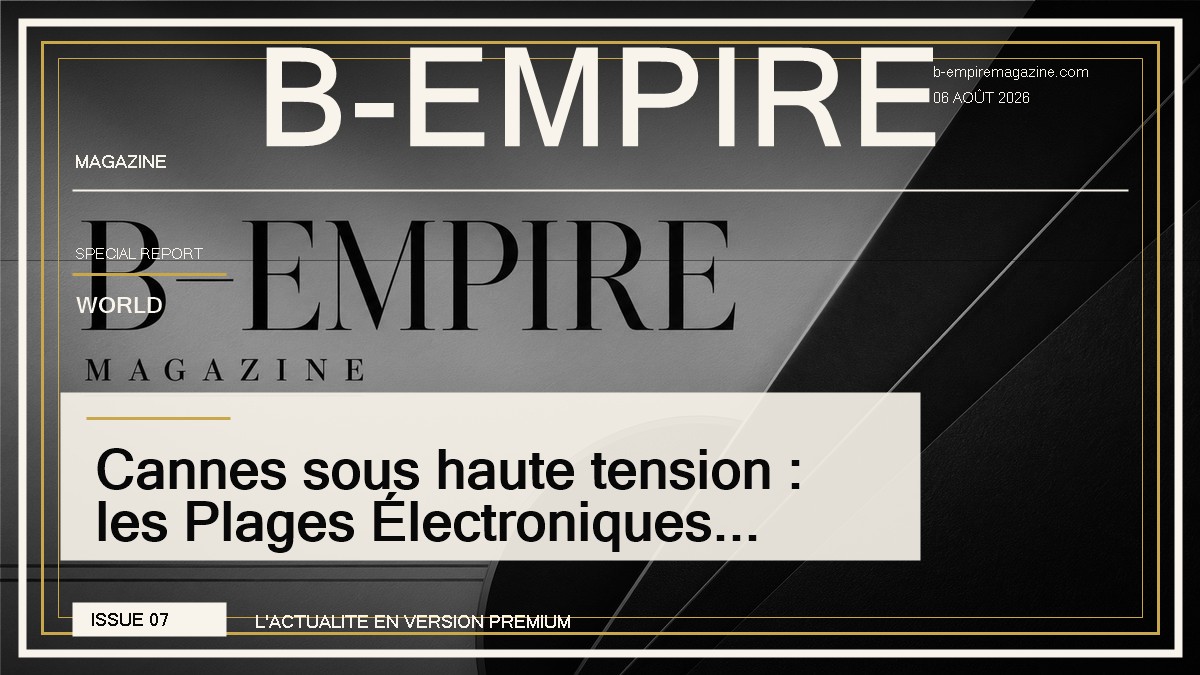
Cannes is about to change frequency. From August 7 to 9, 2026, the beach and terraces of the Palais des Festivals will host the 20th edition of the Plages Ãlectroniques. Where global cinema usually rolls out its red carpet, Martin Garrix, Amelie Lens, Marshmello, PLK, and DJ Snake will face the Mediterranean in front of an audience gathered for three days of music, sand, and extended nights.
The anniversary goes beyond mere nostalgia. Born in 2006 with the ambition to make electronic music accessible in a spectacular setting, the Cannes event has become an international showcase. Its 2026 edition condenses the evolution of the sector: superstars capable of filling stadiums, more radical techno, French rap, new talents, and an immersive experience designed for social media. Cannes is not just celebrating twenty years of partying; the city is showcasing a new way to create a global cultural event.
Three Days, Fifteen Hours of Music, and a Transformed Croisette
The City of Cannes announces three days of celebration and up to fifteen hours of non-stop music between daytime concerts and after-parties. The festival unfolds on the beach of the Palais, its terraces, and several complementary spaces. The setting is an essential part of the promise: the stages face the sea, the dancefloor touches the sand, and the sunset itself becomes a moment of programming.
This geography distinguishes the Plages Ãlectroniques from large gatherings held in fields or stadiums. The audience finds itself in the heart of Cannes, just a few meters from hotels, the train station, restaurants, and the Croisette. This proximity creates a highly visual experience but also imposes a complex mechanism of security, traffic, sound, and coexistence with a tourist destination in peak season.
Martin Garrix Opens, DJ Snake Closes: A Lineup Designed as a Narrative
On Friday, August 7, Martin Garrix takes center stage, surrounded by Mosimann, Nico Moreno, Sonny Fodera, Oguz, Rivo, and Lessss. The Dutchman represents the global power of EDM: instantly recognizable anthems, an international audience, and a staging designed for large spaces. The lineup also incorporates harder house and techno currents to avoid a uniform evening.
Saturday pairs Amelie Lens, a major Belgian figure in techno, with Marshmello and French rapper PLK. Vladimir Cauchemar, Interplanetary Criminal, Emma B, and Liv Del Estal complete a deliberately hybrid day. This meeting of techno, electronic pop, and rap reflects the blurring of boundaries: festivals no longer cater to a single musical tribe but to audiences who compose their playlists without adhering to old categories.
Sunday will be dominated by DJ Snake and his collective Pardon My French, featuring Anetha in a duo with Patrick Mason, Salvatore Ganacci, Dany Neville, and BUNT. This choice carries symbolic weight. DJ Snake is a French star whose career has been built on a global scale, spanning Paris, the United States, India, the Middle East, and giant stages. Having him close the twenty years connects the festival’s French identity to its international ambition.
The Risky Bet of a Festival That Refuses to Choose a Single Audience
The 2026 lineup embraces a tension that has become central to the festival economy. Highly popular headliners sell tickets and attract partners; specialized stages preserve artistic credibility and allow emerging talents to reach a broader audience. Too many stars can turn the event into a succession of hits. Too much niche can reduce its ability to finance a costly production.
The Plages Ãlectroniques respond by multiplying spaces and temporalities. A festival-goer can come for Martin Garrix, discover a techno set around a corner, follow a still-unknown French artist, and then extend the night with Mind Against, Mathame, or Maceo Plex. The experience becomes a journey rather than a single concert. It is also a way to distribute flows within a constrained urban site.
Cannes Plays Its Card as a Global Music Capital
The name Cannes remains inseparable from cinema, but the city has been working for several years to expand its calendar. MIDEM, Cannes Lions, trade shows, series, video games, and music transform the Palais des Festivals into a permanent platform. According to the 2026 tourist press kit, the Plages Ãlectroniques typically attract around 40,000 people, a volume that makes it much more than a local summer event.
For hotels, restaurants, transport, and businesses, three full days in August represent direct activity. But the most sustainable value is also measured in images. Every video filmed from the beach associates an international star with the bay of Cannes. Posts from artists and the public become a global campaign distributed for free on TikTok, Instagram, and YouTube.
Twenty Years After 2006, Electro Has Changed Dimensions
When the festival was born, electronic music was already occupying clubs and major European events, but its relationship with the general public was not the same. Two decades later, DJs are global brands, productions use setups akin to pop tours, and tracks circulate instantly from one continent to another. A track can be born in a bedroom, explode on a platform, and arrive weeks later in front of tens of thousands of people.
This globalization, however, produces fierce competition. Tomorrowland, Ultra Europe, Ibiza, Asian festivals, and Las Vegas residencies compete for artists, sponsors, and travelers. Cannes must therefore sell more than just a lineup. Its advantage is a setting that cannot be exactly replicated elsewhere: the beach at the foot of a palace known worldwide, in the center of a city accustomed to hosting cultural industries.
A French Generation Amid Giants
DJ Snake and PLK give this edition a clear French visibility, but the interest also lies in the depth of the lineup. Mosimann, Vladimir Cauchemar, Anetha, Rivo, Clara Cuvé, Salomé Le Chat, and many emerging artists show that a local scene can engage with European and global networks without losing its identity.
For young artists, sharing a lineup with established names is valuable both as experience and as a reputation accelerator. The professionals, media, and content creators present can turn a successful set into touring opportunities. In an industry where visibility is fragmented, major festivals remain rare places where the public, artists, and decision-makers physically meet.
The Real Challenge Begins When the Music Rises
An impressive lineup alone does not guarantee a successful anniversary. The quality of sound, the fluidity of access, available water, rest areas, safety, night transport, and management of high temperatures will weigh heavily on the experience. An urban festival by the sea must also limit its impact on the neighborhood and on a coastline already under intense tourist pressure.
The organizers announce new stages, immersive spaces, and an enhanced experience between the beach, the sea, and the Palais. The promise will be judged in real-time by thousands of phones. This is the rule of events in 2026: production must work on-site but also survive the immediate scrutiny of social media, where a long line can become as visible as a spectacular sunset.
A French Showcase Viewed Well Beyond the Mediterranean
From the first beat on Friday to the closing of Pardon My French on Sunday, Cannes aims to prove that it knows how to create a great contemporary party without renouncing its image as a cultural destination. The twenty years of the Plages Ãlectroniques thus tell a double success story: that of a festival that has evolved from a beach idea to a global lineup, and that of a city that uses its symbolic power to exist well beyond cinema.
Success will not only be measured by the number of tickets or viral videos. It will depend on the ability to coexist between the general public and niche stages, international stars and French talents, spectacular celebration and responsible organization. If this balance holds, the Croisette will not simply celebrate twenty years gone by; it will open the next chapter of a festival that has become one of the most recognizable musical showcases in France.
Sources
- Les Plages Ãlectroniques, official programming and presentation of the 2026 edition.
- City of Cannes, dates, format, and information on the 20th edition.
- Cannes Soleil, history of the festival and evolution of its international reputation.
- Cannes Tourist Office, press kit 2026 and usual attendance of the event.