
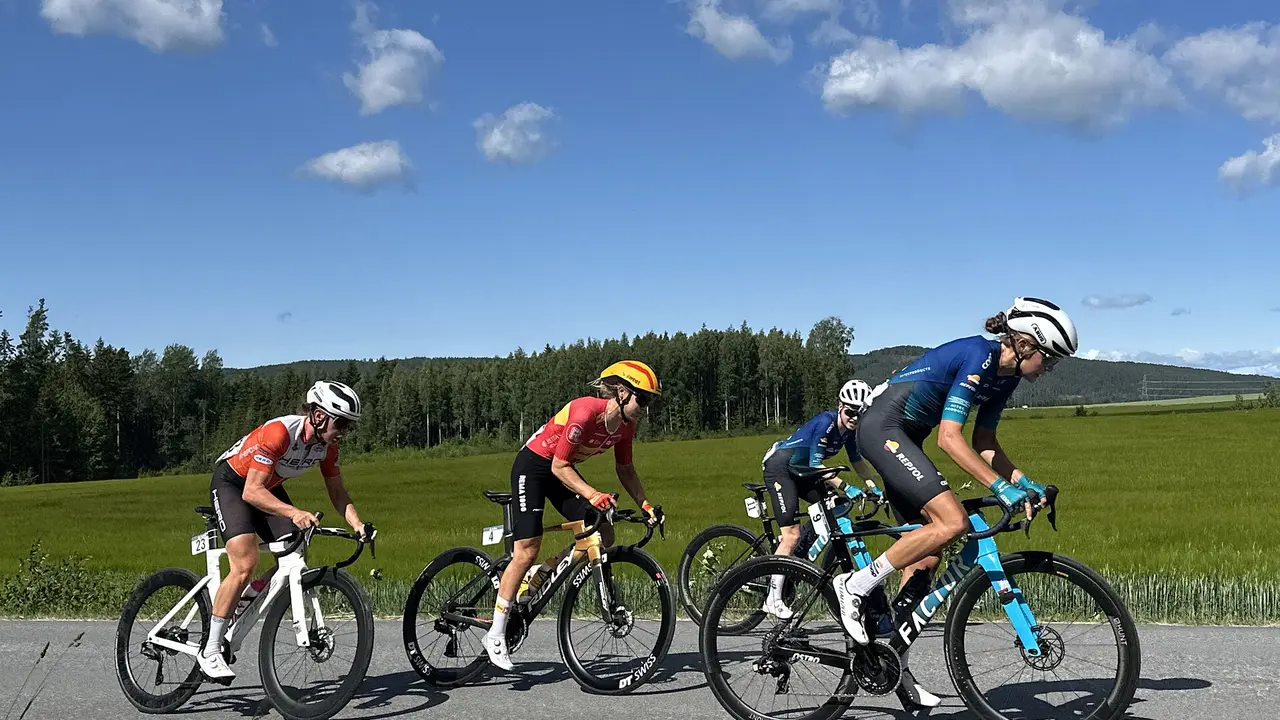
The 2026 Tour de France Femmes has been turned on its head by an attack that the peloton could never erase. Setting off more than 110 kilometers from the finish, Norwegian Sigrid Ytterhus Haugset withstood the rugged Jura terrain, distanced her breakaway companions, and won solo in Poligny. The result: her first stage victory in the Tour and the yellow jersey.
On Monday, August 3, the third stage connected Geneva to Poligny over a distance of 156.5 kilometers. The course entered France almost immediately before tackling the Col de la Faucille, the Côte de Lajoux, the Col de la Savine, and the Côte de Chaux-Champagny. On this challenging terrain, Haugset did not merely take advantage of a moment of hesitation; she crafted a demonstration of endurance and clarity.
The Raid That Shattered Expectations
At the start, calculations seemed divided between a finish suited for punchers and a breakaway capable of going the distance. Haugset made this hesitation decisive. She left the peloton with over 110 kilometers remaining, in a race where the favorites were primarily focused on monitoring their direct rivals and the general classification.
The Norwegian then preserved enough strength to shake off the other attackers. According to AS, her offensive began in the early part of the stage, around the challenges posed by the Col de la Faucille. The peloton allowed the gap to grow, only to discover too late that the breakaway was not just fighting for the stage win but also for the yellow jersey.
The official Tour results confirm Haugset as the day’s winner and leader of the event. Thus, her day is not merely a spectacular interlude: it alters the hierarchy ahead of the 21-kilometer individual time trial between Gevrey-Chambertin and Dijon, scheduled for Tuesday.
Why This Victory Feels Like a Sports Earthquake
Haugset rides for Uno-X Mobility and is competing in her first season at the highest global level. She was initially among the solid riders capable of surprising in the mountains, but not among the most mentioned names alongside Demi Vollering, Pauline Ferrand-Prévot, Katarzyna Niewiadoma-Phinney, or Elisa Longo Borghini.
In a single stage, she has changed this perception. Winning after a long breakaway requires a rare combination: choosing the right moment, accepting the effort without guarantee, fueling properly, maintaining power on the final climbs, and mentally resisting the peloton’s return. The yellow jersey amplifies the significance of this achievement.
El PaÃs describes a prepared victory, with the team identifying the Jura stage as an opportunity for the Norwegian. This detail matters. Behind the apparent improvisation of a breakaway often lies a precise plan, informed by course analysis, gaps, wind conditions, and the tactical interests of the major teams.
A Course Between Switzerland and France Tailored for Audacity
The stage offered an international backdrop before diving into the French Jura. After departing from Geneva, the race crossed the border via Ain, then tackled the Col de la Faucille: 11.4 kilometers at 6.3%, classified as a first-category climb. The Côte de Lajoux, the Col de la Savine, and the Côte de Chaux-Champagny extended the wear and tear.
On paper, the last 25 kilometers after Chaux-Champagny could have favored an organized chase. However, a chase only works if multiple teams are willing to sacrifice teammates. When leaders hesitate, a lone rider can turn every second offered into a strategic advantage. Haugset exploited this dynamic all the way to Poligny.
The Yellow Jersey Changes Everything Before the Time Trial
The question is no longer whether this victory is historic for Haugset, but how long she can defend her new position. Tuesday’s time trial will be a radically different test. Over 21 kilometers through the Burgundy vineyards, each favorite will ride without teammates, against the clock and facing an intermediate climb towards Marsannay.
Haugset will wear the yellow with the energy of a liberated rider, but also with new pressure. Time trial specialists will seek to regain time, while contenders for the general classification will aim to avoid any losses ahead of the mountain stages and the unprecedented finish at Mont Ventoux.
Even if the jersey were to change shoulders, the impact of Poligny would remain intact. A team like Uno-X gains global visibility, a young rider enters the central narrative of the Tour, and the favorites receive a warning: controlling only the expected names can open the door to a new generation.
A Strong Signal Sent by Women’s Cycling
This stage also narrates the sporting maturity of the Tour de France Femmes. The public no longer watches merely an announced duel between two or three champions. Teams have more ambitious tactics, the courses allow for multiple scenarios, and a long-range attack can become a global event within hours.
For France, the arrival in the Jura also recalls the territorial strength of the Tour. Geneva offers international openness, the Col de la Faucille imposes the mountains, and Poligny transforms a French town into a global stage. This circulation between borders, landscapes, and audiences remains one of cycling’s most powerful assets.
A Day That Sigrid Haugset Will Never Lose
The Tour remains unpredictable, and the time trial can reshuffle the cards as soon as tomorrow. But no subsequent stage will erase the image created in Poligny: that of a Norwegian who set off from very far, strong enough to finish alone and audacious enough to seize power.
In a sport obsessed with data and control, Haugset has just reminded us of the value of a human decision made at the right moment. She saw an opening, accepted the risk, and forced everyone else to react. The world of cycling now knows her name, and the yellow jersey gives her achievement an impossible-to-ignore hue.
Sources
- Tour de France Femmes â official site, August 3, 2026, winner, leaders, distance, and detailed profile of the stage.
- AS, August 3, 2026, account of the breakaway of over 110 kilometers and the taking of the yellow jersey.
- El PaÃs, August 3, 2026, tactical analysis of the victory and preparation for the stage.
- L’Ãquipe, July 28, 2026, general course and presentation of stages 3 and 4.