
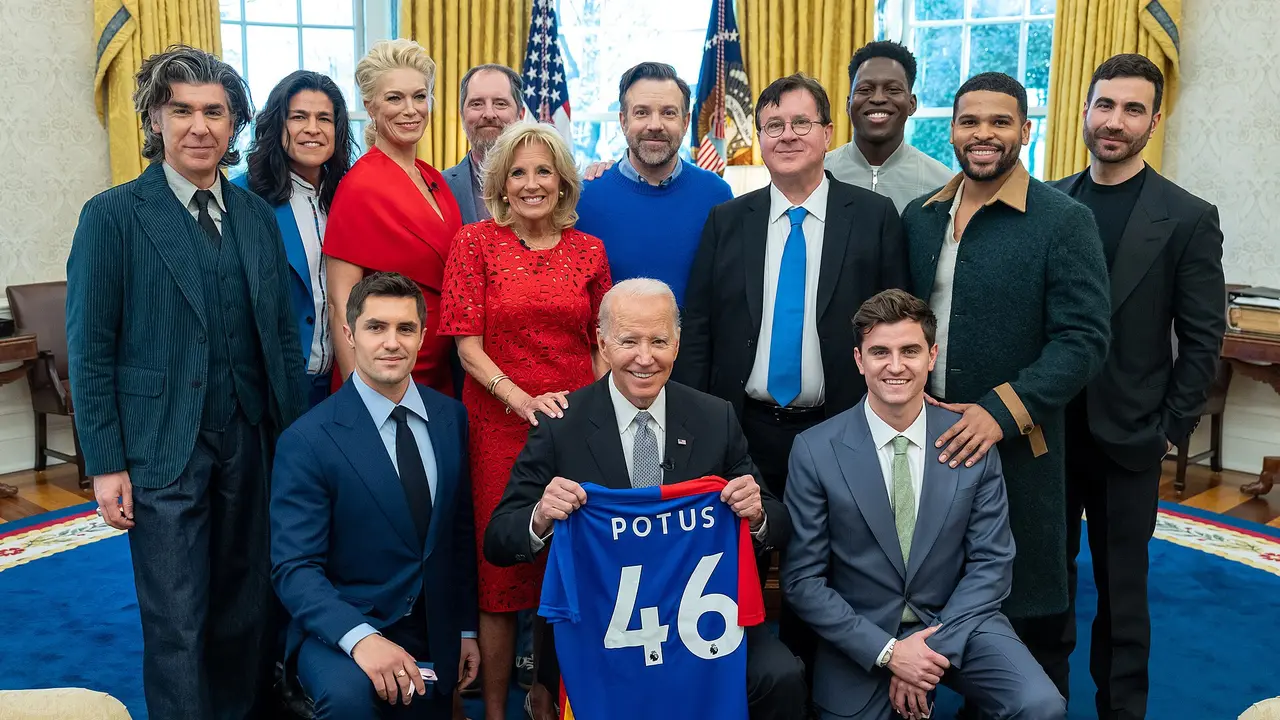
Three years after leaving the bench of AFC Richmond, Ted Lasso returns with a mission that completely changes the scale of the series: to coach a second-division women’s team. Season 4, launched globally on August 5, 2026, does not simply replay the formula that made it successful. It places one of the most powerful movements in contemporary sportsâthe rise of women’s footballâat the heart of a popular franchise.
The gamble comes at a strategic moment. The audience reunites with Jason Sudeikis, Hannah Waddingham, Juno Temple, Brett Goldstein, Brendan Hunt, and Jeremy Swift, but the Richmond universe must now reinvent itself around new players, new power dynamics, and a less exposed competition. Between global entertainment, the streaming battle, and sports visibility, Ted Lasso Season 4 and women’s football form a culturally potent intersection.
A Global Return After Three Years Away
The third season concluded on May 31, 2023, with Ted’s departure for the United States. This ending suggested that the series could conclude at its peak, having transformed a naive American coach into a global television phenomenon. Apple ultimately chose to reopen the story, with the first episode airing on August 5, followed by a new episode every Wednesday until October 7.
The change of pitch was already hinted at at the end of Season 3, when Keeley Jones proposed creating a women’s team for AFC Richmond. Season 4 brings this idea to fruition. Ted returns to England to lead a second-division team, far from the narrative comfort of a men’s team already established in the Premier League. The challenge is no longer just to win: it is to build an institution, convince, and give identity to a new project.
Women’s Football Becomes the Engine of the Story
This choice is more than just a simple casting change. It forces the series to look differently at locker rooms, salaries, infrastructures, media, and the expectations placed on athletes. A second-division women’s team rarely lives with the same resources or exposure as its male counterpart. For a fiction known for addressing mental health, masculinity, and work culture, this new environment opens up considerable narrative territory.
However, the series must avoid the trap of overly simplistic discourse. Women’s football does not need to be presented as an abstract cause or as a copy of men’s football. It has its own stars, rivalries, history, and economic stakes. The success of the season will therefore depend on the real space given to the players: their ambitions, contradictions, and football must matter as much as the return of the famous mustachioed coach.
A Series That Has Already Converted Millions of Viewers
Since its launch in 2020, Ted Lasso has transcended the realm of sports comedy. The first season became the most nominated debut comedy in Emmy Awards history, before the series won the award for Best Comedy two years in a row. Its blend of humor, optimism, and vulnerability has resonated with an audience that often did not follow football before.
It is precisely this conversion power that lends weight to the new storyline. Brendan Hunt, who plays Coach Beard and is a writer for the series, explained to the Associated Press that he has met people who became football fans thanks to Ted Lasso. By directing this curiosity towards a women’s team, Apple can expose the discipline to a much broader audience than that of traditional sports competitions.
Kansas City, a Real Symbol Behind the Fiction
Part of the season was filmed in Kansas City, the hometown of Jason Sudeikis. In July, the cast participated in an event held at CPKC Stadium, home of the Kansas City Current. The venue is not anecdotal: it is presented as the first stadium of its size built specifically for a professional women’s club.
This bridge between fiction and reality enhances the credibility of the project. Women’s football is no longer developing solely through major international tournaments. It is gaining dedicated infrastructures, investors, supporter communities, and its own media value. The backdrop of Kansas City tells this transformation even before the script explains it.
Apple Engages in a Cultural and Commercial Battle
For Apple TV, this return also represents a major operation in the global streaming war. Ted Lasso remains one of its most identifiable brands. Reviving the series allows for subscriber retention over ten weeks, fuels conversations on social media, and connects the fiction catalog to an increasingly visible sports offering.
The timing reinforces this effect. The season arrives in the wake of a summer dominated by global football, when public attention remains at its peak. Apple thus transforms a comedy into a gateway product: fans of the series can discover women’s sports, while football enthusiasts have a new entry point to the platform.
In France, the Message Comes at the Right Time
The French resonance is direct. The French Football Federation already counted over 251,000 female licenses during the 2023-2024 season, a record, and aimed for 500,000 by 2028. More than 3,000 clubs host girls’ teams. However, the regular visibility of championships and the economic stability of clubs remain essential challenges.
The creation of the Women’s Professional Football League and the labeling, in 2026, of thirteen clubs from Arkema Première Ligue and Second League show that structuring is progressing. The criteria focus on infrastructures, training, attendance, partnerships, and territorial anchoring. These are precisely the realities that a series set in a second division can make accessible to the general public if it chooses to address them with precision.
The Real Challenge: Transforming Attention into Legacy
UEFA aims to make football the most played team sport by women and girls in every European country by 2030, while increasing the number of fully professional leagues. A series cannot achieve these goals alone. However, it can change the narrative, make players visible, and instigate conversations in households that institutions sometimes struggle to initiate.
Season 4 will therefore be judged on two fronts. The first is artistic: to recapture the emotion and nuance that have built Ted Lasso’s reputation. The second is cultural: to represent women’s football as a complete, popular, and demanding sport, without reducing it to a virtuous backdrop. If Apple succeeds in this double feat, the return of AFC Richmond could matter far beyond weekly viewership.
The kickoff is thus more important than a mere television revival. By giving its best global spotlight to a second-division women’s team, Ted Lasso can bring into popular culture faces, ambitions, and struggles long kept off-screen. This time, the famous “Believe” does not just promise a victory: it invites an entire audience to view the game differently.
Sources
- Apple TV Press â launch date, synopsis, and cast of Season 4
- Associated Press â streaming selection for the week of August 3 to 9, 2026
- Associated Press â the cast in Kansas City and the shift towards women’s football
- FFF â figures and objectives of women’s football in France
- FFF â labeling of professional women’s clubs in 2026
- UEFA â Unstoppable strategy for women’s football by 2030